Emojis have long infiltrated all sorts of communications, including text messages and even work emails. Now, doctors are dropping these expressive icons into medical records.
Healthcare providers have already been found to incorporate emojis and emoticons—their vintage counterparts—into texts with colleagues on a clinical messaging platform, according to a 2023 JAMA Network Open study. Now, researchers say they’ve conducted the first study examining emoji use in electronic health record clinical notes, which includes portal messages sent to patients. Compared with the 2023 paper, doctors seem to use them a lot more when chatting with patients than with their coworkers.
A team from the University of Michigan and Cornell University sifted through more than 200 million notes sourced from 1.6 million patients created between 2020 and 2025 at the University of Michigan’s academic medical center. They identified 372 unique emojis used in 4,162 notes, findings recently published in JAMA Network Open.
While the rate of emoji inclusion stayed relatively stable at 1.4 notes with emojis per 100,000 notes between 2020 to 2024, it suddenly jumped to 10.7 by late 2025.
“These were scattered throughout clinical notes but were mostly found in brief messages sent to patients via the portal,” said study co-author David Hanauer, a clinical informaticist at the University of Michigan, in a statement. “While emoji use in medical records is still rare, their use seems to be on the rise, raising important questions about age-related differences in use and interpretation, as well as best practices for digital clinician-patient communication.”
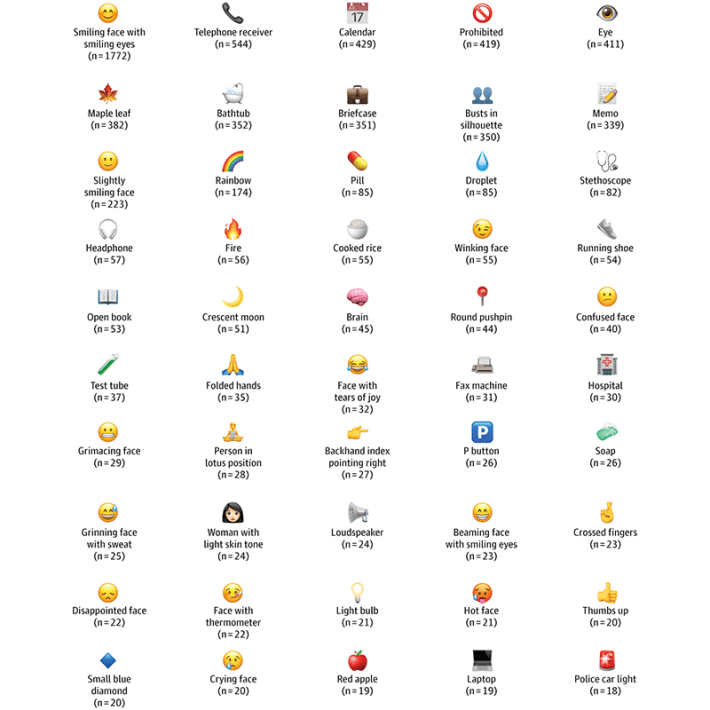
They noticed that smileys (😀) or emoticons such as the classic : ) were the most commonly used type of emoji, appearing in 58.5 percent of notes, along with objects, like a pill (💊) and maple leaf (🍁), in 21.2 percent, and emojis related to people and the body in 17.6 percent. As for the most popular specific emoji, the smiley came out on top, with far more appearances (1,772) than the second most popular, the telephone receiver (📞, 544).
Read more: “Your 🧠 On Emoji”
Emojis were very rarely incorporated in messages to replace a word, such as a pill bottle for the word medicine—this only occurred among 1 percent of all emojis that the researchers analyzed. Most served to highlight a point, or were included “for their own sake,” the statement explained. This aligns with past findings that emojis tend to be employed to reduce ambiguity and shape a message’s tone.
But these symbols may not always clear things up—they could create confusion, especially for older patients, the authors noted. Patients between 10 and 19 years old received the most emojis per 100,000 portal messages from providers, followed by patients between 70 and 79 years old. Some studies have suggested that older adults are less likely to accurately interpret emojis than younger people, but researchers haven’t reached any clear conclusions. Other factors, like gender and culture, may also affect one’s understanding.
“Given the small but growing presence of emojis in clinical documentation, we recommend that healthcare institutions proactively develop guidelines for their use to maintain clarity and professionalism in clinical communications,” Hanauer said in the statement.
Further research should probe how emojis seem to influence “patient understanding, trust, and outcomes and explore whether these playful digital symbols offer new opportunities or pose unintended challenges in electronic health record communication,” he added. 
Enjoying Nautilus? Subscribe to our free newsletter.
Lead image: Roman Samborskyi / Shutterstock