
In the middle of October a few years ago, I was hit by a crisis of anxiety and despair. There had been a death in the family, I was unhappy at work, and I was confronting the existential doubt of middle age.
But above all, it was the global political and environmental situation that really made me panic. Fires, floods, hurricanes, heat waves—these were clearly getting more severe and more common all the time. The nations of the world had already met in Paris and agreed to limit global warming to no more than 2 degrees C above preindustrial levels, but that pact was looking unrealizable. Economies all over the world were prioritizing business as usual, even a growing nationalism, over the promised transformations. I was hopeless—I felt the planet was doomed and there was nothing I could do.
This story is from “The Hot Issue,” the latest from Nautilus.
To get it in print, join by Nov 30.
I began to heal, in the following winter, spring, and summer, largely through practices of connection: connecting to other people, to my work, to nature, and to a sense of purpose. Key to all of these was a connection to art—to its powers of expressing sadness, disappointment, and criticism, on the one hand, and of promoting feelings of innovation, joy, and meaning, on the other. Visiting exhibitions, teaching about art, and even making my own photographs gave me a sense of collective belonging and helped me to see a path for my own modest contribution to our gigantic world.
As we now know too well, rising concentrations of CO2 and other greenhouse gasses have raised the average temperature on Earth well over 1 degree C warmer than before industrialization, hotter than at any time in the entire history of Homo sapiens. The results of the heat include desertification, rising seas, more extreme storms, and worsening wildfires. Humans and other beings are confronted with water shortage, food scarcity, dehydration, trauma, and death. Even on days we do not suffer directly, we often feel fear and sadness.
Unquestionably, solving the climate crisis will require technical and political solutions. But it will also require a remaking of some of the foundational beliefs of contemporary global civilization. We cannot build 21st-century civilization on unsustainable ideas and values carried over from the Enlightenment and industrial modernity. That’s where the powers of art come in.
We can turn to art for the ways in which its creativity and innovation can help ignite the process of remaking our structures of thought. Art can be a guide toward connection, well-being, action, and balance. It can help us reconceive our world. It can push us to unlearn the philosophies, myths, and fantasies that got us into this global existential crisis.
A reasonable person might argue that art is just entertainment, a distraction from what really matters. But art is different from everything else we see and think about every day. Most of the time we are consumed with short-term productivity. We have projects to finish at work, laundry to do, and loved ones to care for. We make calculations, in short, to achieve our immediate goals.
This is largely how it should be: A productive mindset allows us to survive and succeed. Art, however—as the philosopher Immanuel Kant argued centuries ago—is wonderfully purposeless. It is a key realm of human activity that exists not as a tool but instead for its own, illogical sake. And yet this very purposelessness allows art to be a great source of reorientation, growth, and learning.
Art offers us intimacy, creativity, connection, and critical engagement with our values. It puts us in contact with the deeper things we necessarily sideline in the everyday. It invites empathetic understanding of other human beings, and of plants and animals. Art involves critique but also wonder and love. It taps into the transformative power of emotion. Art provokes us, promoting radical dreams beyond our normal trains of thought. Art insists that things could be different. It helps us flex the muscle of imagining a reality other than the one we now occupy.
One of the great compounding difficulties of the climate crisis is that we—I mean all of us human beings here on Earth, suffering acutely or subconsciously—do not grasp it. We see photographs of a devastating flood, hear stories from a friend whose house went up, so fast, in flames. But we still have almost no tools for connecting these traumas to our everyday experience: our work, our shopping, our relationships, our going out at night for fun. As a result, we too often feel disconnected—from the crisis, from each other, even from our own grief and hope.
In part, the problem is that climate change is so devilishly difficult to visualize. Our conundrum is like that of the proverbial blind men apprehending the elephant: We can perceive this effect or that one (California’s fire, Pakistan’s flood), but the whole remains almost impossibly abstract.
Climate change is a prime example of what the philosopher Timothy Morton has called a “hyperobject”—a real phenomenon that, because of its gigantic scale and complexity, eludes our conceptual grasp.
Our culture represents climate primarily in two ways: with data (temperature graphs, CO2 concentration tables, and the like) and in journalism (photographs of families fleeing their homes, interviews with failing farmers). These charts, images, and news stories are crucially important—they show us the acute effects, the climate events of greatest suffering—but they are not enough. We lack an image of the megaphenomenon itself, and of our place within it.
“Metajournalism” is a term I coined to denote work by art photographers and filmmakers who aim to show us not individual climate events (as photojournalism does), but rather the hyperobject of climate change itself. Growing out of the tradition of landscape painting, wilderness photography, and, to a degree, conceptual art, this movement may be best represented by Canadian photographer Edward Burtynsky.
After working for decades picturing the effects of industry, Burtynsky has more recently turned his attention directly to climate change, including a collaborative, multimedia body of work called the Anthropocene Project. Many of his photographs from the last 15 years, often shot from the sky, depict important nodes in the global network producing, and suffering the effects of, climate change.
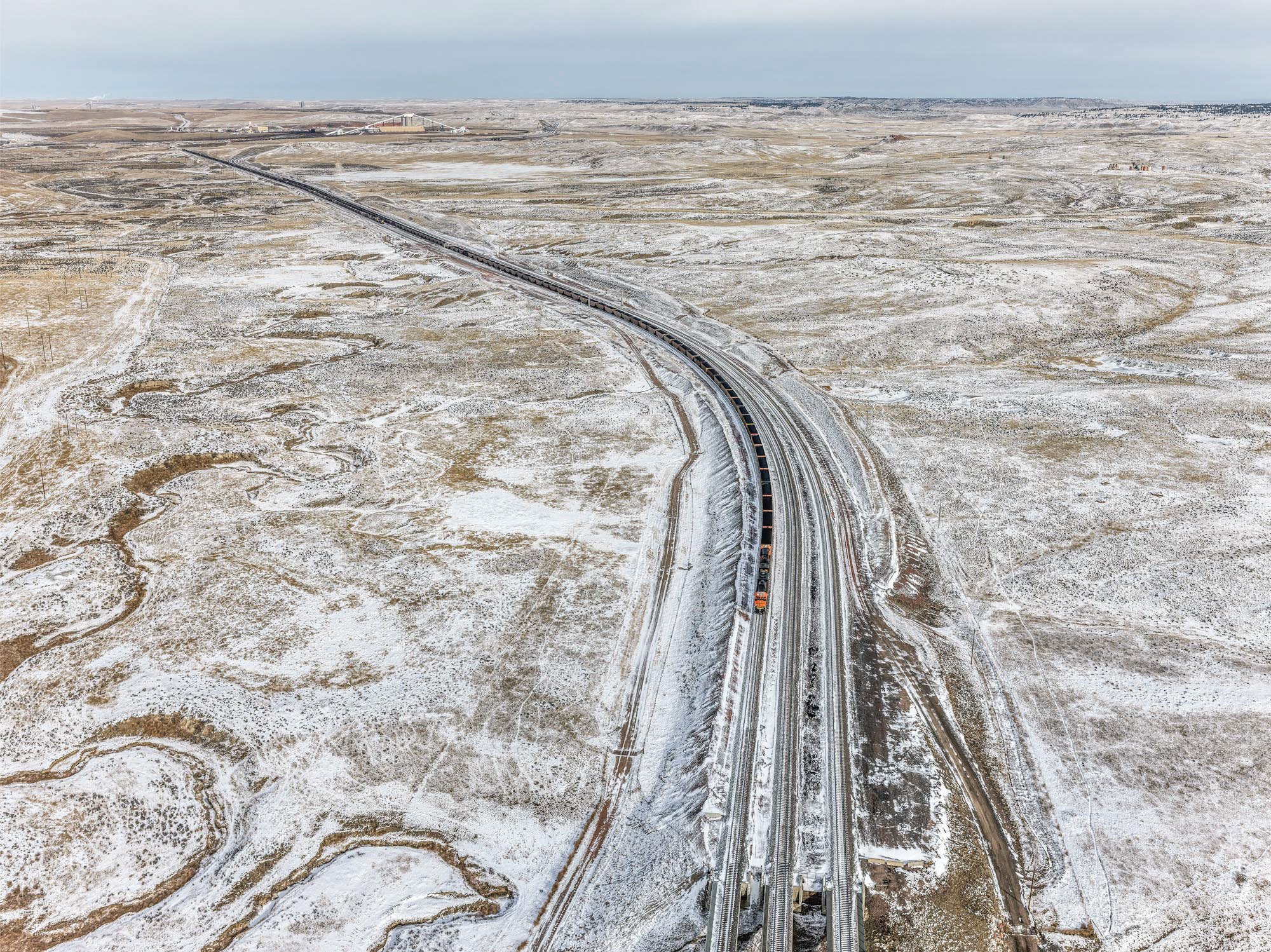
In Coal Train Near Gillette, Wyoming, USA, 2015, Burtynsky gives us a frozen white and tan expanse of treeless prairie. A few sinuous curves of eroded rock appear to scratch the Earth’s surface like doodles. Cutting hard across this expanse is the berm of a railroad and on it, approaching us, a nearly endless train of coal cars.
Our distance and angle are such that we can identify several dozen individual wagons, each heaped with an identical burden of fossil fuel. Behind these, the coal continues to snake into the distance, all the way to the silos deep in the background at left. This is the everyday reality of the Powder River Basin near Gillette, Wyoming, among the most productive coal deposits in the United States. It is ton upon ton of coal, headed for plants where it will be burned, freeing carbon dioxide that will then remain in the air for centuries.
The starkness of this landscape, its snow-dusted emptiness, is what gives this image its force. The train cuts across the landscape like a mile-long knife; the whole operation looks so very efficient. And this is where the photograph lays its finger on one of the psychological oddities of the climate crisis. In a way, everything here seems just fine: orderly, neat, productive—yet we know that it is anything but.
Consider another of Burtynsky’s wide-screen aerial photographs, Makoko #1, Lagos, Nigeria, 2016. Here, too, what we are observing is not a climate event—no fire or storm, not even a flood. Instead, we confront the opposite end, the likely near future, of the process revealed in Coal Train.
Burtynsky gives us an overview of Makoko, an enormous informal settlement at the edge of Lagos, much of it built on stilts over the Lagos Lagoon on the Atlantic. Thousands of people live here in extreme poverty, many involved in fishing, while clinging to the shoreline of Africa’s largest city. Burtynsky’s angle and distance again allow both the meticulous identification of many particulars and an almost infinite multiplication of those details in the background. Here, a couple dozen wooden boats clustered in the front exemplify countless others throughout the picture. In its overall composition, too, this photograph recalls Coal Train: meandering lines across a plain, a central path cut down the middle, a thin band of gray sky along the top.
On some level, the picture depicts the present: recording (at some distance) signs of ingenuity, labor, and suffering, of resilience and cruel deprivation. But the work also foreshadows disaster. The flashy silver-black reflectivity of the placid canals cuts through the settlement, catching our eyes and quietly, emphatically intoning Makoko’s vulnerability. We see how close that water is to inundating the shacks, even to engulfing them altogether. A single massive storm surge—to say nothing of two meters of sea-level rise—will kill many Makoko residents and leave thousands more homeless.
Like the Wyoming photograph, though, this image stands for a reality that it glimpses in a fragment: Swelling storms and rising seas will mean the loss not just of Makoko but of districts in Karachi, Rio de Janeiro, New York, and many other cities around the globe. Makoko #1, in short, pictures floods that have not yet come. It represents one of the places where carbon dioxide excavated from the Powder River Basin will enact its deadly effect.
In picturing the wellsprings of climate change together with the locations where it will rage, Burtynsky reaches for the hyperobject. As a group, his works uncover an existentially threatening global network of forces and conditions. And the surreal quality of these landscapes gives form to the uncertainties accompanying the slowly unfolding crisis: What is happening? Is this really happening? How on earth did we allow this to happen?
Burtynsky, who was born into a Ukrainian immigrant family in Ontario in 1955, worked summer jobs as a teenager in mines and factories. He has walked a delicate line in talking about the relationship between his work and activism, refusing to be categorized as “an environmentalist in the classic sense of the word,” portraying himself instead as “a concerned artist for the planet.”
The art historian Mark Cheetham has classified Burtynsky’s photographs as “earth-death pictures,” seeing them as embodying the opposite of the German Romantic painter Carl Gustav Carus’s theory of Erdlebenbildkunst, or earth-life art. Rather than the glories of Earth’s functioning, they depict the catastrophe of its devastation.
More generally, Burtynsky’s approach embodies the sublime—that tradition, theorized since antiquity, of aestheticized threat. According to its influential 18th-century formulations, written by Edmund Burke and Immanuel Kant, the sublime is the category of aesthetic pleasure involving feelings of being overwhelmed by something one cannot quite grasp.
Burtynsky’s 2014 film, Watermark (codirected with Jennifer Baichwal) consists of 90 minutes of what could be called the “ecological sublime.” It’s built on large-scale panning shots, a minimum of voice-over, and foreboding electronic music.
Watermark shows its audience the dried-up Colorado River delta in Mexico, fields irrigated unsustainably by an ancient aquifer in Texas, and researchers on the Greenland ice sheet. The film focuses especially on the Xiluodu Dam on China’s Jinsha River.
The directors visualize the dam’s gigantic, curved gray wall as an earthly Death Star, matching it with tragic music. They offer no consideration of what carbon emissions will be avoided by the dam’s generation of clean power in place of coal. In a voice-over, Burtynsky betrays an impossibly purist attitude about the relationship between humans and everything else. “I understood what nature is,” he says. “I’ve learned to understand what is there before we come, before we change it… This work is a lament for that loss.” His work, Burtynsky seems to say, can see human activity only as tragedy.
Luckily, Burtynsky’s work also escapes such resignation. Flood Control Levee, Maasvlakte, Rotterdam, The Netherlands, 2011, pictures at once the carbon-intensive past and the wind-powered future of Rotterdam. Deadly floods look likely, but a successful energy transition does, too. Ugliness and failure cohabitate with innovation and possibility. The coming story of our Earth remains unsettled. “The Anthropocene doesn’t necessarily have to end in a negative way,” Burtynsky points out. “It could be an epoch with a reasonable outcome if we can get our act together, or it could be a terrible one.”
The power of Burtynsky’s art is it permits us to grasp the very abstract condition we inhabit, while glimpsing our path out of it. 
Excerpted from Looking for Tomorrow: Lessons from Art for the Time of Climate Change by Joshua Shannon, published by the University of California Press. © 2027.
Enjoying Nautilus? Subscribe to our free newsletter.
Lead Image: Photo © Edward Burtynsky, courtesy Robert Koch Gallery, San Francisco