
When we tell the story
of how we survived the collapse,
we might say:
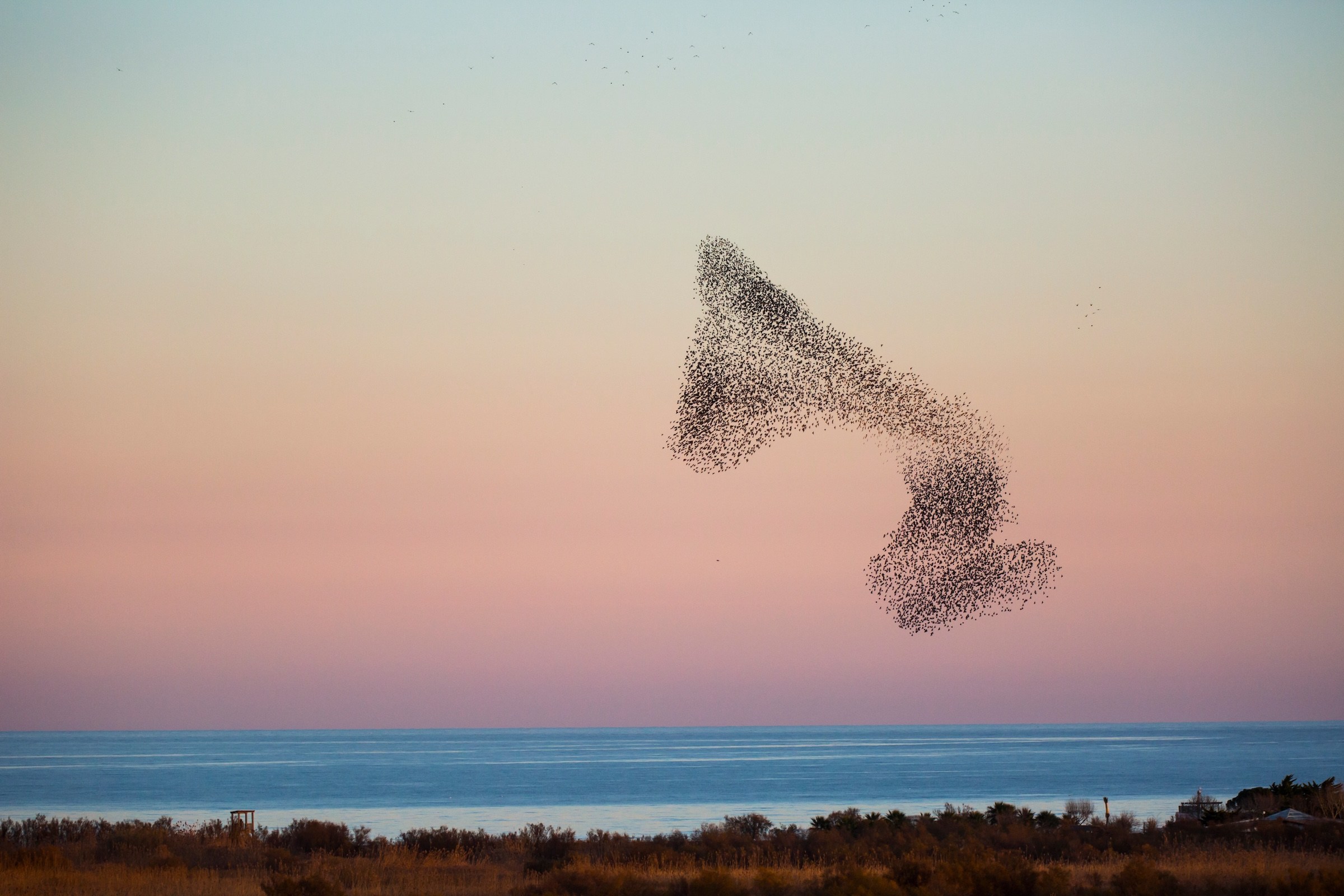
like birds, we learned
to move as one.
We grew lighter
and lengthened our wings.
These are the final lines of “Dear Human at the Edge of Time: A Community Poem.” Assembled from the contributions of 14 different writers across the United States, the poem tells a story about the future that is simultaneously devastating and hopeful.
The poem was published in 2023 by Poets for Science in connection with the Fifth National Climate Assessment, which revealed that climate change was already ravaging every region of the United States through rising temperatures, punishing drought, savage wildfires, and deadly storms.
READ MORE: Poetry Gives Us Power
In the three years since the poem was published, the question of how we might collectively survive collapse has become an increasingly pressing one. It turns out, we are not paying enough attention to the birds. We have not learned to move as one.
The data on climate change have told a clear story for a long time, but that story is not getting through. So far, humanity has fallen short of the change needed to keep the Earth on a safe course for future generations.
Could art and poetry dedicated to conservation themes help ignite a greater feeling of urgency about our predicament and map a way forward? Poets for Science, forged in the turmoil of the first Trump administration, has made this call to action one of its missions.
The group is uniting poets and scientists in collaborations that aim to make the science of conservation both felt viscerally and understood intellectually. It’s also inviting the public to participate with verse or other creative work of their own. The poem “Dear Human” lives on an interactive platform that allows anyone to contribute. Writers can respond to poems published in an award-winning climate poetry anthology, add to a digital gallery of climate art, or build their own “found poems” out of text borrowed from the Fifth National Climate Assessment.
“Why not poetry?” says poet David Hassler, who co-founded Poets for Science together with American nature poet Jane Hirshfield in 2017. In just a couple of weeks, Poets for Science will hold its first in-person gathering, where scientists and poets will meet across three days to explore the connections between their disciplines, and ways to inspire the civic imagination. That meeting is sponsored by the Wick Poetry Center at Kent State University in Ohio, which Hassler directs. I spoke with Hassler about how poetry is like lichen and how it can help make science meaningful while inspiring collective action.
There have been many periods across history when art and science were closely aligned. Artists were scientists and scientists were artists. Nobel laureate neuroscientist Eric Kandel beautifully describes such a period in Vienna at the turn of the 20th century in his book The Age of Insight. The Renaissance, too, was packed with figures who merged artistic mastery with scientific inquiry. But during the scientific revolution, art and science split. There was this intellectual divide. Today it seems like the pendulum might be swinging back the other way. What do you make of this shift?
Yes, all these collective efforts have been co-arising all around the globe, people pursuing similar intersections of science and humanities and arts. It’s what we have discovered in pulling together this Poets for Science gathering. You know, we’re not alone. When we started Poetry for Science in 2017, we were tapping into a collective nerve that I think is shared by so many people. And it’s really been growing over the past 10 to 15 years.
In a recent interview, I was reminded that the word “scientist” was coined in the mid 1800s. Before that, they were “natural philosophers.” There’s this divide between our belief that over here’s my rational thinking, and over there’s my emotional thinking. Here’s my scientific inquiry and over there’s my creative expression.
This divide has been exacerbated by our biases and our technology. I think that it has come to a breaking point, where people are hungering to integrate facts with feelings, so that what we’re learning through the facts of science has meaning in our lives, emotionally and in our lived experience. Perhaps this need to be intentional about bringing them back together in conversation has happened out of an awareness of our failure at progress. We’re feeling sicker. We’re feeling more divided, more alone, more unhealthy, and there’s been a kind of quiet desperation.
We’re also looking for creative solutions to intractable problems in our collective lives and AI is making us question what it means to be human. There’s this attack on the humanities, and tech bros are saying we just need to be good bots. Maybe there’s a moment here where we’re infusing the arts back into our rational scientific thinking because we need to remind ourselves what it means to be human and what we value about being human. Scientists are trying to remember that the questions they ask and the work they do is informed by their humanness, by their cultural background, their emotional lives, their beliefs, their lived experience.
Do you think that poetry does something for science or for public understanding of science that other art forms can’t?
I think all art forms can help us make meaning and carry grief and hold our sense of awe and to use that as an energy source, to contain it and to give it shape. All art can do that.
But here’s what poetry can do: It can take the natural metaphors of science and highlight them. We’re not inventing them. If I say that we’re having a “mycelial” conversation, you know what I mean, because we now understand how a mycorrhizal network in soil helps trees communicate with each other and share signals of nurture, but also warning, through this fungal network, this mycorrhizal network.
I think that the language we use to describe the world not only influences how we behave toward the world, it truly influences what we’re able to actually see in the world. The root word of science means to know from Latin, and I think the economy of language in a poem helps us carry new knowledge into the world. And that’s gone a long way. We have been told over and over again that poets are now feeling inspired and getting prompts for their writing from scientific articles and using the language of science in their poems.
But it’s working both ways. Scientists are saying they’re turning to poetry. We have so many poems on the poetsforscience.org global gallery and in this anthology The Nature of Our Times written by scientists. Why? They say that they don’t have a place in their scientific paper or essay to put their emotional language. The poems offer a place to put their awe and grief and fear. Many scientists also say they’re using the arts and humanities to help them shape the questions they ask and the directions they go in their scientific inquiry. Laura Valski, for instance, talks about how in her research with ecology [in Washington State], she’s attuned to the stories of the native people of that region and of the language they use to inform the questions she asks.
I love what Jane Hirshfield says, that the metaphor and the microscope are both instruments of discovery.
Yes, metaphor stems from metapheran in Greek, its origin. It means to carry, to cross over. In a sense, we’re carrying new knowledge over from science into our emotional lives through language and metaphor. And that’s how it can bring change.
Obviously, science is many things. Not just conservation, but also technology, so it’s AI and surveillance cameras, or it’s building weapons.
Yes, and some kinds of poetry are used by dictators to influence mass crowds and to hypnotize people. The spell of poetry can be used for good and for bad. So can science. Both of them are that powerful.
How do you grapple with this darker side of science and poetry when you encourage collaborations?
The 14th century poet Rumi said your intention does all the work. We do it with care and with the right intention and with rigor and with honesty. I’m not writing a poem to influence your behavior for my gain. I’m writing a poem because I have an intention to speak a truth that is authentic to me. The paradox is that if I can speak authentically and truthfully about my own idiosyncratic personal life, only then can it have a power that speaks to others and help them find their own meaning from it.
So, yes, we can create nuclear weapons and toxic chemicals. I just watched this frightening documentary about the pesticides that we’re using in agriculture that are destroying our soil, our health, and our bodies. Those chemicals were invented by a German scientist for warfare in World War II. The companies literally took the research that was being done for warfare and tweaked it to use on our crops. How’s that for an image?
In the essay you write that art without science risks inspiring ineffective action. Why is that?
If I don’t understand how mycelial networks actually work and I wanna write a poem about mycelium, then perhaps what I’m writing might work as a poem, but it doesn’t help me understand the forest and act in ways that create the conditions for that forest to thrive. We have a crisis of science communication, which was the origin of the Poets for Science movement in 2017, so poems can help us make meaning and speak to our own lived experience and our emotional lives. And by doing that, to make meaning of science.
This Poets for Science initiative began in response to the actions of the first Trump administration, and out of desperation, anger, grief, and fear. Jane Hirshfield wrote a poem, and that poem went around the world essentially in 2017. And then she called me, and said, “Can you help me?” And I said, “Of course.” And our design team put together 23 seven-foot banners of poems about science that she curated. We went to the National Mall for the very first March for Science on Earth Day. Poets for Science had a teach-in tent. There was never room for anybody to sit because it was constantly full the whole day.
What do successful poems about conservation like Hirshfield’s get right?
I avoid rating this poem over that poem and saying this poem succeeds and that poem fails. I go back to the intention of the poet and the context in which the poem is presented. I work a lot in the schools with fourth graders and eighth graders and I’ve seen the work of poems happen. We write poems to change ourselves. The poem becomes a kind of residue, it marks a new insight.
The poems that seem to translate the experience of the poet to another listener use metaphors grounded in authentic truth. The language has specificity to it. The metaphor works at multiple levels. The figurative language accurately describes or points to, for instance, how root systems in the soil communicate and support one another toward the collective health of a forest. Ideally, this language has the vibrancy of a true conversation, which from Latin “conveyor” means “together to turn.” We forget when reading where your idea ends and my idea begins. We’re caught up in this decentralized collective effort to move an idea further or to hit upon phrasing for an expression.
Are there poems either from The Nature of Our Times or otherwise, that you feel meaningfully changed a conservation outcome? Or would you not measure it in that way?
There’s a great phrase that Jane Hirshfield used: She says perhaps poems are the lichens of activism. And one of the things about lichens is that the work they’re doing is often very, very, very slow, often subtle, and often unseen. I think the same can be true of poems. It’s not so easy to say, “Ah, two weeks later, you changed your behavior.” And there’s something about the arts and poetry that resists scientific inquiry.
So this is also pushing against a tension that I think is interesting. So many questions of the spirit are not answerable or provable. Donald Hall says, “Poems are the unsayable said.” What he’s pointing at is the tyranny of what we can measure. Rebecca Solnit talks about this. We can be tyrannized by only believing in what we can absolutely measure. And then suddenly, we’re feeling deprived of spiritual life, because that’s what we can’t measure.
I think poems flirt with that notion of “let’s be patient like lichen. Let’s be tolerant of things that don’t have an easy answer.” Maybe the work of lichens is that work of breaking rocks, slowly making soil. It’s the creative, productive work of decomposition. There’s an element of poems breaking our rigid ways of thinking and feeling and opening up new possibilities that we don’t quite fit into yet. We don’t know when that’s gonna change our behavior. We never quite are certain about it. But they’re pulling us in and they’re making us pause. And in that pause, we suddenly have room for new thought or for making a connection we would never have made before or for simply questioning a very rigid way of thinking that we always carried for so long.
Towards the end of the essay, you suggest that we need research into which kinds of artistic approaches and collaborations could have real impact.
What I'm saying is take caution. Research with patience. This is not supposed to be easy. We don’t need to be overly ambitious. James Pennebaker’s research from 30 years ago about journaling and the power of using language to process grief, it moved the needle. It wasn’t overshooting in its statements. How do we find the appropriate way to engage in research that can bring other people into the conversation? We’re a small group, the world of poets. Talk about a bubble. Nobody inside it needs convincing. “Look at this poem. Oh, I love that poem. You know, that reminds me of this poem.” Nobody’s asking, “Where’s your data?”
If you were to fantasize about a first study in this vein, one that can sort out what kinds of collaborations between poets and scientists might change behavior, what would it look like?
I’ve spent 30 years going into the community. At the Wick Poetry Center, we like to say that we bring poetry to people’s everyday lives. We want people to encounter a poem who would never go to a bookstore and buy a small book of poems. They’d never think of themselves as writers or readers of poetry. We love to introduce it to them in a friendly way that invites them in.
During the pandemic, we worked with nurses and we brought poems about nursing for an incredible project we called “Sacred Breath,” and another project called “Some Days.” And we invited nurses to write their own reflections inspired by a model poem about their experiences. And we didn’t say it has to be a poem, but many of them ended up writing beautiful phrases and images in metaphors that is the work of poetry. They weren’t fearful that they could be judged. We pulled them into a conversation through poetry about their profession and their life experiences that were emotionally charged and needed an outlet. Why not do that with the environmental movement or with climate change? Could we set up a group where we’re studying how it affects people’s ways of thinking? When we change our thinking, we change our behavior.
What impact are you hoping the first Poetry for Science gathering in a few weeks will have?
We have this incredible group of featured speakers: Phillip Levin, Jane Lubchenco, the former head of NOAA, Melissa Nelson, who’s an Indigenous environment ecologist. And wonderful poets. We will be celebrating this collective work that so many of us have been doing. We were inspired to create this intentional space and time for people to come together because we were learning about this work happening in so many areas around our country and around the world. Our hope is that we create the time and the space for people to meet one another, to share ideas, to be inspired by each other, and then leave the gathering and have new relationships that can help us form new collaborations.
We’re creating an online community directory where people can, if they wish, post their project, their research interest and their contact information, either as poet, artist or scientist, and it can be searchable. We want to provide more momentum to this collective movement that has been building for 14 or 15 years in a decentralized way. Nobody’s ever called it out and named it until now. There is power in naming, and this Poets for Science gathering is halfway between an academic conference and a festival. It’s a gathering because we’re gathering the resources that we all carry within us and we want people to share their expertise, their knowledge, their passion with each other. 
Enjoying Nautilus? Subscribe to our free newsletter.
Lead Image: AlbertoGonzalez / Shutterstock