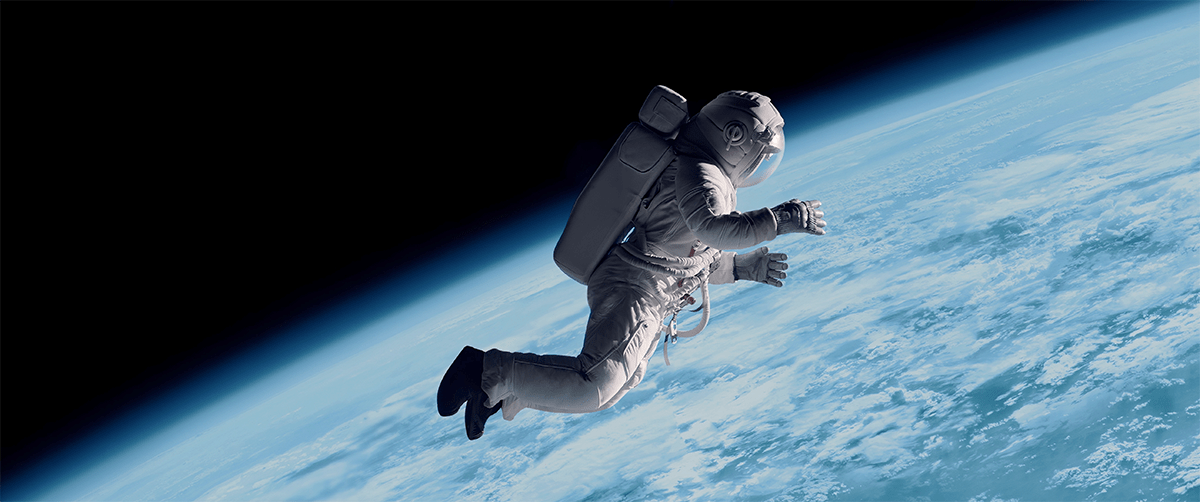
Today, NASA astronauts aboard the International Space Station took a space walk to ready the station for a future power upgrade. While this particular extravehicular excursion had been previously postponed by a medical emergency, moving and working in the vacuum of space has become routine for astronauts. Of course, it wasn’t always that way.
On this day, 61 years ago, Soviet cosmonaut Alexei Leonov became the first human being to step outside a spacecraft with nothing between his fragile body and the punishing abyss of space except for a few layers of material. Tethered to the Voskhod ship with an umbilical cord of sorts, Leonov floated freely for around 10 minutes before being called back.
That’s when things started to go wrong.
Because of the pressure differences, Leonov’s spacesuit had swelled up like a balloon, causing his hands to slip out of the gloves. To cover the 16-foot distance, he was forced to wrap the cord around his arm until he regained contact with his ship.
“My suit was becoming deformed, my hands had slipped out of the gloves, my feet came out of the boots. The suit felt loose around my body,” Leonov later told the BBC.
Once he reached the inflatable fabric air lock, Leonov was supposed to slip inside feet first, but his suit had ballooned to such a level that he no longer fit. To make matters worse, the spacecraft was mere minutes away from orbiting into Earth’s shadow, meaning he’d soon be left to struggle in total darkness.
So Leonov made a judgment call. Without notifying Soviet ground control, he started bleeding air from his suit to depressurize it—a maneuver that carried risks beyond losing precious oxygen. As he did, Leonov began to feel “pins and needles” tingles in his extremities, a telltale sign of decompression sickness. Still, it was his only option for survival.
“I didn’t have any choice, I didn’t have any recourse,” he once told NASA in an interview.
Slimming down the suit helped him regain some control, but he soon discovered squeezing into the air lock feet first still wasn’t going to work. To get the necessary leverage, he was forced to pull himself inside head first. That meant he had to turn his body around in the cramped air lock chamber in order to seal the hatch behind him—the equivalent of attempting a headstand in a phone booth. Dripping with sweat, he finally managed to flip his body, close the hatch, and re-join Commander Pavel Belyayev in the descent module.
His relief was short-lived. With oxygen saturation reaching dangerous levels, threatening to spark deadly fires in the module, the automatic re-entry system failed. The two would have to attempt something that had never been tried before—manually firing the retro rockets so they entered the atmosphere at the right angle. If their approach was too shallow, they’d bounce back into space; too deep and they’d violently crash to Earth.
It worked. Following a nerve-racking but precisely controlled burn, the cosmonauts were finally on their way home—they just didn’t know where. While American astronauts of the era enjoyed comfortable splashdowns in the oceans, the Soviets, lacking naval superiority, were forced to give their cosmonauts a rougher welcome on land.
After tumbling through the atmosphere, the parachutes deployed, and they finally touched down—in the Siberian wilderness. Leonov, who had just become the first man to survive in the cold vacuum of space, now had to endure a night spent in the frigid Siberian winter.
The two sent a coded transmission relaying their location, and then hunkered down to spend the evening in the freezing descent module. A Soviet recovery team reached them the next day, bringing supplies, a makeshift shelter, and a cauldron. “They landed 9 kilometers away and came on skis,” Leonov told the BBC. “They made a little hut for us and brought us a big cauldron which we filled with water and put over a fire. Then we washed in it.”
The next day, they strapped on skis of their own to head to the helicopter that would finally take them home.
Although their mission was a grueling ordeal, punctuated by calamity, what stuck with Leonov wasn’t the complications. Instead it was what he experienced in that brief moment floating miles above our planet.
“You just can’t comprehend it,” he said. “Only out there can you feel the greatness—the huge size of all that surrounds us.” 
Enjoying Nautilus? Subscribe to our free newsletter.
Lead image: supamotion.co / Shutterstock