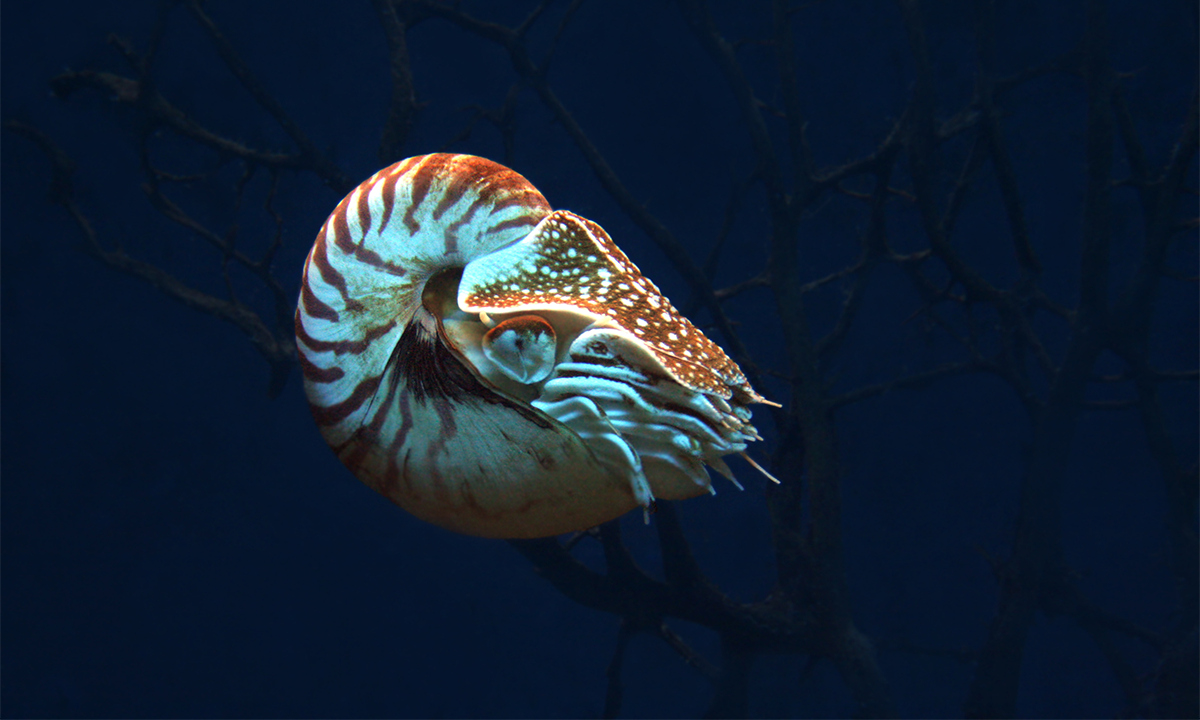
There was a time when the most formidable ocean predators included massive squid relatives enclosed in spiral shells. From about 485 to 444 million years ago (or the early Paleozoic Era), these “nautiloids” were highly abundant and diverse. Because some species survived the End-Cretaceous extinction event, nautiloids persist on Earth today, reminders of ancient ocean ecosystems, and researchers have long wondered whether these “living fossils” still use marine habitats like their ancestors.
To that end, a new study led by Peter D. Ward of the University of Washington, a Nautilus contributor, with a team of researchers from Australia, Papua New Guinea, Samoa, and Switzerland, documented evidence that modern nautiloids, including Nautilus spp. and Allonautilus spp., have distinct habits from their long-gone cousins.
Read more: “Pirates, Killer Whales, and Cheap Jewelry: A Life in Science”
The researchers tracked nautiloids with transmitters bearing temperature sensors to study their daily behavior and indicate the depths where hatching, growth of juveniles, and sexual maturity occurred. During their lifespans, nautiloids changed water depth by as much as 200 meters. Meanwhile, isotope analysis of the shells of both modern and fossil nautiloids provided a profile of growth relative to water temperature. The results showed that extinct nautiloid species matured in much warmer waters than the nautiloids of today.
Ocean temperatures were warmer from the Cretaceous through the Miocene, but modern nautiloids also live in deeper waters than their ancestors. “The extant species of both living genera appear to live deeper, and grow in colder water, than any extinct species,” wrote the researchers. They hypothesized that modern nautiloids have evolved to find food using chemoreception in the darker ocean depths instead of vision. The shells of modern nautiloids appeared to have thickened as well, a potential adaptation to withstand higher water pressures at depth.
Read more: “Twilight of the Nautilus”
Surprisingly, these modern nautiloids were much more abundant than any single species of fish, which the study authors attribute to fishing pressures at these sites. Similarly, nautiloids may be reaping the benefits of lower populations of their main predators: sharks and other bony fishes. They might also be adapting better than other species to environmental changes in ocean temperatures and chemistry, thanks to their low metabolisms.
So, it’s fair to say that nautiloids today aren’t “living fossils” as much as they are species holding their own in the face of environmental changes. 
Enjoying Nautilus? Subscribe to our free newsletter.
Lead image: farbkombinat / Adobe Stock