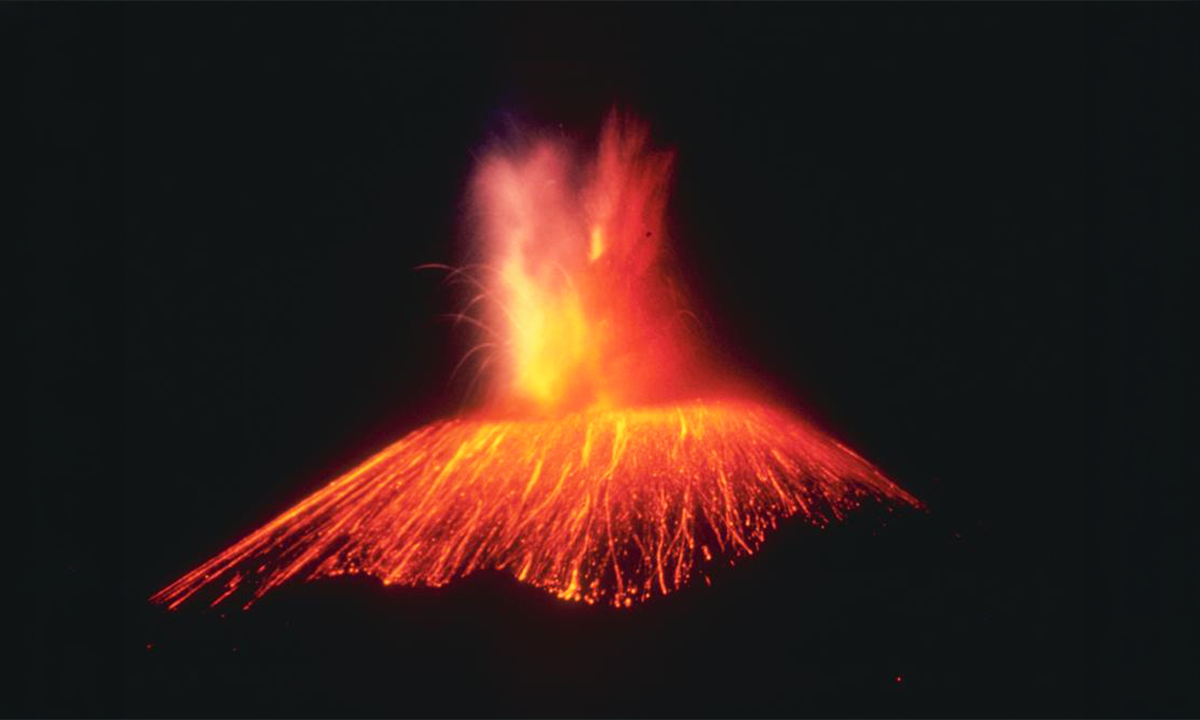
On this day in 1943, Dionisio Pulido was tending to his cornfield in Mexico when he witnessed geological history in the making. Over the previous few weeks, people in the region had felt the ground shake. On February 20, these tremors reached their peak.
That afternoon, Pulido was burning a pile of branches when he noticed something odd: a long fissure in the ground he’d never seen before. Suddenly, he “felt a thunder,” and the trees around him shook. The ground ballooned several feet high out of a hole, smoke billowed out with a hiss, and he smelled sulfur.
Pulido called out to the sacred Lord of Miracles: “You brought me into this world—now save me from the dangers in which I am about to die.”
The farmer had witnessed the birth of one of Earth’s youngest known volcanoes, named Paricutín after the nearby village. Within the first day, Paricutín’s cone grew over 160 feet tall.
Paricutín is unique because it offered modern scientists the first opportunity to witness a volcano’s entire lifespan, and teams from around the world came to check it out. The eruption continued for nearly a decade until 1952, which is unusually long for relatively tame blasts like Paricutín. It’s categorized as a Strombolian eruption, the same type as most at Mount Etna in Italy.
Read more: “The Volcano That Shrouded the Earth and Gave Birth to a Monster”
The most intense activity occurred during the first year, when Paricutín’s cone swelled to 1,100 feet. Ultimately, Paricutín’s lava flows blanketed some 10 square miles. By August 1944, the eruption had coated the nearby villages of San Juan and Paricutín with ash and lava, forcing thousands of people to find new homes and jobs. While no deaths were reported as a direct result of the eruption, three people died from the resulting lightning.
Paricutín is the youngest member of the Michoacán-Guanajuato volcanic field, an expansive collection of more than 1,100 volcanic centers that emerged within the past few million years. It’s one of the largest monogenetic volcanic fields on the planet, in which each volcano only experiences a single burst of activity. These fields emerge in places with low stocks of magma, and the volcanoes within “do not share a common volcanic plumbing system,” according to the National Park Service.
Often, monogenetic fields experience a long pause between eruptions—so that stretch of Mexico is unlikely to see another blast like Paricutín anytime soon. 
Enjoying Nautilus? Subscribe to our free newsletter.
Lead image: R.E. Wilcox, U.S. Geological Survey / Wikimedia Commons