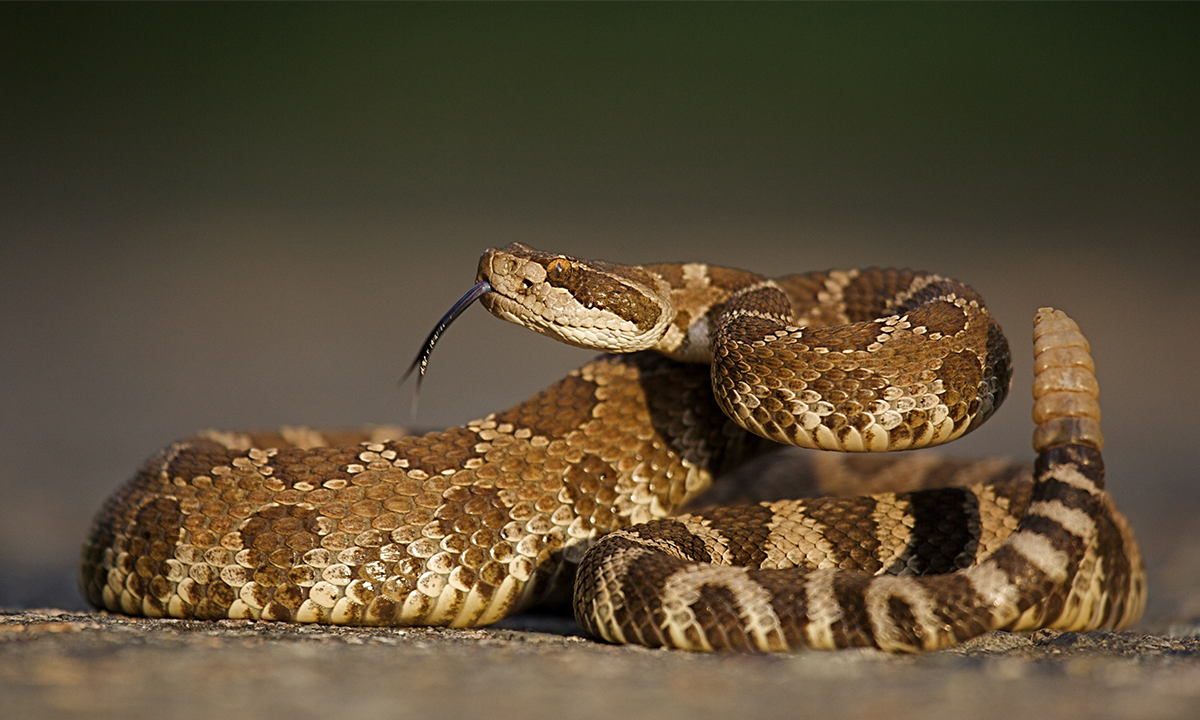
When people think about snakes, rattlesnakes invariably come to mind, even though they constitute just two of the more than 500 genera of snakes. Only the pit vipers (Crotalus) and the massasaugas (Sistrurus) have the unique adaptation of loosely interlocked keratin parts on their tail tips that can be vibrated by shaker muscles. How has this structure, along with its deep imprint on the human psyche, persisted over millions of years?
A study published today in PLOS One by University of Texas at El Paso ecologists explores the impacts of the iconic rattling sound on a wide range of animals to better understand its function. The researchers constructed a robotic 3D-printed rattlesnake body modeled after a western diamondback rattlesnake (Crotalus atrox) in a threat position, with a sheath at the tail end to hold real Crotalus rattles. Next, they tested the response of 38 zoo animals to the “rattlesnake” across controlled experimental trials. Each animal was exposed to both the robot without the sound and the robot with the rattling sound, which was triggered as the animal approached a food reward.
Across the board, animals showed fear responses to the rattling sound—ranging from backing away from the robot, dropping the food, and vocalizing distress. Since all study animals were born in captivity, their behaviors were attributed to innate responses rather than learned experiences. However, species that in nature share their geographic ranges with rattlesnakes reacted more intensely, indicating the evolution of species-specific avoidance behaviors to the threat signal.
Read more: “The Secrets of Deadly Snake Bites”
“Animals with no prior exposure to rattlesnakes still reacted strongly, which supports the idea that rattling acts as a deimatic, or startle, signal. But the amplified response in species that share their present distribution with rattlesnakes points to an evolved, innate sensitivity to the rattle,” explained study author and behavioral ecologist Oceane Da Cunha in a press release.
The results support the long-standing hypothesis that the rattlesnake threat display serves as a deterrent. Just the sight of the snake in a defensive position was sufficient to trigger avoidance responses, but the addition of the rattling sound amplified the responses. The study authors conclude that rattling “triggers existing reflexive neural mechanisms,” causing potential predators to leave the snake alone.
The demonstrated effectiveness of the rattlesnakes’ signal explains its continued occurrence across millions of years, since it undoubtedly contributes to the survival of Crotalus and Sistrurus snakes.
So the next time you’re startled by a rattlesnake-like sound, pat yourself on the back for having a nervous system in good working order. 
Enjoying Nautilus? Subscribe to our free newsletter.
Lead image: Tom Reichner / Shutterstock