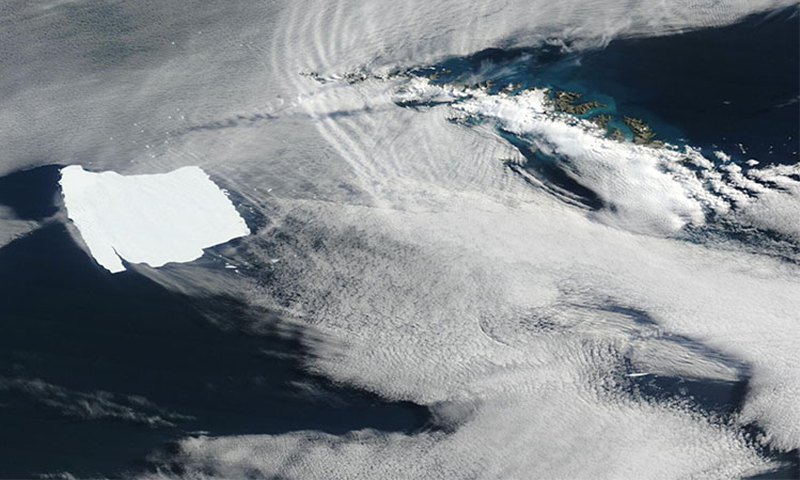
The world’s largest iceberg has been through a lot. Born in 1986, when it broke off from Antarctica, it has since traveled the rough seas of the Drake Passage, got trapped spinning in circles in an ocean gyre, and now seems to be stuck on a shallow shelf just off the coast of South Georgia in the Atlantic Ocean.
And a new satellite image of the massive iceberg shows that in its stationary state, it’s losing volume at rapid pace.
Named A-23A, the iceberg still spans some 1,197 square miles (making it slightly larger than the entire state of Rhode Island), according to the latest satellite measurement from NASA’s Aqua satellite. But the berg lost 140 square miles of ice (larger than the city of Philadelphia) just in the span of weeks between early March, when it first seems to have gotten lodged, and early May.
A process called edge wasting seems to be primarily responsible for the loss of ice from A-23A. As waves and other weather forces bombard the ice hunk, they weaken its perimeter, loosening smaller pieces that crack off and float away from the parent berg. Though they look infinitesimal from the satellite image, many of these ice chunks are more than half a mile long. (Too big, it turns out to be quarry—yet—for iceberg cowboys.)
Since breaking off of Antarctica, where it was part of the Filchner-Ronne Ice Shelf, A-23A has traveled through the frigid Weddell Sea, coming to temporary rest in its current location. This area of the South Atlantic has snagged many a giant iceberg before. Just five years ago, one of the largest recorded icebergs, A-68 got waylaid in this same region. A-68 was nearly four times the size of A-23A before it broke apart, its chunks all but vanishing four months after it arrived near South Georgia.
Maybe before it melts into the sea, A-23A will inspire not just more science on icebergs—but also new art, as so many other bergs have before it in their own fleeting but venturesome lives. 
Lead photo: MODIS Land Rapid Response Team, NASA GSFC