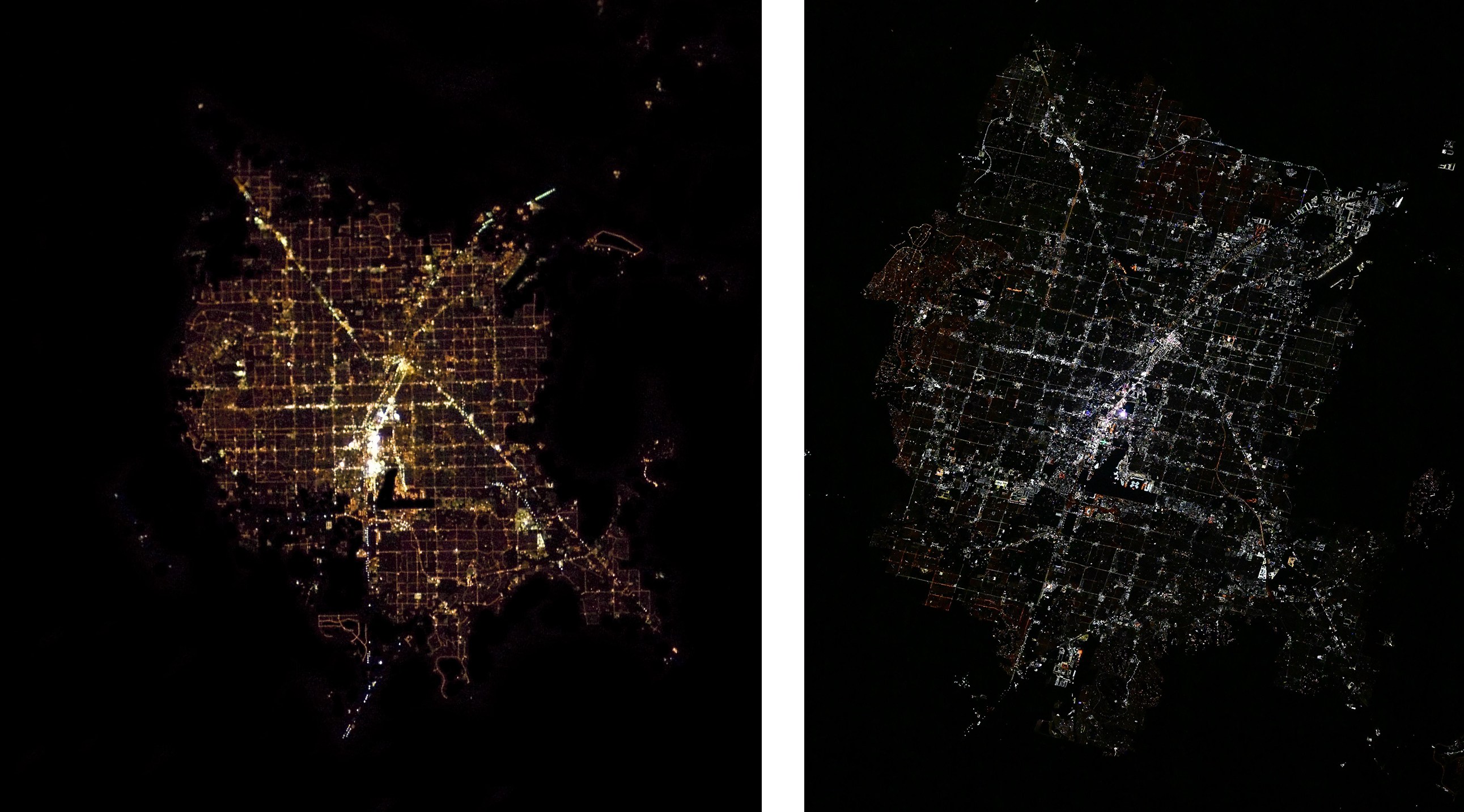
You may not notice it from here, but Earth is glowing. It’s not from the Northern or Southern lights, instead it’s “airglow.” When light from the sun strikes gases in the upper layers of the atmosphere, their electrons get excited to higher energy states. As they return to their normal levels, they emit the energy again in the form of light, giving our pale blue dot a faint, ambient glow.
You can see it from the ground, but it’s particularly vibrant when viewed from space.
NASA actually monitors airglow, and recently they detected a captivating pattern in it caused by the Super Typhoon Sinlaku. This cyclonic storm, as powerful as a category five hurricane, battered the Northern Marianas Islands and Guam back in April. As it gained steam over the warm waters of the Pacific Ocean, the Visible Infrared Imaging Radiometer Suite (VIIRS) aboard a NOAA satellite captured gravity waves emanating outward from the eye of the storm.
Read more: “The Strange Blissfulness of Storms”
Importantly, while these waves are called “gravity waves” they’re not the same as the disturbances in spacetime of the same name. Instead, they’re simply vertical waves that propagate through the atmosphere like ripples in a pond.
Here’s how it works: As the eyewalls of these cyclonic storms release heat, tall fingerlike clouds form in the troposphere (the lowest level of Earth’s atmosphere). These clouds can punch upward through the stratosphere into the mesosphere and disrupt the airglow, causing ripples that can be detected by VIIRS. Research has shown that these gravity waves often form when storms are intensifying, and NASA scientists believe that monitoring them can offer crucial insights into a storm’s power before it hits land.
And so, keeping an eye on the airglow could help save lives. 
Enjoying Nautilus? Subscribe to our free newsletter.
Lead image: 1xpert / Adobe Stock