The next time you’re getting a quote to have some work done to your house, here’s something to have in reserve when you’re told how long it’ll take: A new study suggests the moon could’ve formed in as little as five hours.
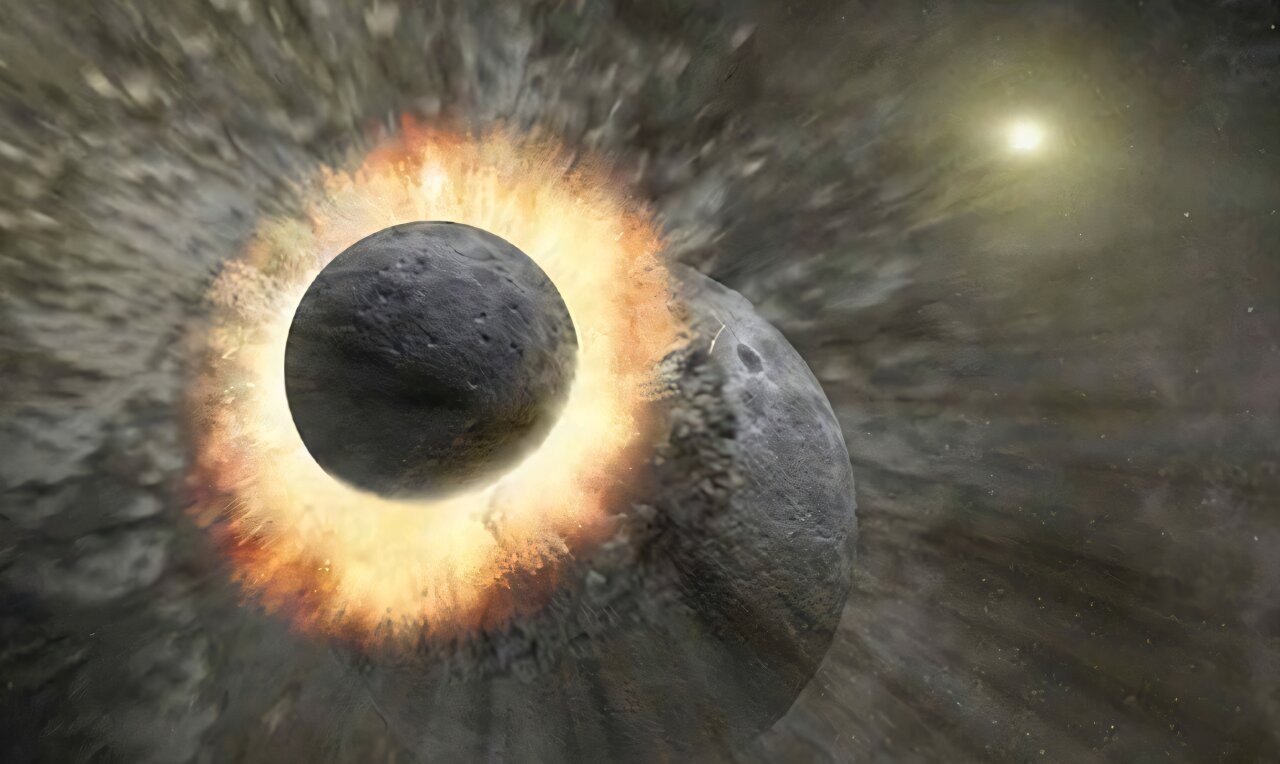
Researchers from the University of Arizona and the Southwest Research Institute (SwRI) have used computational modeling to analyze how our nearest celestial neighbor may have been created some 4.5 billion years ago. In one corner: Earth. In the other: the Mars-sized object known as Theia that our planet theoretically struck. And in the middle: the collision.
For the first time in a model like this, the researchers factored in the material strength of the two planets. The moment of impact was previously thought to have released so much energy and been so phenomenally powerful, that these giant masses could have temporarily turned to goo, acting as fluids—meaning the rules that govern solid objects didn’t apply.
“When you simulate the Earth and the moon as colliding bodies with geologic properties, it changes how the moon forms out of that impact—that’s something we considered unnecessary before,” explained lead author Adeene Denton, from SwRI.
Read more: “The Moon Bases of Yesteryear”
Published in the Astrophysical Journal Letters, the study found that if Earth and Theia behaved more like real rock than fluids, there’s a scenario where part of Theia gets absorbed into our planet and part of it is left over as an almost fully formed moon.
In this case, the moon can reach close to its finished state in as little as five hours, though it would continue to shed some mass for another day or so. Previous estimates have suggested the moon formed in around 10 years.
In order for this new, five-hour hypothesis to be possible, the surfaces of Theia and Earth would have needed to cook at around 3,140 degrees Fahrenheit, which is hot but just short of melting. If two colder objects had slammed together, moon formation is likely to have taken longer, as cooler temperatures mean greater material strength and less likelihood that Theia would have been absorbed by Earth with only a fragment of the remains becoming the moon.
While the researchers aren’t the first to suggest that it might’ve only taken a few hours for the moon to appear and settle into something very close to its current form and position, the extra details on temperature add some crucial context. Although it’s not clear how hot or cold Earth and Theia were when they theoretically collided, we do know that younger planets run hotter than older ones that have been baked longer in space.
More clues about the viability of this theory might come from the moon itself, Theia’s hypothetical leftovers. In the meantime, it’s a reminder that not every world-altering event in the universe is measured in eons. 
Enjoying Nautilus? Subscribe to our free newsletter.
Lead Image: NASA/JPL-CalTech/T. Pyle