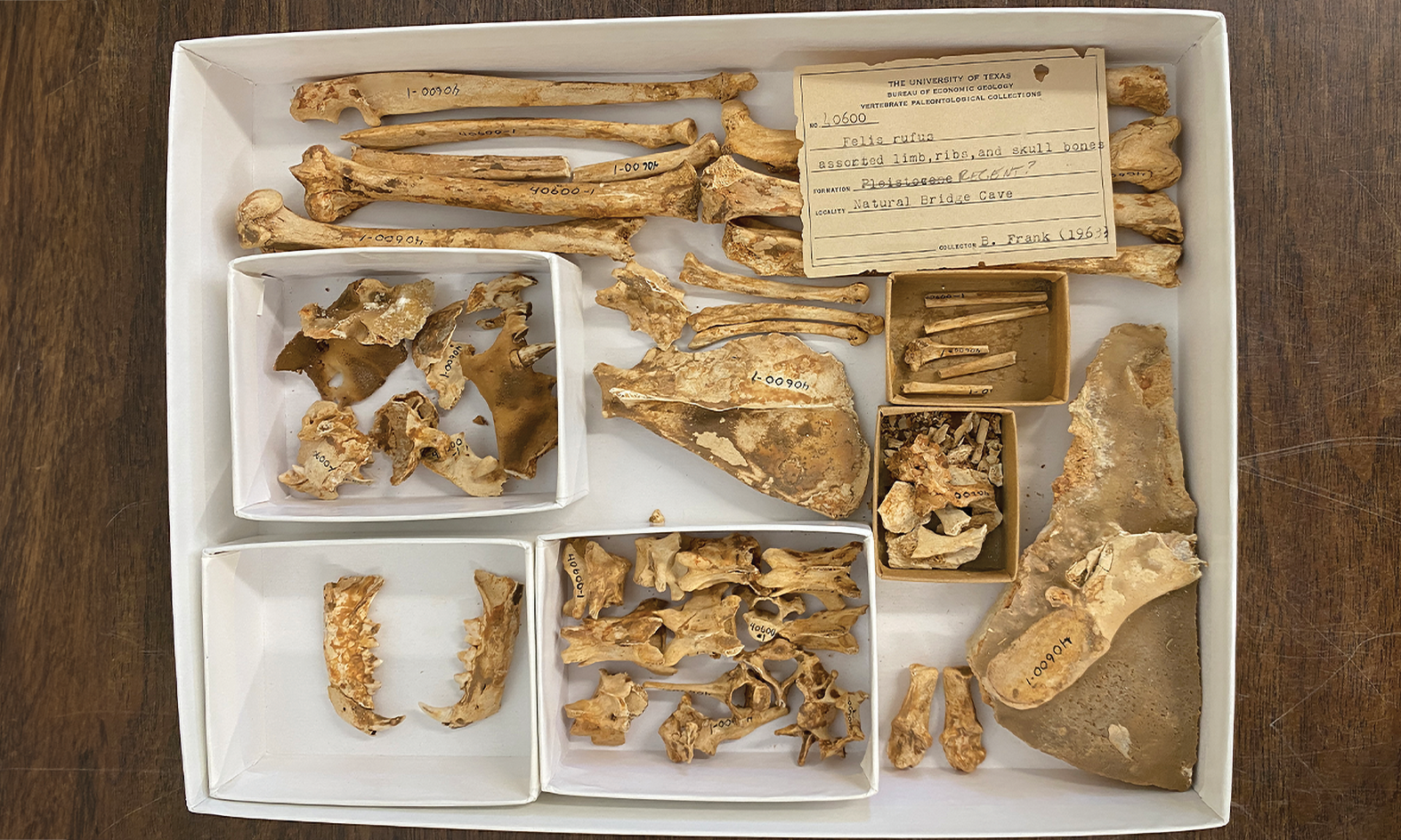
Last year, cavers rappelled into Natural Bridges Caverns in Texas—a popular commercial tourist cave that reaches 230 feet into the ground—and picked up two small cat skeletons that were impeccably intact. Both looked like house cats, but researchers suspected they might have a larger story to tell.
Now, scientists at the University of Texas have discovered that the skeletons date back to the Ice Age—they’re 11,500 years old. The recovery of ancient DNA and protein from the specimens holds potential to reveal how Ice Age cats relate to living species today.
“Ancient DNA could provide us with a Rosetta Stone to associate the species with the skeletal form,” says John Moretti, a graduate student at the University of Texas at Austin.
Moretti remembers getting a call from the ranching family that owns the cave—they had found some bones and wanted help studying them. He did some research and figured out other bones had been discovered in the cave back in the 1960s—an incomplete specimen that had been labeled as a bobcat. Moretti wondered if the new bones were related to that finding, but he soon realized the old bones didn’t belong to a bobcat at all—they likely belonged to a group of neotropical cats whose relatives live in Central America today. Moretti published his initial findings at a paleontological meeting earlier this year.
The story of the cats was likely one of an increasingly desperate struggle to escape. Fossilized pawprints in the floor and walls of the cave suggest the cats had tried to leave the cave system before wandering in the darkness and slipping into the deepest part of the chamber.
A decade ago, it would have been impossible to decipher ancient DNA from a cave, because the warm and wet environment would have made it too difficult to collect. But new technologies make this possible today.
Joshua Samuels, a paleontologist who heads the Gray Fossil Site & Museum in Tennessee, says that the new work does a great job of filling in an important gap in our knowledge. While ancient big cats—and the charismatic (but now extinct) sabertooth in particular—are the focus of many studies each year, small cats rarely get the spotlight.
“Small cats are important predators in many habitats today, but their fossil record and evolutionary history isn't very well understood,” he says. “Bobcat, ocelot, margay, and jaguarundi were historically distributed across much of North America, but the impacts of humans have reduced both their range and abundance, leading to endangered status for tropical small cat species.”
The most important question, he notes, is what species these cats represent—whether they are fossils of living species like margay or jaguarundi or represent an extinct species like the margay-like Leopardus amnicola. Samuels says the skeletons from Natural Bridge Caverns could reveal clues about how the cats lived and hunted, which vary widely from one small cat to the next.
“Some species, like bobcats, can climb but spend most of their time on the ground, but margay are specialist climbers that even hunt in trees,” he says. The skeleton findings could even improve our understanding of what ancient environments in Texas looked like. In the late ice age, Texas was likely an open savanna, populated by herds of mammoths, bison, horses, and camels, a very rich ecosystem.
The study is still ongoing, and there’s no definite answer of what the fossil cat represents—but when the results come, they will help fill in a lot of blanks in the story of small cat evolution. When the ice age ended, many ecosystems were toppled. The cat skeletons could help us unravel the mystery of which cats were able to adapt. 
Lead photo by Winter Prosapio / Natural Bridge Caverns