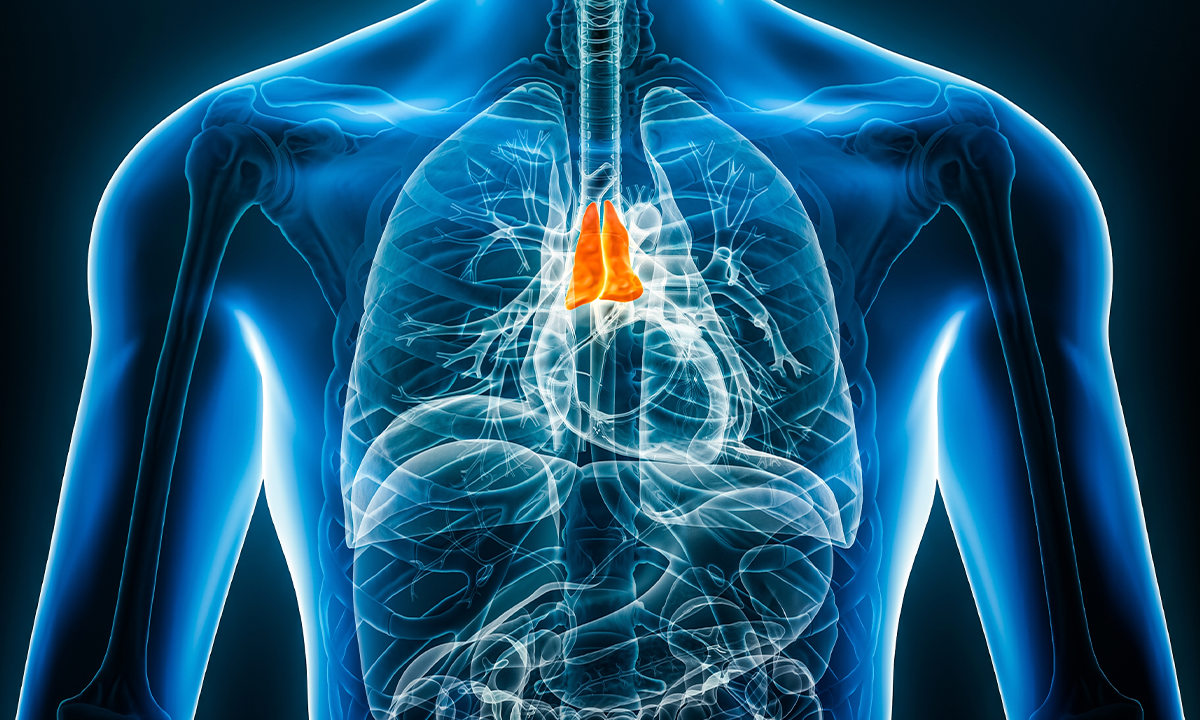
The humble thymus doesn’t get a lot of press. In fact, most people probably couldn’t point to it on their own bodies (hint: it’s in the middle of the upper part of your chest). But two new studies published in Nature indicate this little organ might play a big role in our longevity.
Often overlooked, the thymus acts as a kind of finishing school for T-cells (in fact, the “T” in “T-cells” comes from “thymus”). After being produced in the bone marrow, immature T-cells migrate to the thymus to mature and differentiate into T-helper cells, killer T-cells, memory T-cells, and more.
The thymus is particularly active during childhood when your immune system is encountering all kinds of new antigens, but after puberty it starts to atrophy and eventually undergoes a process called “involution.” During involution, thymus tissues get replaced with fatty tissue (kind of like using your kid’s room for storage after they go off to college). Because the thymus seemingly deactivates like this, it’s been dismissed in research—until now.
Read more: “The Anatomical Quirk That Saved Dr. No”
Using artificial intelligence to analyze CT scans, researchers from Mass General Brigham in Boston measured the size, shape, and composition of thymuses from more than 2,500 healthy adults participating in the famed Framingham Heart Study. This allowed them to assign each one a “thymic health score.” The team found that those with high thymic health scores had much better health outcomes, including a 50 percent lower risk of death, 63 percent lower risk of cardiovascular death, and 36 percent lower risk of developing lung cancer compared to those with lower thymic health scores.
So what’s going on?
Researchers think that when thymic health and T-cell diversity decline, so does the body’s ability to combat new threats like cancer and other diseases. Killer T-cells in particular are tasked with identifying and eliminating cancer cells and cells infected with viruses.
In another study, researchers looked at the importance of the thymus in cancer patients treated with immunotherapy. Because immunotherapy recruits the patient’s own T-cells to fight cancer, they believed those with a healthier thymus would mount more robust defense. Studying the thymuses of over 1,200 lung cancer patients revealed they were right. Patients with stronger thymic health had about a 37 percent lower risk of cancer progression and a 44 percent lower risk of death.
What can you do to keep your thymus healthy for as long as possible? Lifestyle factors like smoking, obesity, and inactivity were associated with decreased thymic health, but researchers didn’t test whether altering them improved thymus performance. (Still, these factors are already associated with a whole host of other health problems, so it couldn’t hurt to make a change.)
Researchers hope these new studies will lead to renewed interest in the lowly thymus, and eventually new treatment options.
“The thymus has been overlooked for decades and may be a missing piece in explaining why people age differently, and why cancer treatments fail in some patients,” study author Hugo Aerts said in a statement. “Our findings suggest thymic health deserves much more attention and may open new avenues for understanding how to protect the immune system as we age.”
It’s a lot to put on an incredible shrinking organ, but it might be worth it. 
Enjoying Nautilus? Subscribe to our free newsletter.
Lead image: MattL_Images / Shutterstock