Why does the color we associate with wholesome things like bananas, sunshine, and honeybees—“the color of hope, joy, and optimism,” according to one of the world’s foremost color experts—also signify the creeping presence of illness and death?
Not death in the abstract: the dark-cloaked, scythe-brandishing spirit of Victorian art, or the symbolic black vestments worn at funerals. No, yellow connotes death in more concrete, physical terms. The signs of decay and putrefaction in the human body: respiratory secretions, jaundice, skin disease, vomit, and bile. All these signals of bodily disintegration can present as sickly, noxious yellow.
When the respiratory system is under attack—whether from harmless allergies or from serious infection—mucus turns yellow, colored by the pigment from the dead white blood cells unleashed in the immune system’s response. The thick discharge is sometimes known as “lung butter.”
Yellow can permeate the limbs when the body’s natural filtering system, the liver, fails. When that happens, bilirubin—a chemical produced by the disintegration of hemoglobin in dying red blood cells—leaks into the bloodstream, where it slowly turns the skin and the whites of our eyes a sickly yellow. This discoloration, known as jaundice, is often a temporary condition in newborns. In adults it can be a sign of several diseases, many lethal, such as serious anemias or liver disease—including yellow fever, a mosquito-borne disease that kills an estimated 30,000 people each year.
In the gut, we sometimes see yellow hues formed by gastric acid as it breaks down our meals—and sometimes ends up back on our plates when we’ve overeaten, suffered food poisoning, or contracted a nasty illness. Yellow nails can indicate a fungal infection.
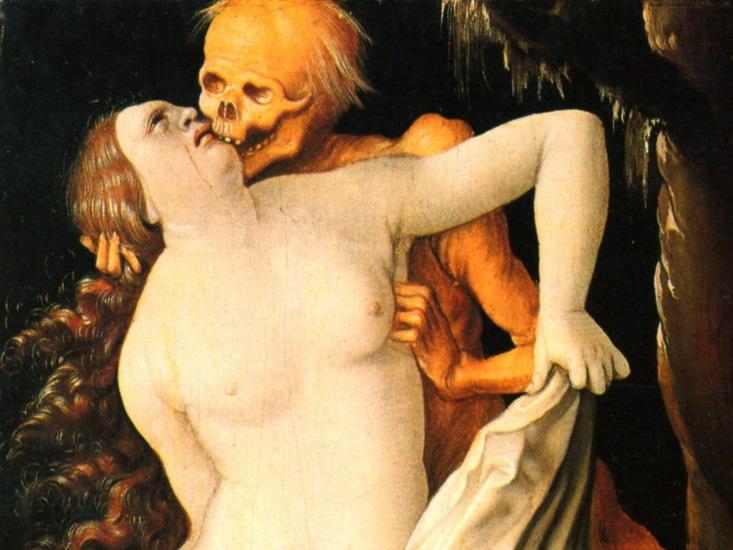
In Hans Baldung’s Renaissance painting Woman and Death, the dark angel is depicted as a yellowed, emaciated cadaver with a skull head embracing his pale victim. The painting was also used for the cover of John Kelly’s great account of the Black Death, The Great Mortality. And it may be due to Europe’s greatest biomedical disaster that artists began to highlight yellow in gruesome representations of apocalypse.
What become known to historians as The Black Death struck Europe at the end of the Middle Ages. According to Kelly’s account, “In late September [of 1347] Sicily was infected by a fleet of Genoese galleys. One chronicler reported that the Genoese tumbled off the infected ships with ‘sickness clinging to their very bones.’” The diseased shipmen bore large oval swellings—in their armpits, on their throats, and in their groins. The bulbous protrusions oozed blood and yellow pus.
Victims suffered greatly and most died within five days of the first symptoms—many within hours of coming down with the disease. Between 1347 and 1350, Europe lost between 30 and 50 percent of its population to what historians now believe was a combination of two pestilences: bubonic plague, which infected the bloodstream, and a pneumonic plague that attacked the lungs. “This is the end of the world,” wrote one chronicler at the time. And like the visions that grace our favorite cinematic horror stories, villagers throughout Europe saw the dead stacked like yellow firewood, chewed at and eaten by feral animals, or buried hastily in mass graves that failed to stifle the stench.
For all their fantastical elements, our modern fables of apocalypse tap into a deep historical association of yellow with epic disease and death. So if you watch an episode of the AMC series The Walking Dead, don’t be surprised to see how many of the zombies feature yellow eyes.
John Farrell has written about science and technology for Forbes, Aeon, New Scientist and The Wall Street Journal. He is the author of The Day Without Yesterday: Lemaître, Einstein and the Birth of Modern Cosmology (2005).