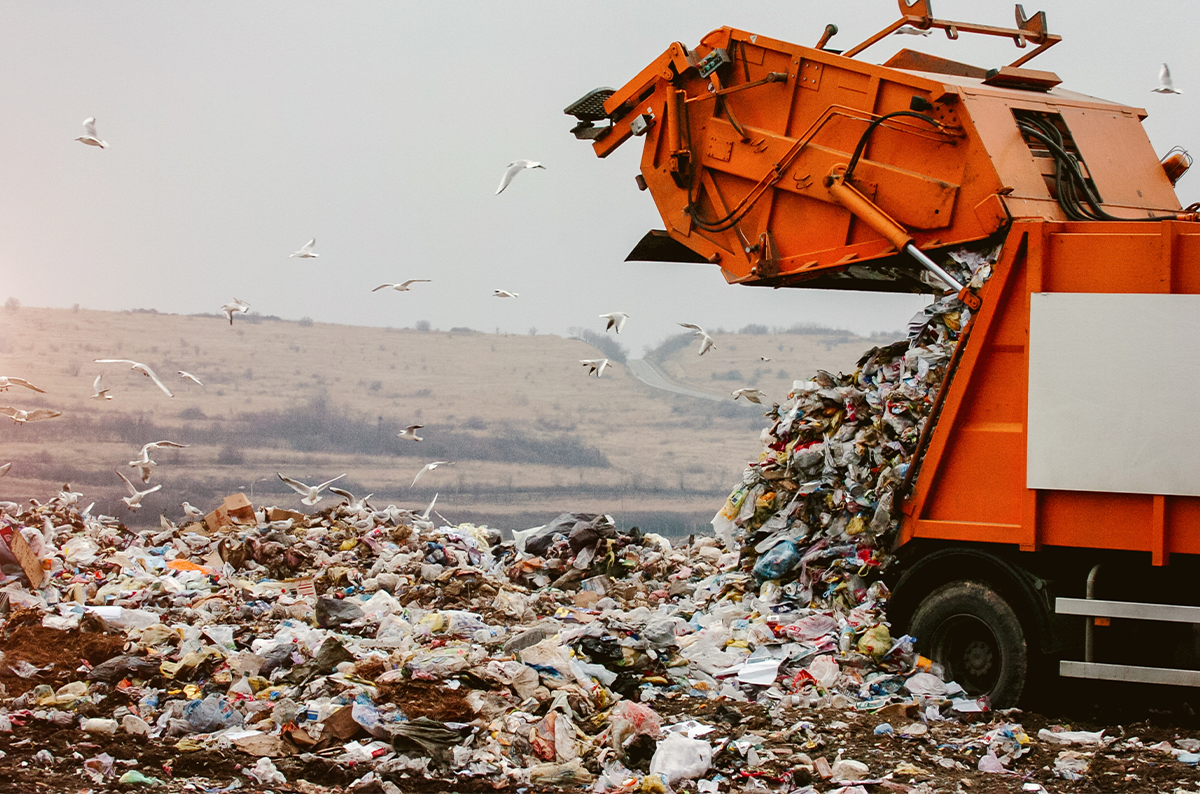
The garbageman is the Sisyphus of our consumer society, writes Simon Paré-Poupart in his jaunty new memoir Trash!: A Garbageman’s Story. But we don’t give these outcast heroes enough credit, argues Paré-Poupart, and the phenomenal job they—and the companies who employ them—do at making our trash disappear, which allows us to continue making a mess of the Earth.
Paré-Poupart started hauling trash as a teenager, and fell in love with the job. He loved the rush he got from sprinting behind a truck and hauling massive castoffs into it, something he compares to running an ultramarathon every day. He loved the raffish no bullshit style of his g-man comrades. He loved the pay, too, which put him through school.
Today he’s not just a garbageman, he’s a sociologist. And he uses Trash! to not only tell his own colorful story and those of his mates on the job, but to critique the way our society deals with trash, and the devastating effect it has on the environment. He’s also a freegan, who finds almost everything he needs in the waste he collects.
I spoke with Paré-Poupart about what stories and secrets he sees in the trash, what it takes to make it as a garbageman, and what we can do to better manage our waste.
How did you get into the trash business?
When I was a teenager, I was a really shy guy—what we call a mama’s boy. I was kind of skinny. My stepfather was a different kind. He really liked Arnold Schwarzenegger—he was going to the gym a lot, maximizing protein, and taking steroids. He was pretty pumped up. He decided that I was too skinny, not strong enough, and too overprotected by my mom, who was his wife at the time. I have no grief with him because it was a dynamic we had—I was laughing at his muscles, he was laughing because I was so skinny. But when you’re a teenager, you’re in an identity crisis. At some point in my life, what my stepfather had been telling me started to go through my mind. I began searching for answers. He told me to go collect trash—to be a man—because it was the kind of job that would pull me out of my mother’s world and into a different one.
Maybe it wasn’t the best way of getting into it, but it was his way. I don’t think he knew how different it would be. But in fact, it was helpful, because it made me try something new. And collecting trash in Montreal paid really well, so it helped me pay my tuition and education fees. It was a perfect job.
I stayed in this job because my real dad was an alcoholic—he's passed away now. What I’ve found is that most of the guys who stay in this world of trash had really tough childhoods. Having an alcoholic father is kind of a prerequisite. Many of them have had far more tragic lives than I’ve had. So it’s a mix of those two influences: my father and my stepfather. I came to collecting trash at 18. Now it’s been 22 years.
What does it take to make it as a garbageman?
I train garbagemen now. One of the first questions I ask them is: Do you love it? Because otherwise, it’s so hard to get through all the pain. It’s like doing an ultramarathon. Before you become used to it, before you start having a lot of pleasure—what you’d call an endorphin rush—it’s hard. To reach that level, to get through all the pain and hardship, you have to really love it from the start. Actually, to do this interview with you, I left the guys on the truck. I enjoy this, but I was having a lot of fun out there.
Ah, the pressure is on! What else do you look for in a new garbageman, aside from love for the job?
What we call in French Quebec “avoir du chien”—to have some dog in you, or grit. A lot of grit. It comes from very deep inside. Because when you do a sport like boxing or mixed martial arts, there’s a lot of external support—society tells you what you’re doing is good. School, peers, the whole system pushes you toward accomplishment. When you collect trash, nobody cares. So it has to come from inside you. Having a hard childhood helps, because behind the truck, you sublimate that violence—you can express it. I think guys find that behind the truck. It helps them get through all the painful moments, because it makes them able to confront what they’re fighting inside themselves.
You’ve been living in two very different worlds for a long time, earning degrees in sociology while also picking up trash. How do you find a balance between those two sides of yourself?
They’re more than just different—they’re complementary. There’s an Italian intellectual, Antonio Gramsci, who wrote about what he called the “organic intellectual,” the idea that wherever you are, whatever you do, you can think about it and learn something—for yourself and for society. I try to embody that kind of thinking. I also have a master’s in management, and when a manager wants to implement a new policy, they have to go into the field to test their ideas against reality. It’s the same here.
I read Barbara Ehrenreich's Nickel and Dimed, an investigative book about the impossibility of surviving on minimum wage. But she also tried to show that we can learn a lot from people who do jobs we might think of as low-status or uninteresting. I agree. At first, I was just doing the job for myself—I was learning about what I do, because what I do as a garbageman is kind of really absurd.
Read more: “You Are Made of Waste”
What have your explorations taught you about the human drive to consume? Where do you think it comes from?
If capitalism is modernity, and modernity is overconsumption, what we call progress, and the logic of continuous growth, then capitalism may be part of the problem. On that, I'd point to a German sociologist, Zygmunt Bauman, and his book Wasted Lives: Modernity and Its Outcasts. He argued that the garbageman is a hero of modernity—he takes care of all the downsides of modern consumption without consumers being aware of what he does. That invisibility is what allows the system to keep functioning. Because what companies proposed in the 1960s, in Montreal, was what we now call “waste management” as a concept in social science: the easiest, lowest-cost way to make trash disappear. And the system works because consumers don’t want to see their waste. That’s why it’s possible to keep buying things—because we don’t see the landfills, the burning, the dumps far outside the cities.
I’d bring in another French philosopher, Georges Bataille, who wrote about what he called the la part maudite—the “accursed share.” It’s something that, without our awareness, we leave behind as we advance. I think throwing away is, for those of us in the West, an unconscious act—and that’s why the system works. There’s another example I sometimes give: After 9/11, George W. Bush told Americans to go out and shop. And in the 1960s, the Coca-Cola ads were telling us that buying makes you happy. All of that buying also means growing landfills—all around the world.
In the book, you cite a passage from Victor Hugo’s Les Misérables, which essentially says trash doesn’t lie—that it tells the whole story. What secrets or stories do you see in the trash you pick up?
For instance, I can sometimes know a woman is pregnant before her boyfriend does—because I might see a pregnancy test in the trash. We can see anything in there, because everything we have around us will be thrown away at some point. And since the 1990s, we throw away more than before. In the past, objects outlived us—some things passed from generation to generation. Now that’s disappearing, because objects are like Ikea furniture, built for one use. We see all of that in the trash.
The pandemic is another example: There was so much packaging that people stopped sorting it into recycling. It used to be that companies were responsible for their packaging—now it’s increasingly the consumer. So much packaging from individual orders goes straight to the bin. If policy doesn’t adjust, we’ll face a great waste crisis. But politicians generally aren’t interested in trash because it’s hard to build a beautiful project around trash.
I understand that you are a Freegan, someone who recovers, scavenges, forages for the things they need rather than buying them new. What kinds of things do you find, and what do you do with them?
This shirt I’m wearing came from the garbage. Pretty much everything in my house came from trash. I have to think carefully about what I actually buy—food is about it. Everything else, I collect. Today, we collected 50 tons of trash in one day. For me, 50 tons isn’t trash—it’s possibilities. I don’t see it the way most people do. Sometimes I challenge people: Tell me something you need, and I’ll find it in the trash. Give me some time, but I’ll find it. I’ve found gold in the trash. Money. When you can find gold, you can find anything.
What’s the hardest thing someone’s asked you to find in the trash?
A friend of mine—a big geek, a Dungeons & Dragons player—asked me to find the most expensive Magic card, The Gathering trading card. I told him I probably couldn’t find that specific card, but I did find Magic cards, because he’d put the idea in my head. It’s a bit like what they describe in The Secret: If you hold something in your mind, you increase your chances of finding it. So when someone asks me to find something, I will find it. Just maybe not the rarest version.
Were there any stories that didn’t make it into the book?
A lot. I have a friend, Olivier, who is now running behind the truck. In his 20s, he was dealing drugs heavily. He was stabbed in the back and did time in prison in Montreal. When he got out, the only work available to him was collecting trash. He eventually traveled in Europe, converted to Islam, and developed strong values that kept him away from drugs—both selling and using. Now he’s 44, he has a kid, a house. Garbage work can be a form of social reintegration—it gives people with what we might call deviant behavior a space to express that energy in a job where they won’t be judged. Collecting trash helps some people escape their problems. And beyond that, it’s one of the most important jobs in our society—because without garbagemen, society collapses.
What insulted me was when Donald Trump got in a garbage truck during his campaign, trying to embody the working class. For me, as someone who actually does this work, it felt deeply false. You have to genuinely respect people who work hard—not just garbagemen, but teachers and bus drivers, too. All of these people are essential to society.
You wrote that the book on trash that’s stayed with you most is Giants of Garbage. The central question of that work is whether we can even maintain democratic governance over waste management. What do you think?
The author, Harold Crooks, is now based in New York. He’s an investigative journalist, and what he documented were the links between organized crime and the leaders of waste-management companies in the United States. There’s a quote he found from an executive at a major Toronto company, who told Congress that landfills are to them what oil fields are to Big Oil. They make money on trash, and they’re invested in a logic of endless growth.
So we face a real dependency problem—in the United States and in Canada—and we need to break from it if we want to take back control of our waste, because our waste could be a resource. Just last Monday, I found a bag with 30 iPhones in it. Donald Trump is currently in a conflict with China over strategic minerals, but when we put those iPhones into landfills, we’re burying those same strategic materials. We could be building a new economy around our waste. That’s what China did when it stopped accepting the world’s recyclables—because there was more actual waste than recyclable material; it had already built a strong economy processing the trash of the world.
We need to think the same way. There’s not just an economic cost to throwing away these materials—there’s an environmental one, too. Some of these resources will be nearly impossible to recover.
What would you tell city planners about how to manage garbage better?
What’s interesting is that, until now, waste has been the least-addressed problem of all. So almost anything would be an improvement. I mentioned that apartment buildings once had incinerators in the basement. Today, it might make more sense to require urban planners to include proper sorting rooms in residential complexes: places for batteries, areas where residents can share goods with their neighbors, spots for motor oil. Help people do what the ragmen [scrap collectors] did—take care of waste without being afraid of it. We can learn that from garbagemen, because we live with trash all day. We don’t have the distance that “waste management” as a concept has created between people and their waste.
The French philosopher Georges Bataille wrote about how, in the 19th century, the people who handled waste—not just trash, but corpses and mud—were seen as corrupted by what they touched. I think we still carry that idea. And it’s compounded by the fact that those people who did the jobs were working class. The distance isn’t just about the object—it’s also about class. Waste management as an industry understands that, and it’s why companies like Waste Management and others have built their business model on the idea that people don’t want to deal with their own waste. That’s what waste management as a concept will always offer cities and governments: the easiest way not to care about where our waste goes.
I actually met someone over the weekend who grew up not far from here—I’m in San Diego—in a place that didn’t have trash collection. It wasn’t that long ago, because he’s in his late 30s or early 40s, and he said as a kid his family would load all their trash into a barrel and burn it. It was almost like a family ritual. They couldn’t just make it disappear. But I doubt that state of affairs would be preferable.
It would be very hard to do that now, because objects are so complex. An iPhone travels around the world four times before it reaches Montreal, because of all the minerals and components involved. You can’t just burn it the way people burned trash in the early 20th century. In Montreal, people once had small incinerators in the basements of apartment buildings. In rural areas, people burned their trash at the edge of their fields, and what was left—metals—was collected by ragmen. Before garbage trucks with compaction systems, there were just too many tons of waste for people to manage on their own.
What your friend was experiencing is more common in rural areas than urban ones. Organized waste collection came first to cities like Montreal, because waste causes much more serious problems when space is limited. At that point, sanitation became the overriding concern and environmental issues took a back seat.
How can we make people more aware of the trash they create?
What I’d like to say to people is this: If you throw something in a trash bin or recycling bin, you should be required at some point in your education to visit a site that processes that waste. That would create some real consciousness about the systems that have been built to keep our waste invisible. That’s one thing city councils or states could require citizens to do. We need to feel responsible for the waste we generate. 
Enjoying Nautilus? Subscribe to our free newsletter.
Lead image: Dalibor Danilovic / Adobe Stock