One night in the 1770s, an optician showed a pastor a microscope. The theologian, Johann August Ephraim Goeze, was so taken that he sold his library to purchase one for himself. “The very next day, he began his exploration of the microscopic world,” writes Ralph O. Schill of the University of Stuttgart in Germany, in a paper about the discoveries Goeze would soon make.
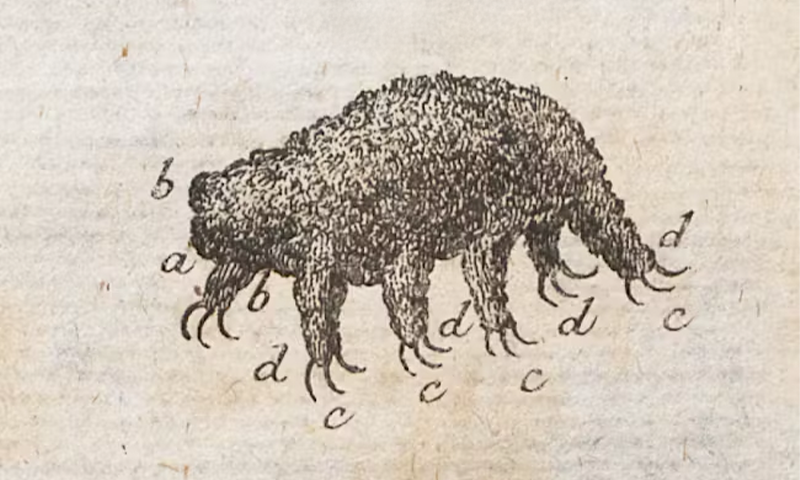
Goeze was particularly enchanted by organisms he found in a pond just beyond his church in his small German town. One such animal seemed particularly curious. “Strange is this little creature,” he wrote in a 1773 paper about his observation. “At the first glance, [it] has the closest similarity to a little bear.” Despite its striking appearance, he could not find other mentions of it. “I have searched for it in the records of the greatest naturalists—whose eyes have seen far more than mine—but in vain.” So he named it “little water bear,” having found it overwinter on aquatic plants from the pond.
This illustration accompanied Goeze’s published description of the creature—the earliest one on record. According to Schill, there’s some debate about which human first observed a tardigrade, with other contenders including an Italian botanist, a Danish naturalist, and an Italian polymath and Catholic priest. But Goeze was first to press.
We now know that tardigrades have many more remarkable features than just their whimsical form. They can survive extreme radiation, pressures, temperatures, dehydration, and air and nutrient deprivation. They famously can even survive the harsh environment of space. But their sturdiness, it turns out, might not entirely protect them from negative pressures, even ones created by mere humans, such as pollution from cars.
Some 1,500 known species now belong to this phylum, Tardigrada, and they have been found far beyond German ponds—in glaciers, coral reefs, forest moss, citrus groves, and beyond. And new species are still being discovered—including one—Dactylobiotus taiwanensis—just described in May. It had been collected in winter from a lotus pond in a sports park in Taiwan. Unlike Goeze’s early paging through old manuscripts to verify his finding, however, Chih-Yu Pai, who collected the tardigrade, was only alerted to its novelty after they photographed it and “posted photos on Facebook,” as the new paper notes.
It seems the Tardigrades are still proving themselves, as Goeze observed some 250 years ago, “among the rarest and most peculiar.” 
Lead image: The Public Domain Review