It’s easy enough to forget to take a daily pill—but what if your medication could report back to your doctor within minutes of you swallowing it?
Non-adherence to medication contributes to around 125,000 preventable deaths annually in the United States, and nearly half of all people with chronic conditions don’t take medications as they’re prescribed.
Now, a new biodegradable system with a radio frequency antenna could help tackle this problem. The tiny gizmo could, for instance, help ensure that transplant patients regularly take their immunosuppressive drugs, which are critical to the long-term success of these procedures. It could also be used with people with infections including tuberculosis or HIV, who require treatment for extended periods, according to a new paper in Nature Communications.
Again, sticking to a drug schedule matters: HIV can progress more quickly into AIDS if people don’t take their medications as directed, for example.
“The goal is to make sure that this helps people receive the therapy they need to help maximize their health,” said study co-author Giovanni Traverso, a physician and engineer at the Massachusetts Institute of Technology, in a statement.
Researchers have looked into several high-tech methods to ensure that people stay on track with their medications, like smart pill bottles that send reminders to patients and ping physicians and caregivers when they’re opened.
Labs have also looked into pill capsules with sensors that can communicate with doctors when swallowed. But most designs for these ingestible sensors rely on polymers that don’t dissolve in the body and stiff bits of electronics, which people excrete intact. This could risk gastrointestinal injuries, not to mention add to the growing piles of electronic waste accumulating around the world.
Read more: “Getting Googled by Your Doctor Is the New Normal”
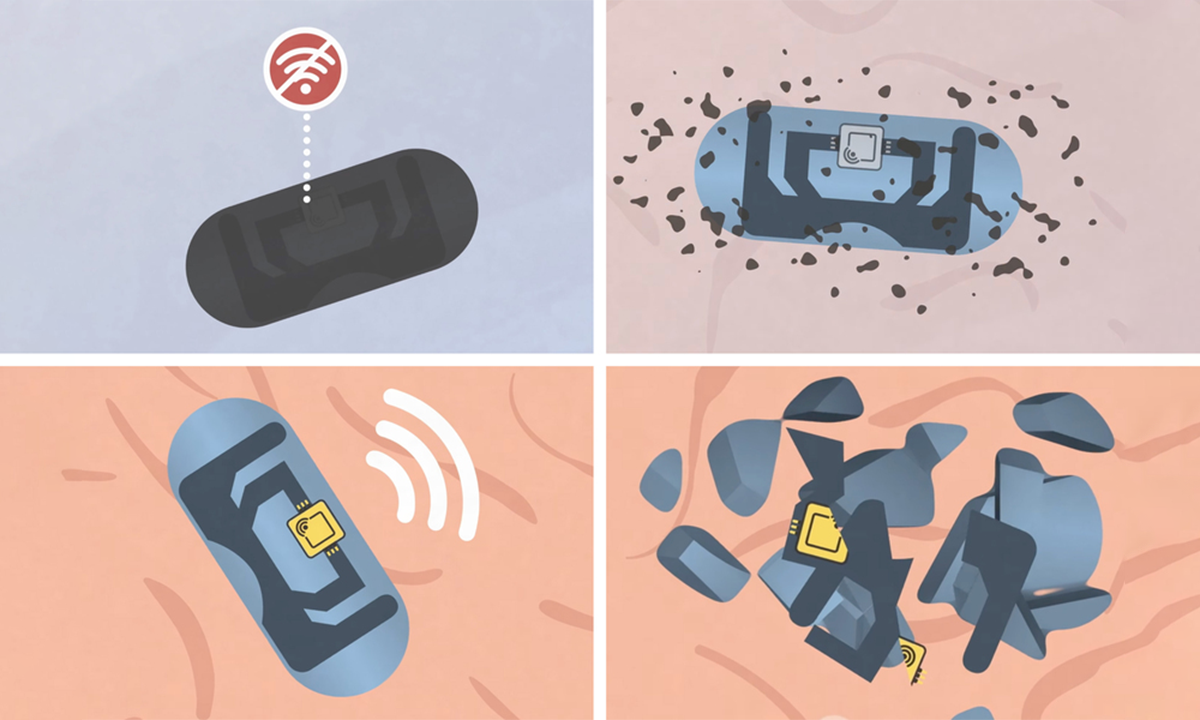
But with the new system from Traverso and his colleagues, most of the components break down in the stomach within a week, and a micrometer-sized radio frequency chip leaves the body through the digestive tract. The antenna is made of zinc and enclosed in a cellulose particle, and the surrounding capsule is made from gelatin coated with cellulose. These materials are known to be safe and commonly used in medicine. The capsule is also covered in safe levels of molybdenum or tungsten, materials that block radio frequency signals until the pill starts to break down in the body.
During experiments in pigs, which have similar-sized gastrointestinal tracts to humans, the radio frequency signal was successfully transmitted from within the stomach and was read by a receiver up to 2 feet away. The devices dissolved as intended in the pigs’ stomachs as well.
“These findings highlight the system’s potential to improve patient adherence tracking without introducing significant logistical burdens or ecological impact,” the authors wrote in the paper.
In a potential design for humans, the team would create a wearable device with a receiver that can send the information to a patient’s healthcare providers. They aim to conduct more research before testing the concept in people. The system isn’t meant for the mass market, they noted, but for situations where people’s lives—and public health more broadly—depend on steady drug regimens.
“We want to prioritize medications that, when non-adherence is present, could have a really detrimental effect for the individual,” Traverso said. 
Enjoying Nautilus? Subscribe to our free newsletter.
Lead image: Courtesy of the researchers