When an unwitting victim stumbles into a spider web, the host arachnid typically welcomes the hapless creature into its home by wrapping it in silk and piercing it with fangs full of venom. In most cases, this venom is enough to completely paralyze, and sometimes even kill the prey. But for the insects that get caught by rare Uloboridae spiders, it is not venomous fangs they need to be concerned about. It's what is brewing in these spiders’ guts.
“I found this reference of this very old paper saying that this family of spiders were non-venomous and I was like what? Wait a second. I thought all spiders were venomous,” says Giulia Zancolli, an evolutionary biologist at the University of Lausanne. “So, then I then started digging.”
She stumbled on a drawing in a 1931 paper, which showed that the heads of these spiders don’t contain the venom glands that most spider species do. “But this was really the only data available,” she says. So, she decided to check for herself.
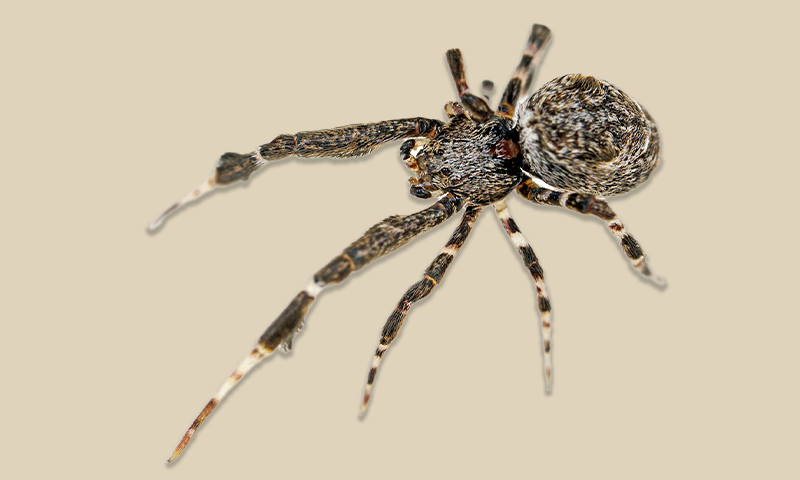
Zancolli and her colleagues turned their attention to one species in family Uloboridae called Uloborus plumipes, or the feather-legged lace weaver spider. A tiny, delicate spider, U. plumipes swathes its prey in hundreds of feet of silk, more extensive wrapping than most spiders. After mummifying its prey, the spider then vomits all over the tight bundle.
When Zancolli and her colleagues dissected the spiders’ heads, they found large, prominent muscles but no venom glands. And when they looked closely at the spiders’ fangs, they found that they even lacked an opening through which venom could be ejected, providing further evidence that these spiders had lost their venom glands over the course of evolution.
After mummifying its prey, the spider then vomits all over the tight bundle.
“As far as I know, there are no other groups of spiders that have lost their venom glands,” says Ronald Jenner, an evolutionary biologist at the Natural History Museum, London who was not involved in the study.
The scientists wanted to figure out whether some other organ in the spider’s body could perhaps contain the missing venom. So they looked for active venom-producing genes in its other parts, like its reproductive organs, its silk producing glands, and its gut. And lo and behold, the gut seemed to contain genes that could code for venom-like substances.
To confirm that U. plumipes’s gut secretions were indeed toxic, they injected them into fruit flies. As a comparison, they also injected the flies with secretions from the gut of a venomous spider species. Both sets of secretions killed the flies, suggesting that U. plumipes does use its toxic digestive fluids to go in for the kill but that these gut secretions are common in spiders more broadly. In other words, the fang venom used by other spiders likely did not migrate to the gut, but rather U. plumipes learned to use pre-existing gut secretions in a new way. The scientists recently published their findings in BMC Biology.
“The venom system is expensive … it costs metabolic energy to make venom and to maintain that system,” says Jenner. “So, in these spiders, the loss of the venom system means that they will have to have evolved a different way to immobilize prey.”
The secret to immobilization for U. plumipes lies in the extensive silk wrapping it does and the equally extensive spreading of fluid. The spider makes “a burrito” out of its prey, says Jenner. Then it regurgitates toxic digestive fluids on the entire package, which both kills the prey and then goes on to dissolve its tissues. “A spider only takes liquid food so they can slurp up the digestive broth that is caused by regurgitating digestive fluids,” explains Jenner.
Usually, spiders only throw up toxins specifically into the bite wounds, so that if the venom hasn’t already killed the prey, the vomit will. “It's a conserved trait to have such potent digestive fluids, but the idea is that these non-venomous spiders somehow repurposed it to use it for predation,” says Zancolli.
As to why the Uloboridae family of spiders as a whole lost the venom glands in their heads, Jenner thinks it’s because they no longer needed venom to take out their prey. “I think they have become such expert silk burrito makers that they don't need venom anymore for immobilization,” he says. Some sea snakes evolved along a similar trajectory, losing all of the organs involved in poisoning prey around the time they started feeding on fish eggs, which don’t require capture or immobilization.
As a next step in the research, Jenner thinks scientists should look at the expression of certain key toxin or venom genes across the phylogenetic tree of spiders, and also across other arachnids. “It was very interesting to see how many toxins are expressed in the gut” of U. plumpies, says Jenner. But are these toxins present in other spiders, as well?
Either way, across time, spiders seem to have evolved a number of ways to enjoy their liquid lunch. 
Lead image: Netha Hussain / Wikimedia Commons