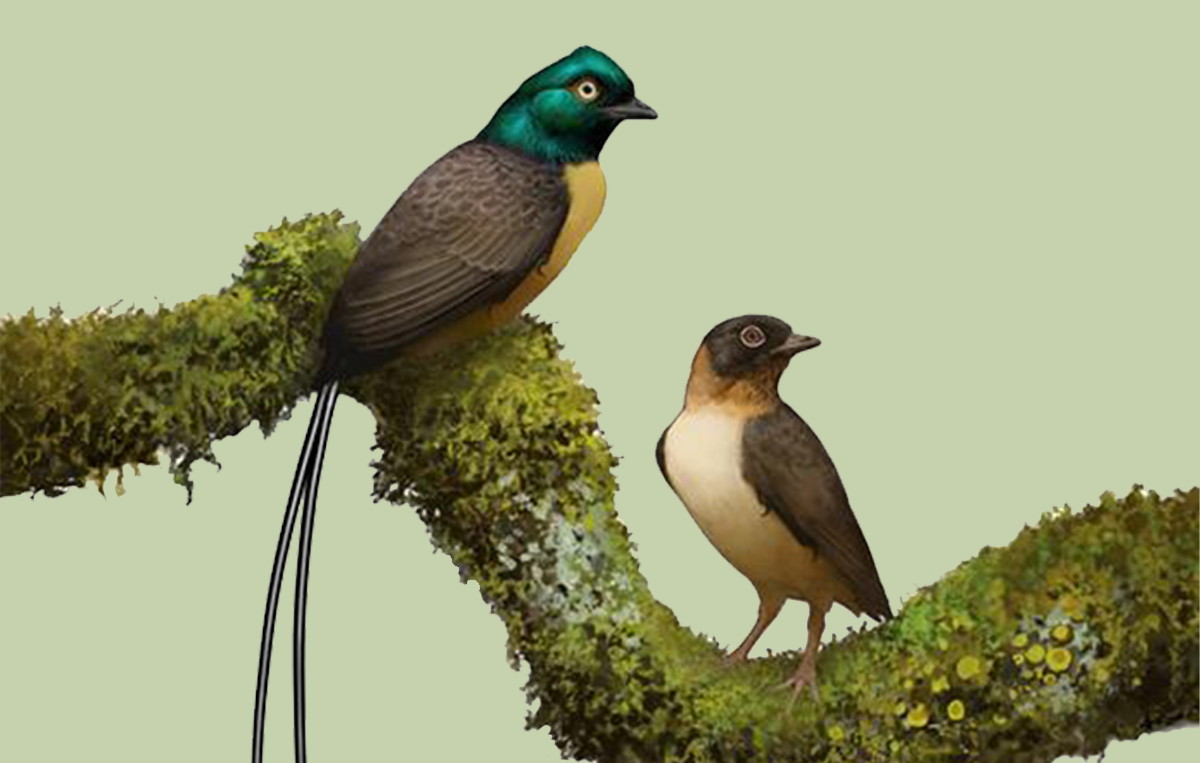
When a male king bird-of-paradise seeks a mate, it puts on an elaborate show. Perching on a branch, it puffs out its white chest, stretches its wings, and sways two spindly tail feathers with iridescent green disks. Of course, it’s not alone. The tail-feather shake is the go-to move for plenty of male birds, including the argus pheasant, the marvelous spatuletail hummingbird, and the white-booted racket-tail. It’s also an avian courtship strategy that dates back to the time of dinosaurs, according to a prehistoric bird species newly described in PLOS One.
Paleontologist Alex Clark from Chicago’s Field Museum discovered the eye-catching specimen while sifting through fossils at China’s Shandong Tianyu Museum. The bird was a member of the enantiornithines, the most diverse bird group living 120 million years ago, and one that died out along with the dinosaurs. Impressively, it boasted two magnificent tail feathers twice the length of its body.
“I saw this little guy, and I did a double-take when I saw the tail feathers,” Clark said in a statement. “I’m really interested in the way birds do displays to attract mates, and I thought that these tail feathers were so crazy, they had to be used for something like that.”
Read more: “Why Females Decide What’s Beautiful”
After determining the long-tailed bird was in fact a new species, Clark and his team gave it the genus name Plumadraco—”feathered dragon.” According to their analysis of the fossil, Plumadraco’s two tapered tail feathers, with stiff shafts and rounded tips, were ideal for flicking around to entice a mate. “The fossils of some other enantiornithine birds show remnants of muscle tissue along the tail region, and based on those muscles, birds like Plumadraco would have had pretty limited movement for their tails,” Clark said. “However, they could pump their tail feathers up and down, and that’s a behavior that we see across birds today.”
It’s a tail as old as time. 
Enjoying Nautilus? Subscribe to our free newsletter.
Lead image: Ville Sinkkonen