For 100 million years, plants had Earth’s surface mostly to themselves while vertebrates thrashed around in the primordial seas. When vertebrates finally crept up on terra firma, they still opted to dine on their fellow animals, leaving the foliage alone. Tens of millions of years later, that changed. Now, researchers have identified one of the earliest known fossils of a terrestrial vertebrate plant-eater. They published their findings today in Nature Ecology and Evolution.
Amateur paleontologist Brian Herbet was fossil hunting in the cliffs of Nova Scotia when he discovered a tiny skull embedded in a fossilized tree stump. “The skull was wide and heart-shaped, really narrow at the snout but really wide at the back,” study co-author Arjan Mann of the Field Museum in Chicago explained in a statement. “Within five seconds of looking at it, I was like, ‘Oh, that’s a pantylid microsaur.’”
Pantylids were among the early pioneers in land colonization. Known as “stem amniotes” they were closely related to the first vertebrates that developed eggs capable of surviving on land without drying out, the true amniotes. Descendants of amniotes would later diverge, becoming the more familiar reptilian and mammalian lineages we’re familiar with today.
Read more: “The Origin of the Asteroid That Killed the Dinosaurs”
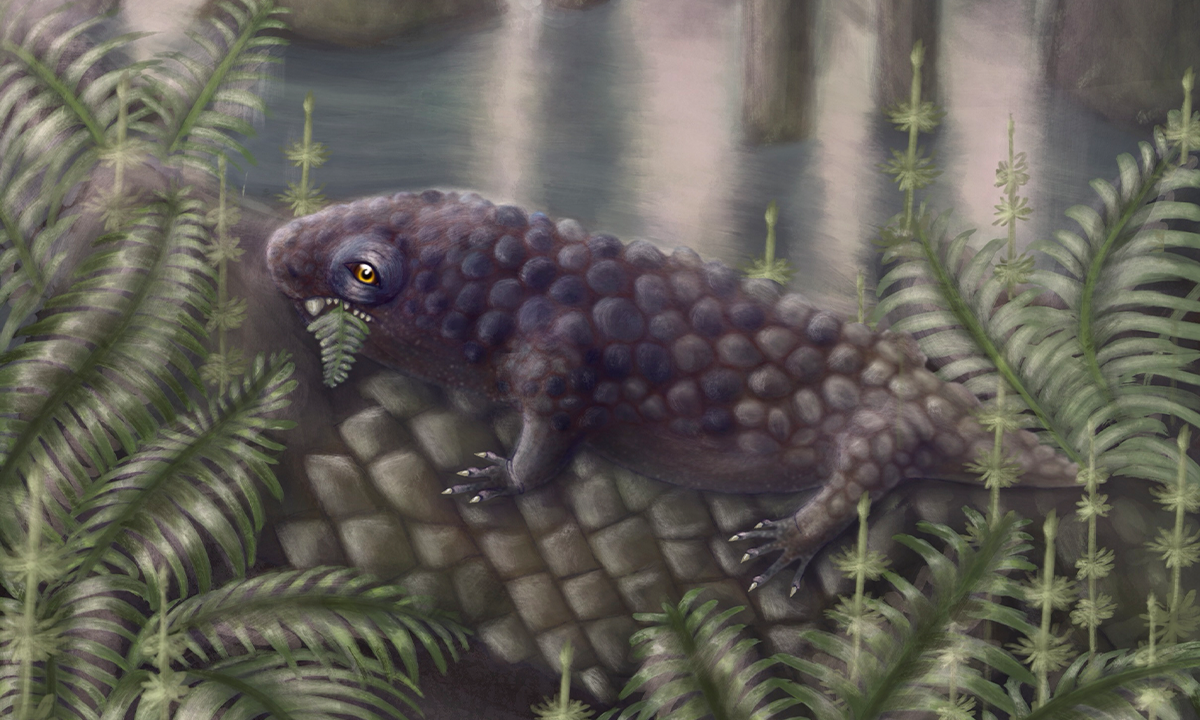
This particular species of pantylid (dubbed Tyrannoroter heberti after its discoverer) existed 307 million years ago and harbored some surprises within its tiny skull. Using a CT scan, researchers peeked inside to find an array of teeth suited to crushing and grinding plant matter, indicating herbivory evolved much earlier than previously thought.
“Tyrannoroter heberti is of great interest because it was long thought that herbivory was restricted to amniotes,” co-author Hans Sues of the Smithsonian National Museum of Natural History added. “It is a stem amniote but has a specialized dentition that could be used for processing plant fodder.”
Although only its skull was recovered, the paleontologists were able to estimate its size. “It was roughly the size and shape of an American football,” said Mann.
That might seem small, but it was probably one of the largest land animals of the time. 
Enjoying Nautilus? Subscribe to our free newsletter.
Lead image: A reconstruction of Tyrannoroter heberti, eating a fern. Illustration by Hannah Fredd.