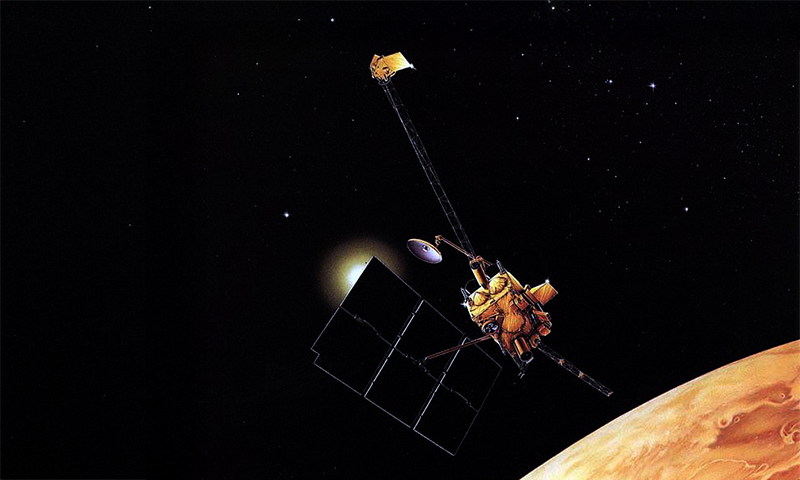
Thirty-two years ago today, on Aug. 21, 1993, NASA’s Mars Observer went eerily quiet—a few days before it was slated to enter Martian orbit. The robotic craft, depicted in this illustration, was sent to inspect the planet’s atmosphere, geology, and climate. It took off from Cape Canaveral in Florida in September 1992. But after entering a suspected fatal tailspin about three days out from Mars, it hasn’t been heard from since.
This isn’t the only tragic Martian accident: So many mishaps have transpired en route to the Red Planet, in fact, that a mythical space monster called the “Great Galactic Ghoul” has been said to gobble up Mars probes.
One major roadblock faced by Martian missions: The Red Planet is quite tricky to land on. It has a super thin atmosphere, that is less than 1 percent of the density of Earth’s, which offers little drag to slow descending spacecraft. This means that probes can barrel into the Red Planet’s surface if their parachutes and airbags are not properly designed to make use of Mars’s scant atmosphere. Things only get harder with larger vehicles, which could be needed if we eventually find ourselves ferrying colonists to Mars.
It’s also tough to phone home from Mars, which is around 140 million miles away from Earth, on average. At that distance radio signals can be delayed up to 20 minutes each way. Plus, the sun gets in the way approximately every 26 months: When our star swings between Mars and Earth it blocks radio signals and causes a two-week communication blackout.
By facing these myriad challenges over six decades of Mars missions, space agencies have learned some valuable lessons.
As for Mars Observer, a fuel leak in the propulsion system might have led to the probe’s demise, a NASA report suggested, among other potential issues. Investigators noted that the spacecraft’s hardware was initially created for near-Earth journeys, a penny-pinching measure. Ultimately, the vanished probe proved that cutting corners in space can be costly. 
Lead image: NASA/JPL