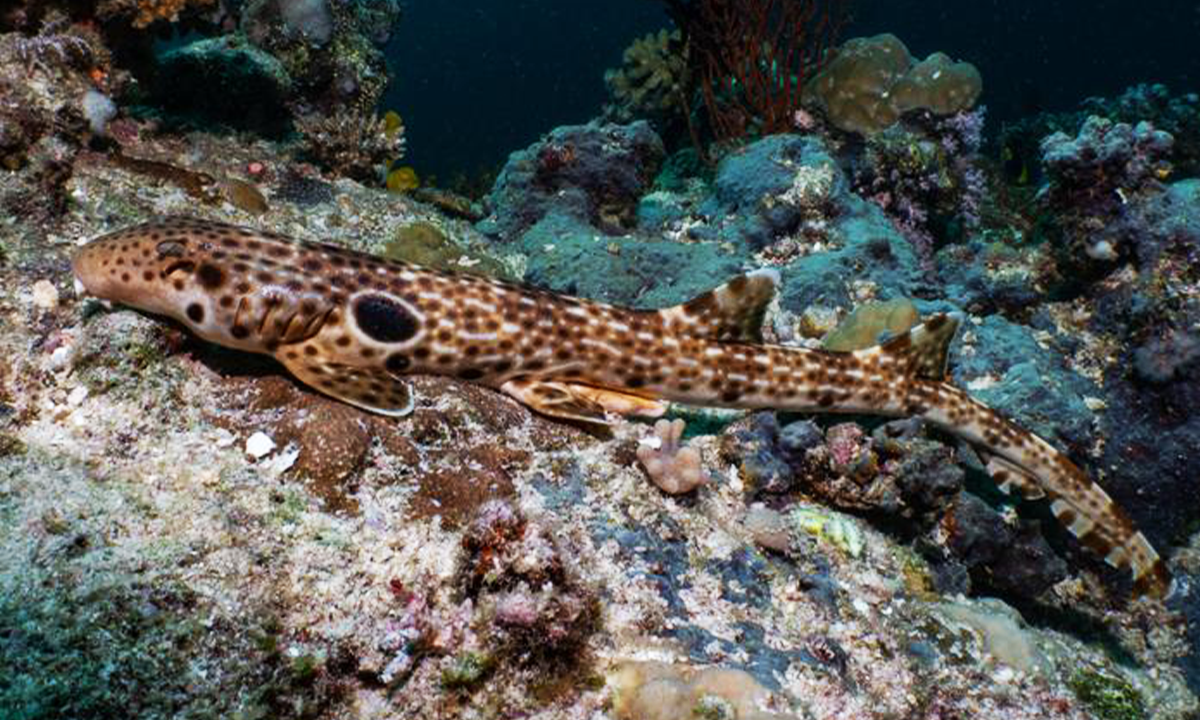
Epaulette sharks get their nickname from the snazzy dark spots behind their front fins, but that’s not the only trick up (or on) their sleeves. They can also walk on land. They use their muscular, lobed pectoral fins to stroll around coral reefs when they’re underwater, but can survive up to two hours on land ambling between tide pools as they hunt for prey. Now there’s a new species of walking shark, described for the first time in a paper published in the Journal of the Ocean Science Foundation.
Marine biologists from the University of the Sunshine Coast in Australia made the discovery while studying walking sharks in Milne Bay, located on the southeasternmost tip of Papua New Guinea. They named the species Dudgeon’s Walking Shark (Hemiscyllium dudgeonae), after the scientist who snagged the first specimen by hand. “New shark species don’t come along that often, and it’s most definitely the first one named after me,” study co-author Christine Dudgeon said in a statement.
Once they had the shark on board their vessel, they measured it (about three feet long) and drew blood for a genetic analysis that revealed it was, indeed, a new species—the first discovered since 2013. What drew the researchers’ eyes was a distinctive white dash pattern along its back. “The first thing that stood out was the white dashes along its brown body,” study co-author Jess Blakeway said. “These dashes were quite different to the leopard-like spots we were expecting.” Over the next two nights, they found 11 more members of the species.
Read more: “How to Find Baby Sharks”
Unfortunately, like many walking sharks, this new species is likely either endangered or vulnerable due to habitat degradation, fishing activity, and climate change. “We hope to collect more data on our next research trip in October to help the International Union for Conservation of Nature Red List assess the species as vulnerable or endangered with extinction,” Blakeway said.
Now, if you’re worried about walking sharks nipping your toes, you can rest easy. The small sharks don’t pose any threats to humans. In fact, the news species’ local name is kadedekedewa, which translates to “dog shark” or “lazy shark” because while it may be able to walk, it certainly can’t run. 
Enjoying Nautilus? Subscribe to our free newsletter.
Lead photo by Mark Erdmann