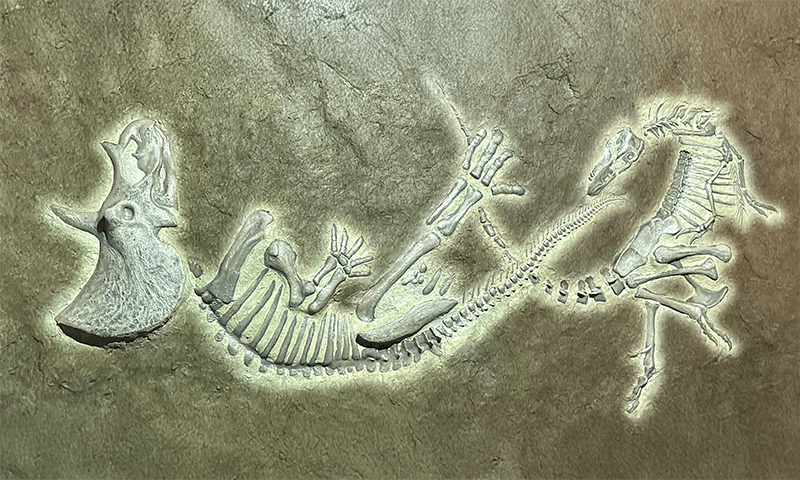
In 2006, a curious specimen was unearthed in the fossil-dense Hell Creek Formation of eastern Montana—what appeared to be a small Tyrannosaurus rex locked in battle with a Triceratops. Dubbed the “dueling dinosaurs,” these fossilized skeletons eventually landed at the North Carolina Museum of Natural History in Raleigh, North Carolina, where they would help end another battle that’s been raging in the dinosaur research community.
For years, paleontologists have debated whether the T. rex-like dinosaur in the fossilized tableau and others are indeed juvenile T. rexes or whether they belong to another species entirely. Now, according to a study by researchers at North Carolina State University and Ohio University published in Nature, they have their answer.
After analyzing growth rings within the fossilized bones, the paleontologists determined they weren’t still growing, as a teenage dino’s would be, rather they were fully developed, suggesting they belonged to an adult. Computer modeling also showed bone growth trajectories differed from the T. rex’s, and an examination of other specimens led researchers to conclude they had not just one, but two new species on their hands. The discovery marks the end of a debate the authors characterized as “acrimonious” at times.
Read more: “T. Rex Was a Slacker”
Naming their newly discovered genus Nanotyrannus, the researchers noted some key differences between the tiny terror and its more famous namesake. First, and most obvious, is the size. While an adult T. rex is roughly the length of a school bus, Nanotyrannus is closer to a pickup truck. It was also likely speedier and more agile, with longer legs and stronger arms, relative to Tyrannosaurs.
Nanotyrannus joins a variety of diminutive dinosaurs that once called North America home, including the herbivorous Aquilops americanus (seen in Jurassic World: Rebirth), the birdlike Fruitadens haagarorum, and the smallest predator discovered on the continent, Hesperonychus elizabethae, a theropod species about the size of a chicken discovered in Alberta, Canada.
The outsized mystery of the small dinosaur now seemingly solved, the researchers present it as yet another piece of evidence for dinosaurs' diversity up until close to their very end. 
Enjoying Nautilus? Subscribe to our free newsletter.
Lead image: Geekgecko / Wikimedia Commons