Have you ever wondered why lakes look so brown?
To many urban dwellers, tea-colored lakes are the norm, but venturing into the wilderness makes it clear that lakes don’t naturally become so murky. And with 40 percent of the world’s fish species living in fresh, inland waters, the browning trend is worth examining.
In a review study published in Biological Reviews, a team of researchers from Canada and the United States explored the effects of freshwater browning on fishes in northern temperate lakes. For 871 lakes in the U.S. and Canada across a gradient of browning, the researchers assessed water hue relative to resident fish populations. They focused on eight ecologically and commercially important species, looking at fish abundance, growth, and survival rates, as well as individual traits like eye diameter, mouth size, and mouth position.
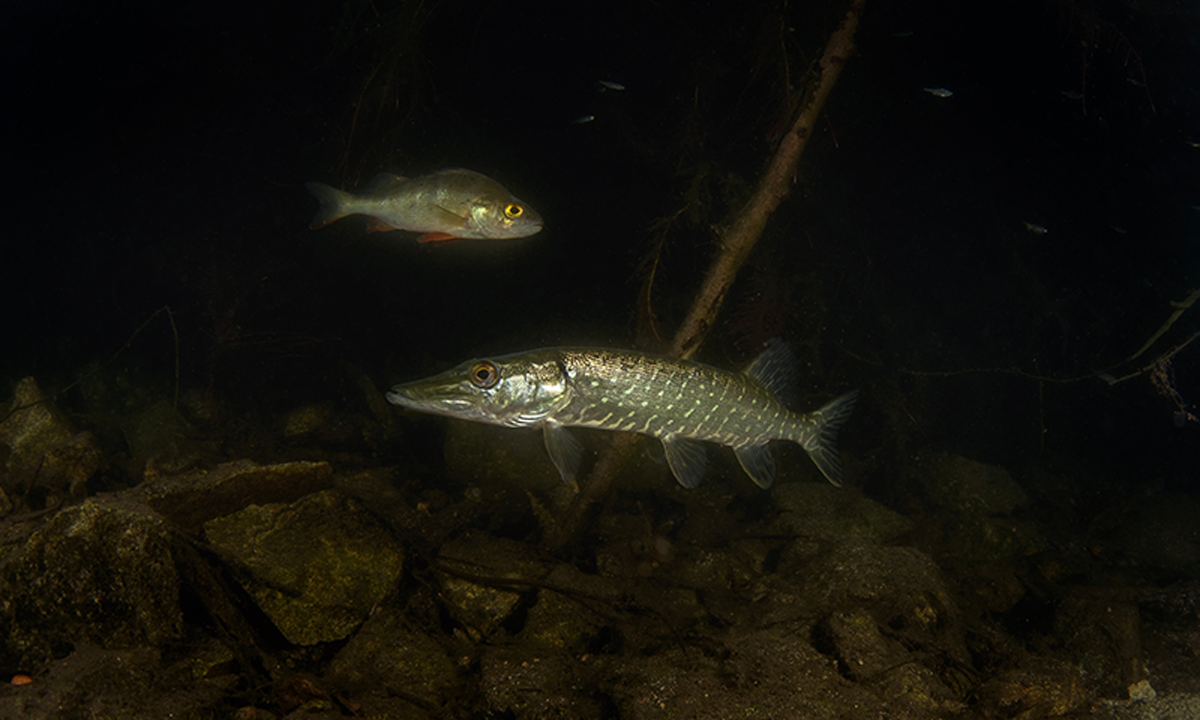
The cumulative results drawn from 59 research papers showed that more brown was generally associated with lower growth rates of fishes, although it didn’t appear to affect how well they foraged for food. For most fish species, abundance was negatively correlated with browning, but with two notable exceptions. Populations of northern pike (Esox lucius) and walleye (Sander vitreus) were more abundant in browner lakes.
Read more: “The Powerful Allure of the Deep Azure”
“Browner waters had greater abundances of northern pike and walleye, but lower abundances of lake trout, brook trout, yellow perch, largemouth- and smallmouth bass, and whitefish,” said Allison Roth, lead author and former McGill University postdoc.
A relationship also surfaced between some individual traits and browning. Species with larger eyes tended to respond better to browning, possibly because of superior vision in murky waters.
Browning is usually caused by increased concentrations of dissolved organic carbon or iron on land that enters lakes through runoff that can be augmented by land-use changes such as deforestation, farming, and roads. Because browning signifies both chemical and physical changes to the properties of fresh waters, it’s not surprising that it affects the aquatic ecosystems.
“Fish themselves affect other organisms in the lake,” explained Irene Gregory-Eaves, study co-author and McGill University biologist. “Because they’re predators, feeding on smaller fish, plankton, and invertebrates, changing their populations can have cascading effects.”
Given that lake browning stunts the growth of some fish species, affects population abundance, and shifts fish community compositions, it warrants further research. Tea-colored water isn’t inherently negative for all species, but it clearly makes a difference. 
Enjoying Nautilus? Subscribe to our free newsletter.
Lead image: Martin Prochazkacz / Shutterstock