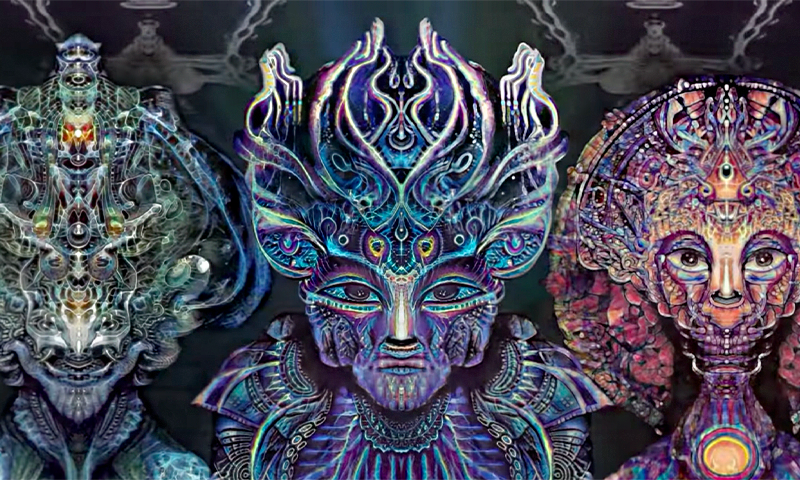
Psychonaut turned scientific researcher Josie Kins has personally tried over 200 psychedelic compounds and had hundreds of psychedelic experiences. But she no longer takes them herself. “I’ve already explored them so thoroughly,” she says. Over the past 12 years, Kins has compiled a list of 233 effects people experience under the influence of psychedelic drugs, drawn from online accounts and her own experience, called the Subjective Effect Index.
In 2021, she began working for a startup drug company called Mindstate Design Labs to make the classification system more precise and comprehensive, under the advisement of renowned psychedelic researchers Thomas Ray and Andy Newburg. That work could double the total number of entries on the list, she says. But it’s the cognitive and emotional effects that seem to elude categorization and need the most refining. “The visual effects are already rigorous,” says Kins.
Below, a selection of some of the 52 visual effects on her list.
Diffraction is the experience of seeing rainbows and spectrums of color embedded within the brighter parts of a person’s visual field. It is most commonly induced under the influence of mild dosages of psychedelic compounds, such as LSD, psilocybin, and mescaline.
Increased pareidolia is an increase in a person’s ability and tendency to recognize patterns (usually faces) within vague stimuli. It is most commonly induced under the influence of mild dosages of psychedelic compounds, such as LSD, psilocybin, and mescaline.
Machinescapes are a complex visual and tactile experience where one perceives hallucinatory mechanical landscapes that are vast in both size and intricacy. They are most commonly induced under the influence of heavy dosages of Salvia divinorum. However, they can also occur less commonly under the influence of psychedelic compounds, such as LSD, psilocybin, and 2C-P.
Object activation is the experience of looking at an object and perceiving it to move, become alive, or become fully animated and autonomous of its own accord. It is most commonly induced under the influence of heavy dosages of deliriant compounds, such as DPH, datura, and benzydamine.
Scenery slicing is the experience of a person’s visual field appearing to split into separate, cleanly cut sections. These individual slices then proceed to drift slowly away from their original position before disappearing and resetting to normal. It is most commonly induced under the influence of moderate dosages of dissociative compounds, such as ketamine, PCP, and DXM.
Texture liquidation is the experience of the texture, shape, and general structure of objects and scenery appearing progressively simplified, smudged, and stylized in such a way that one’s external environment begins to take on the aesthetic of a painting or cartoon. It is most commonly induced under the influence of moderate dosages of psychedelic compounds, such as LSD, psilocybin, and mescaline.
Unspeakable horrors describe the experience of prolonged exposure to indescribable scenarios and hallucinatory content of a scary and disturbing nature, which are often directly influenced by a person’s fears. They are most commonly induced under the influence of heavy dosages of psychedelic compounds, such as LSD, psilocybin, and 2C-P.
Visual exposure to inner mechanics of consciousness
Visual exposure to inner mechanics of consciousness is the experience of being exposed to a mass of visual geometry comprised entirely of innately readable representations which subjectively feel as if they convey the inner mechanics that compose all underlying neurological processes. 
Lead image: Josie Kins / YouTube