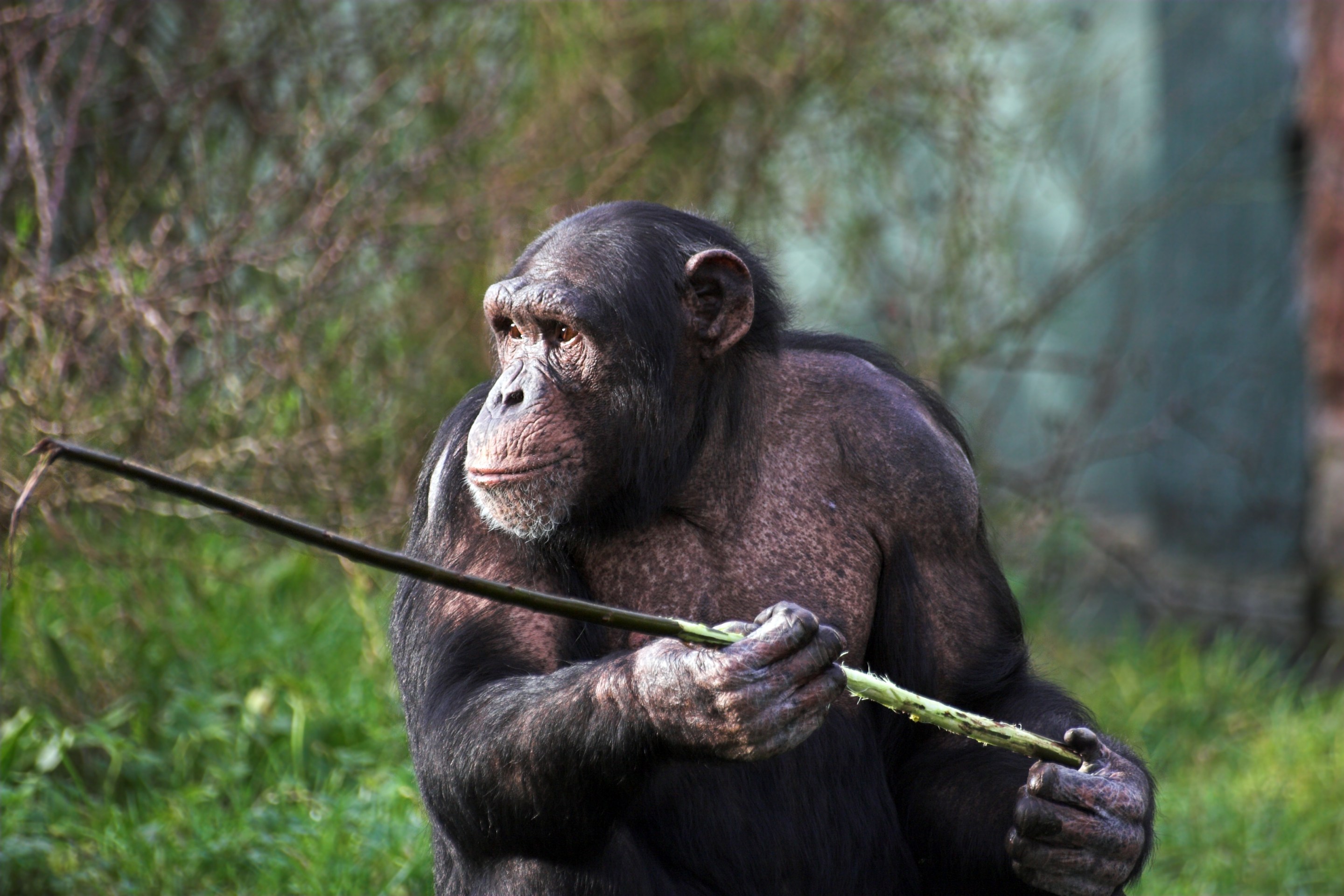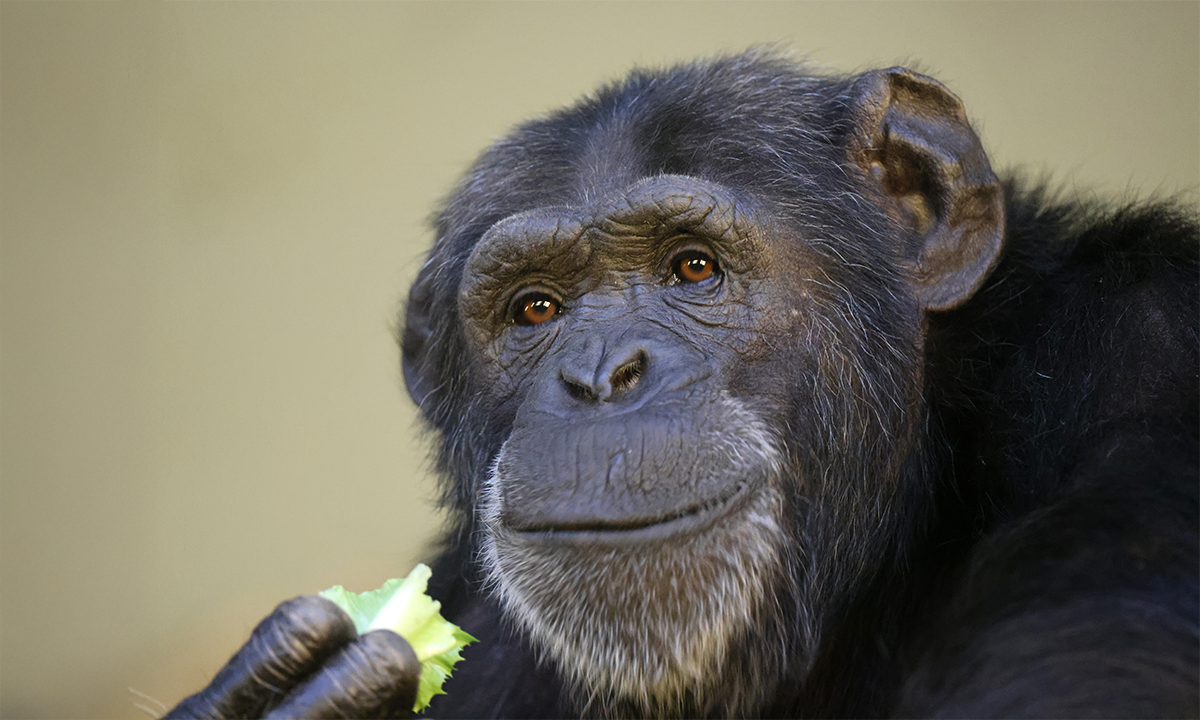
Last Friday marked the major studio release of a graphic new horror movie Primate. In the film, a chimpanzee named Ben, who has been kept as a pet by a family in Hawaii, is bitten by a rabid mongoose, after which he suddenly transforms into a slasher-like villain. Ben stalks a group of teens in the family’s cliffside home, targeting their faces, and leaving a trail of blood and gore in his wake.
It’s a new twist on an old trope: The ape as stalker has a long tradition in Hollywood going back to at least the 1980s. Films like Link, Shakma, and Congo, even the Planet of the Apes series, all frame primate violence in similar ways: relentless, personal, and on purpose.
But what do these films get wrong about apes who go ape—and what, if anything, do they get right?
For answers, I sought out Michael Wilson, a primatologist at the University of Minnesota, who has studied violence and aggression in chimps and other primates for the past 25 years. Watching films like Planet of the Apes and King Kong as a child inspired Wilson to want to study apes in the first place. But what he loved about these films was that they made the apes sympathetic characters. They were moral animals rather than rabid beasts. In fact, Wilson advised on the making of some of the more recent Planet of the Apes movies*: He provided vocalizations—and recommended they be used sparingly. “Movies always show wild animals being much noisier than they are in life,” he says.
I spoke with Wilson about how portrayals of chimps and gorillas have flip-flopped over the years, why we’re so obsessed with chimpanzee violence, and what that violence looks like in the wild versus in captivity. We also talked about the dangers of turning monkeys into monsters on film.
From your perspective, what do films get wrong when they turn chimp aggression into relentless human-style predation?
There are things that movies do with monsters, whether the monster is a chimp or a giant gorilla or something else. The monsters behave in ways that animals just don’t. You mention the relentlessness that the monster brings to it in Primate, right? I think that’s a little tedious. Real animals can be really scary, you know? Chimps have hurt and killed people in real life. They’re strong. They’re powerful. They have sharp teeth. They can do a lot of damage. But it’s not the demon-level, monster strength that gets portrayed in movies nowadays.
What does your work with chimpanzees in the wild tell us about how closely chimp violence actually mirrors human violence and aggression?
There’s a long tradition of seeing chimpanzees as the origin of war. Because chimps are unusual compared to other primates, in that they team up to defend a joint territory and will carry out these gang attacks against members of other communities. So when that was first observed in the 1970s, people immediately made the connection to human warfare and suggested that human warfare has shared roots—that we inherited this from a common ancestor. There’s been really vigorous debate about that. There are some people who just object to the idea that violence has anything to do with biology because they feel that’s a pessimistic argument that makes violence inevitable.
But it’s not just chimps that act violently. It’s pretty widespread across animal behavior. And evolutionary biology provides some explanations that make sense. Among the chimpanzees, males defend a territory that has food for themselves and their mates and their offspring. There’s lots of evidence now that the bigger the territory and the more food available, the more quickly the females reproduce and the more likely offspring will survive. So it pays in these kinds of reproductive terms for chimps to be violent.
Read more: “The Cosmopolitan Ape”
When there are more resources, does violence decline?
People have an intuition that violence is about resource scarcity and that when times get tough, you get more fighting because resources are scarce. But the chimp community with the highest rate of intergroup killing is the Ngogo community that’s in the center of this big beautiful park in Uganda: Kibale National Park. Chimps have a lot of food resources there. Instead, what seems to be happening is that when you have abundant food for everyone, you have spare energy to do other things like hunt monkeys and defend the boundary of your territory and kill the neighbors. And also, there’s something to fight over, resources worth defending.
So there’s between-community fighting, but then there’s also violence within communities that has gotten less attention because it doesn’t link up so obviously to warfare. Those instances of violence include infanticidal attacks by both males and females against baby chimpanzees and within-group killings of older males by other males.
Are the within-group killings of babies and older males carried out by lone killer chimps, or is that idea just complete make-believe?
Well, it’s not completely a fantasy. I guess the movie Primate starts with a lone rabid chimp ripping the face off of somebody. And you know, that comes from these real-life cases. There was a woman in Connecticut who kept a chimp named Travis, and one of her friends came over and Travis attacked her friend and destroyed her face. So you don’t need a rabid mongoose to bite a chimp to make them do that. They’re powerful animals, and when they get provoked or feel threatened for whatever reason, they’re capable of doing that. And that’s not the only case. There have been a number of other cases of people attacked by captive chimps, and also wild chimps.
Are certain chimps repeat offenders?
When I was doing my dissertation research in Uganda, there was a series of cases of children who were attacked and maimed and sometimes killed. One of our field assistants worked in the villages to try to find out what was going on. These killings seemed to be connected to the movements of a particular male chimpanzee who my thesis advisor, Richard Wrangham, named after Saddam Hussein. So they called the chimp Saddam. The Uganda Wildlife Authority eventually provided a rifle to one of our employees who had been a game guard in the past. And after another killing of an infant, the villagers cornered the chimp and the former game guard shot the chimp and killed him. After that, a number of years passed without any predatory attacks on children, though these attacks did resume again eventually. So it’s not just this one extraordinary individual. It’s something that chimps do. It’s kind of a consistent problem in human-animal conflict.
So whether certain chimps can have especially aggressive tendencies isn’t a settled question?
We don’t have really definitive answers about these things. In general, chimpanzees, especially males, are aggressive and they’re also predators and they’re opportunistic. But it also seems to be the case that particular individuals are more interested in pursuing those opportunities than others. So there is that variation among individuals.
What do recent movies about apes get right?
One thing you see with the new Planet of the Apes movies is that they got the message that chimps can be incredibly acrobatic when they’re hunting monkeys. And so, the newer Planet of the Apes movies have tried to show a kind of athleticism and acrobatic skill. That’s a correction from the very first Planet of the Apes movies, where they were just using people in ape suits, right?
Those early movies were made when they still thought of chimps as being basically just peaceful and intelligent. They made gorillas the bad guys. They were the military thugs, and the chimps were intelligent and clever, acting as protesters against the war. They were considered the hippies of the apes. But the [new] filmmakers got the message that chimps are powerful and can be fast and acrobatic and athletic and dangerous and scary.
But they don’t really get the fact that animals in the wild spend a lot of time doing really boring things: looking for food and eating food. Killing each other and beating each other up doesn’t happen very often.
When did the narrative flip-flop about gorillas versus chimps being the good guys?
Gorillas are big, powerful animals, and they look really impressive. They do these charge displays and beat their chests and all of that. They can hurt people, and they can hurt each other. But when people like George Schaller and Dian Fossey started studying gorillas, in the late ’50s and ’60s, they really emphasized that gorillas were gentle giants. They spend most of their time stuffing their faces, eating and digesting. And they don’t move very fast. And they don’t hunt people.
Why do you think we have this urge to turn primates into either heroes or villains, gods or monsters?
There’s this recognition that people can be monstrous and violent. People can be predators. So we’re interested in conflict. And when you look at apes, one of the really striking things about them is that they look so much like us, but they also are clearly animals. They’re covered in hair. They don’t have language. They’re brutes. So they vividly represent the wild monster within. As you know, the scientific name of chimpanzees is Pan troglodytes, and Pan is, of course, the Greek God of the wild, the untamed spirit of nature. And they embody that: They’re lusty, uncontrolled. They’re animals, and yet, they look like people and they do all these clever things.
There are a few films now in which apes raised by humans end up being extra dangerous: Link and Congo, Jordan Peele’s Nope from 2022, and now Primate. Do we know how human upbringing affects chimp behavior over the long term?
It’s kind of amazing to me, when you think about it, that in all the years that we’ve spent as researchers in the wild with chimps, I don’t know of any cases of a researcher really being seriously injured by a chimp. It’s mainly the captive chimps—who have been reared by people, sanctuary chimps—that have mauled and injured and killed people.
The sample sizes are so small. No one’s really systematically studied this. So it’s really just speculation. But one speculation that I have is that in captivity, they know more about how weak we are compared to them. Because they’ve interacted directly with us. Also, when chimps grow up in captivity, they get quite a bit bigger because they have access to so much food. Travis was maybe over 200 pounds. Very little of that was body fat, because they don’t store fat nearly as efficiently as we do. So it’s a lot of muscle.
What is the danger in films that turn chimps into monsters—either for the chimps or for humans?
This was something that Jane Goodall was concerned about: If chimpanzees are depicted as monsters all the time, who’s going to try to save them. And they’re endangered. People pose much greater danger to chimpanzees than chimpanzees do to people. People hunt them for food in much of Africa. And we destroy their habitats. We harm chimps in many, many ways. Like many animals, they’re at risk of becoming extinct. If people think of wild animals as threatening monsters, then the response is, “Well, we need to kill them to save ourselves.” Whereas the facts are that most wild animals leave us alone unless we bother them. 
Enjoying Nautilus? Subscribe to our free newsletter.
Lead image: Edwin Butter / Shutterstock
*An earlier version of this article incorrectly stated that Michael Wilson advised on the making of the most recent Planet of the Apes movie. In fact, he advised on War for the Planet of the Apes (2017) and Dawn of the Planet of the Apes (2014). This has been corrected in the article above.