We’re all hurtling through space right now. Despite sedentary appearances, all of us Earthlings along with our entire solar system are orbiting around the black hole at the heart of the Milky Way at about 514,000 miles per hour. And the galaxy itself (if you subtract that rotational speed of the sun around the center) is traveling at about 1.4 million mph outward, riding the still-breaking waves of the Big Bang.
Although we’re not frequently confronted with tangible evidence of this astounding degree of motion, every so often, astronomers deliver us an image that reminds us of our cosmically peripatetic nature.
This week is such a week.
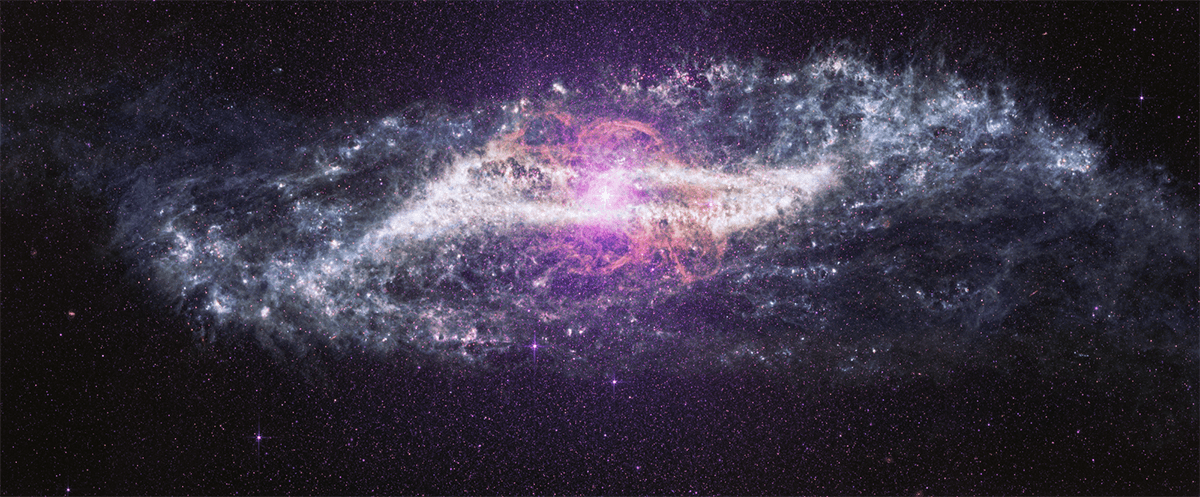
Researchers using the James Webb Space Telescope have shared an image of a galaxy called Centaurus A, which lies about 11 million light-years away from Earth, in unprecedented detail. With its ability to cut through obscuring clouds of space dust with sensitivity to a range of infrared wavelengths, the telescope imaged the center of the galaxy and its dense and fluid tangle of stars.
Unmistakably, even to the casual observer, Centaurus A bears the wounds of a collision with another galaxy that happened a mere 2 billion years ago, as oxygen was flooding the Earth, paving the way for complex life to flourish.
Previous images of Centaurus A, captured by the Hubble Space Telescope and the now-retired Spitzer Space Telescope could not reveal the detail that the Webb has laid bare. “No single telescope tells the whole story,” said NASA astrophysicist Shawn Domagal-Goldman in a statement. “Discoveries build over time and new observatories expand on the foundations laid by earlier missions. Webb represents the most powerful step forward yet, opening a window into wavelengths and details never before accessible. This allows astronomers to examine structures and processes that other telescopes could not see.”
Read more: “Why Galactic Collisions Are So Beautiful”
The new Centaurus A image allows astronomers to interrogate both the evolution of the galaxy and the dynamics of the black hole at its heart, star-by-star. But it also might provide a glimpse of what our own galaxy’s future holds.
The Milky Way may be on a collision course with our neighboring galaxy, Andromeda, about 2.5 million light-years away. Estimates vary, but in 2012 NASA reckoned that this cosmic merger would happen 4 to 6 billion years from now. More recent work, however, casts doubt on the certainty that the two galaxies will clash, eventually forming a single, elliptical galaxy. Last year a team of European researchers used data from the Gaia and Hubble telescopes to calculate that, due to the gravitational forces of other galaxies in our cosmic neighborhood, there is more like a 50/50 chance of a Milky Way/Andromeda collision sometime in the next 10 billion years.
Whatever the chances, it pays to remember that we are in fact zooming through the universe, whether we can feel it or not. Buckle up, Earthlings. It might be a bumpy ride. 
Enjoying Nautilus? Subscribe to our free newsletter.
Lead image: Credit: NASA, ESA, CSA, STScI; Image Processing: Alyssa Pagan (STScI), Joseph DePasquale (STScI), Macarena Garcia Marin (ESA Office at STScI.