Neil Shubin has been going backward his whole life. “I teach anatomy but I want to understand why things look the way they do,” says the paleontologist and professor of organismal biology and anatomy at the University of Chicago. “And to understand the fundamental questions you have to go ever deeper into history. So I have gone backward from humans to fish to planets.”
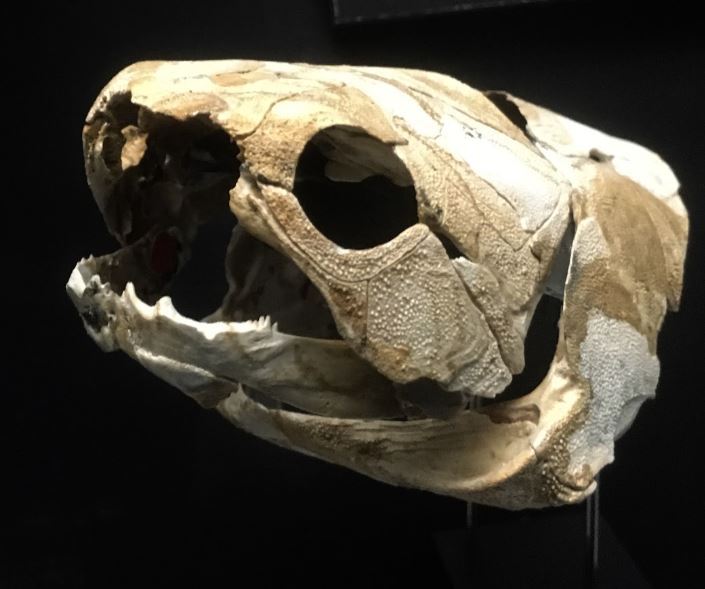
Shubin, 53, is referring to his two books, Your Inner Fish and The Universe Within, which detail the atoms and molecules, genes and cells, sculpted by evolution into the common bonds of life. In 2004, on Ellesmere Island in the Arctic, Shubin discovered one of the key links in animal evolution, the fish known as Tiktaalik, that, he writes, “was specialized for a rather extraordinary function: it was capable of doing push-ups.”
Shubin and his team learned from Tiktaalik fossils that the big fish with the flat head had a shoulder, elbow, and wrist composed of the same bones in a human’s upper arm, forearm, and wrist. Tiktaalik used those bones to navigate shallow streams and ponds “and even to flop around on the mudflats along the banks.” Here was the creature from the lagoon that revealed how animals evolved from fish to us.
Nautilus called on Shubin to discuss the three themes—Mergers & Acquisitions, Feedback, and Light—that make up the Summer 2014 Nautilus Quarterly, in which Shubin is featured. Who would be better, we thought, to discuss themes about the interrelationships of life than a scientist who has spent his career illuminating them? In our interview, which took place in the fossil-stuffed paleontology room of his lab at the University of Chicago, Shubin was as personable and insightful as he is in his books.
Each video question plays at the top of the screen.
View Video
What’s the first thing that comes to mind when you think of mergers in nature?
What comes to mind when you think of acquisitions in nature?
What’s the oldest biological merger?
You study how life forms evolved. Do you ever wonder why they did?
What is Tiktaalik?
Why did fish emerge on land?
What was the hardest thing about finding Tiktaalik?
What kept you going after research expeditions where you didn’t find what you were looking for?
What’s the most amazing part of the human body?
How does understanding fish help us understand human anatomy?
When you stand back from your work, what do you see?
As a scientist, what comes to mind when you think of light?
Where have you seen the most remarkable light?
What comes to mind when you consider feedback in nature?
Give us a great example of feedback and transformation.
What has the study of evolution taught you about yourself?