At a glance, the inner workings of mammalian anatomy can appear a little chaotic. We’ve got intertwining blood vessels, nerves fanning out haphazardly, and a series of “design flaws” that would perplex any engineer. Our sensory systems, on the other hand, are extremely well organized.
The spiral shaped cochlea in the inner ear, for example, detects specific frequencies at specific locations along its length, and the neural regions responsible for processing those frequencies are spatially arranged in the same way. Basically, two adjacent tones get detected by two adjacent parts of the cochlea, which will then be processed by two adjacent parts of the brain.
All sensory systems seem to follow similarly organized topographical maps—except for smell. Unlike wavelengths of light or frequencies of sound waves, our sense of smell depends on the shape of odor molecules, which fit in different smell receptors. These smell receptors were thought to be randomly scattered in nasal tissue—until now. According to research published today in the journal Cell, neuroscientists have finally created the first-ever “smell map” in mice.
Read more: “The Doctor Will Sniff You Now”
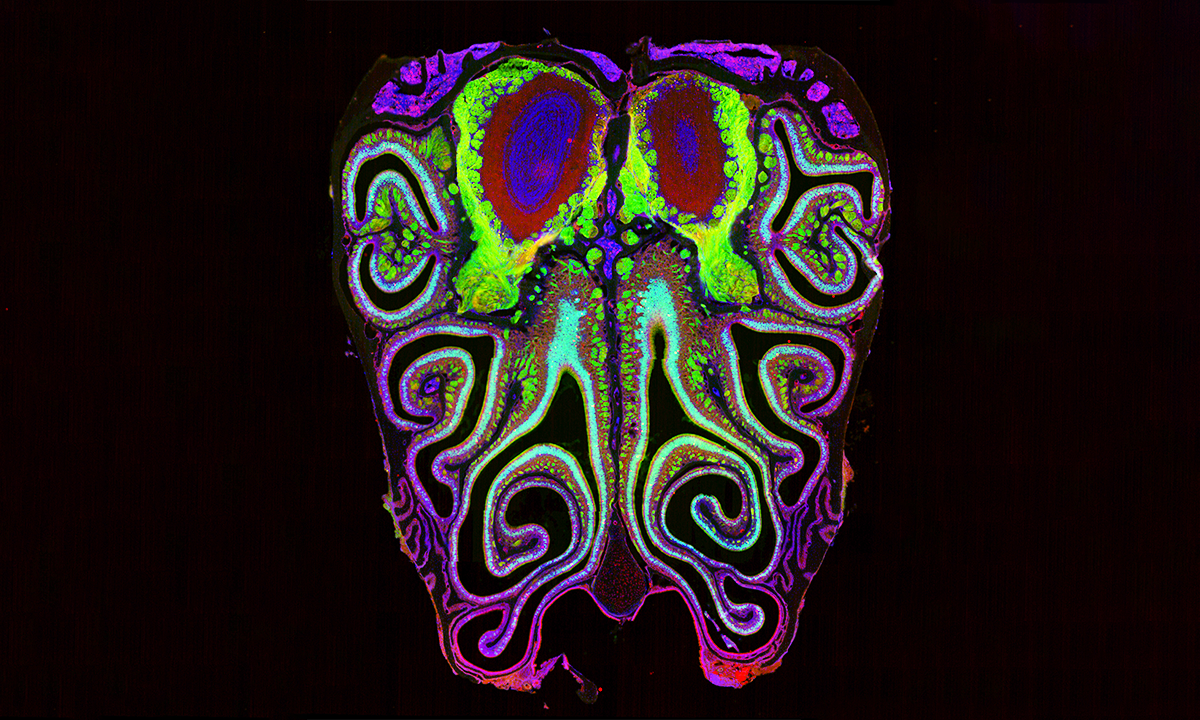
The researchers developed their map by sequencing individual nasal neurons to find out which smell receptors they expressed and then determined where these receptors were expressed. Altogether, they gleaned data from around 5.5 million neurons in more than 300 mice. “This is now arguably the most sequenced neural tissue ever, but we needed that scale of data in order to understand the system,” study author Sandeep Datta of Harvard University said in a statement.
They found that, like other sensory neurons, smell neurons were highly organized into a pattern—horizontal stripes from the top of the nose to the bottom, depending on their receptors—and they lined up with the sensory map in the olfactory bulb of the brain. “Our results bring order to a system that was previously thought to lack order, which changes conceptually how we think this works,” Datta said.
The research team is now moving on to investigate whether odor receptors in humans show the same patterns. If so, it could lead to better treatments for those who’ve lost their sense of smell, a condition that’s linked to depression. “Smell has a really profound and pervasive effect on human health, so restoring it is not just for pleasure and safety but also for psychological well-being,” Datta explained. “Without understanding this map, we’re doomed to fail in developing new treatments.”
The data is out there, we just need to follow our nose. 
Enjoying Nautilus? Subscribe to our free newsletter.
Lead image: Datta Lab