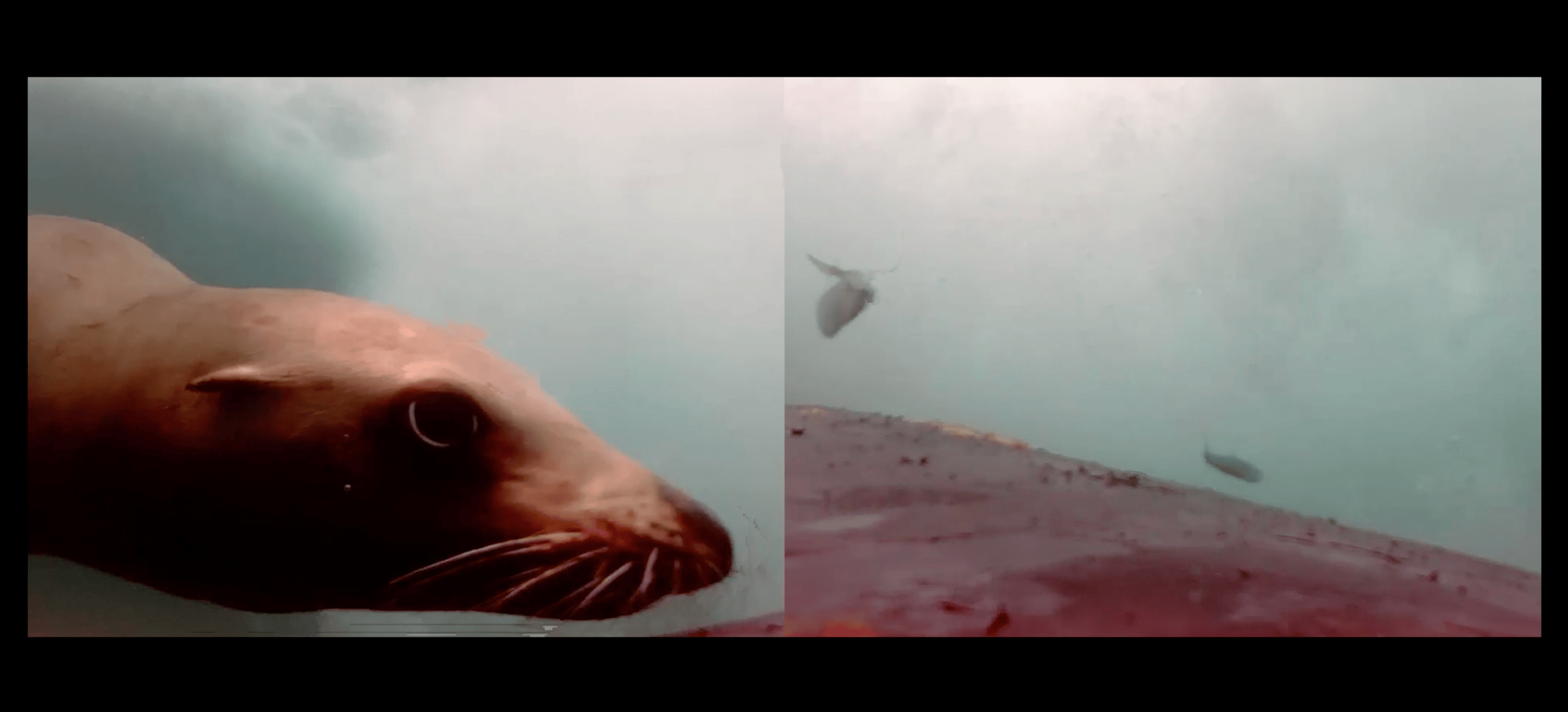
Many mammals have whiskers that help them feel out their environments. The sensory experience may include subtle detection of vibrations, such as how elephant trunk whiskers pick up mechanical signals as they brush up against other objects. Aquatic mammals may sport whiskers as well, even though they’re encountering a much more liquid environment.
In particular, seals have extraordinary abilities to find prey in total darkness. Using their ultra-sensitive whiskers, they’re known to track the hydrodynamic trails left behind as fish and other potential bits of seafood swim by. The bases of their whiskers boast huge concentrations of nerves—more than 10 times what you’d find in the whiskers of a terrestrial animal. As seals hunt prey, they’ve been observed twitching their whiskers forward and back in a “whisking” motion, the function of which has been a mystery that engineering and technology researchers from the University of Groningen in the Netherlands set out to solve in a recent study.
Read more: “What Oceanographers Can Learn From Their Animal Colleagues”
Using soft actuators to mimic the performance of the muscles at the base of seal whiskers, the researchers moved a real seal whisker forward and back in a flowing medium. Specifically, the researchers modeled the whisker whisking of harbor seals, and according to Ph.D. student Chinmay Gupta and other study authors, they achieved an angle of 17 percent with water moving at 0.5 meters per second, which is a typical seal swimming speed.
The results found that when the seal whiskers were pushed forward, they became more sensitive to hydrodynamic vibrations; this, however, required energy use by the “muscles.” When the whiskers were drawn back, they became less sensitive to water vibrations but gave the muscles a chance to relax and recover. Essentially, the forward-and-back whisking movements are balancing a trade-off between sensory detection of prey trails and energy expenditure.
Furthermore, when the researchers constructed a bionic seal nose featuring 60 harbor seal whiskers, the muzzle achieved rhythmic whisking and dynamic changes in whisker angle, which could motivate new robot designs for underwater sensing. For example, imagine a remotely operated vehicle with sensitive whiskers attached to it to help direct it in the utter darkness of the deepest parts of the ocean—or cloudiest depths of a lake.
All thanks, of course, to the simple twitch of a harbor seal’s whiskers. 
Enjoying Nautilus? Subscribe to our free newsletter.
Lead image: TashaBubo / Adobe Stock