Due to its unique volcanic activity, Yellowstone National Park is home to a number of impressive geysers. There’s the world’s tallest active geyser, Steamboat, with a fountain capable of reaching a towering height of 1,600 feet. There’s also the famous and highly predictable Old Faithful, erupting on average every 90 minutes. Then there’s the lesser known Echinus, the world’s largest acid geyser. While it tends to slumber for years, Echinus recently awoke, erupting in February for the first time in six years.
According to the United States Geological Survey, Echinus erupted regularly during the 1970s at 40- to 80-minute intervals before reaching peak activity in the 1990s when it spewed 40- to 60-foot tall fountains that lasted for 90 minutes. During the 2000s, things started settling down, although it still experiences intermittent periods of activity, like this current one.
Geysers are rare phenomena to start with, but acid geysers are even rarer. That’s because acidic water tends to eat away at the rocky “pipes” that build up the pressure necessary to produce the geyser’s fountain. Echinus, on the other hand, is unique. Its acid comes from gas that mixes with the water, protecting the plumbing while creating an acidic spray.
Read more: “The Dark Side of Wolf Reintroduction in Yellowstone”
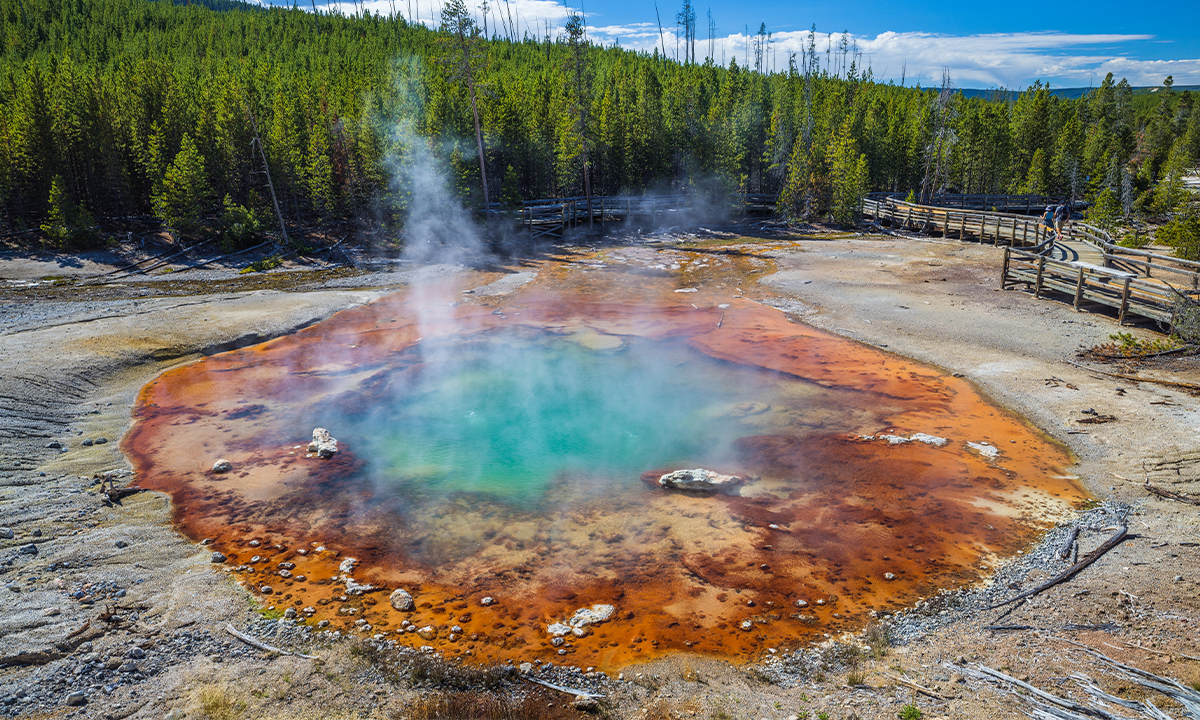
Characterized by deposits of iron, aluminum, and arsenic, the unique chemistry of Echinus’ waters also creates the red color tinting its 66-foot-wide pool, as well as the spiny, silica-covered rocks that surround it. In fact, the geyser was named for these prickly rocks: “Echinus” comes from the sea urchin class Echinoidea.
While Echinus is categorized as an acid geyser, the spray isn’t concentrated enough to burn your skin—the fountain’s water is only as acidic as vinegar. However, it still reaches temperatures approaching 160 degrees Fahrenheit, so if you’re there to witness its breathtaking display, you’ll still want to keep a safe distance.
It’s easy to forget our country is home to some of the most majestic geysers on the planet, but Echinus seems like it’s trying to remind us. 
Enjoying Nautilus? Subscribe to our free newsletter.
Lead image: Leo Kohout / Shutterstock