For decades, “My very excited mother just served us nine pizzas” functioned as a handy mnemonic for anyone trying to remember the order of the planets. That is, until Pluto was unceremoniously demoted to a mere trans-Neptunian object (TNO) in the early aughts. (The new mnemonic, for those curious, is “My very excited mother just served us nachos.”)
Pluto was unique among these outer bodies orbiting the sun beyond Neptune in that it was the only one with a thin atmosphere—or so we thought. New research published in Nature Astronomy reveals there’s yet another trans-Neptunion object with an atmosphere, and it’s puzzling astronomers.
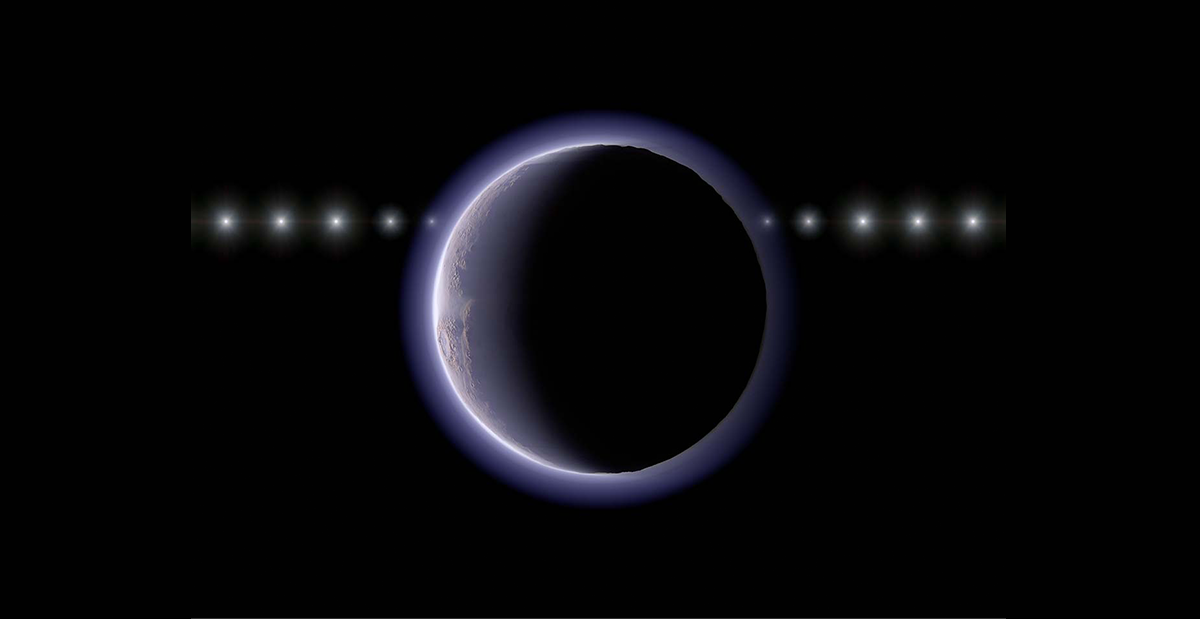
A team of professional and amateur Japanese astronomers monitoring the TNO, known as 2002 XV93, noticed something peculiar. When it passed in front of a star, the star’s light gradually faded during the transit instead of blinking out—key evidence of an atmosphere.
Read more: “The Farm Boy Who Found Pluto”
The weird thing is that 2002 XV93 shouldn’t have an atmosphere at all. At only around 300 miles across—one-fifth the size of Pluto—it’s too small to hold on to one. And that’s not the only strange thing about this cosmic oddity. Observations from the James Webb Space Telescope found no frozen gas deposits on the surface, leaving the team scratching their heads about where the atmosphere came from in the first place. It’s possible it was produced through some kind of volcanic activity pushing frigid gas up to the surface. Another alternative is that it was created by a run-in with a comet that brought gases with it.
Wherever it came from, it’s not going to last for long. The researchers estimate that what little atmosphere is present on 2002 XV93 will to dissipate into space in around 1,000 years.
In space, nothing lasts forever—whether it’s a thin layer of gas on a distant frozen rock, or the status of our erstwhile ninth planet. 
Enjoying Nautilus? Subscribe to our free newsletter.
Lead image: NAOJ