If you spot a mushroom on a hike, there’s a decent chance it’s from an unknown species. The bulk of most fungi exists unseen as vast networks of tiny threadlike mycelia, only popping their fruiting bodies up to spread their spores. In fact, of the estimated 2-6 million species of fungi on Earth, we’ve only identified around 200,000 of them, a tiny fraction. Now there’s one more to add to the list, and it’s a big one.
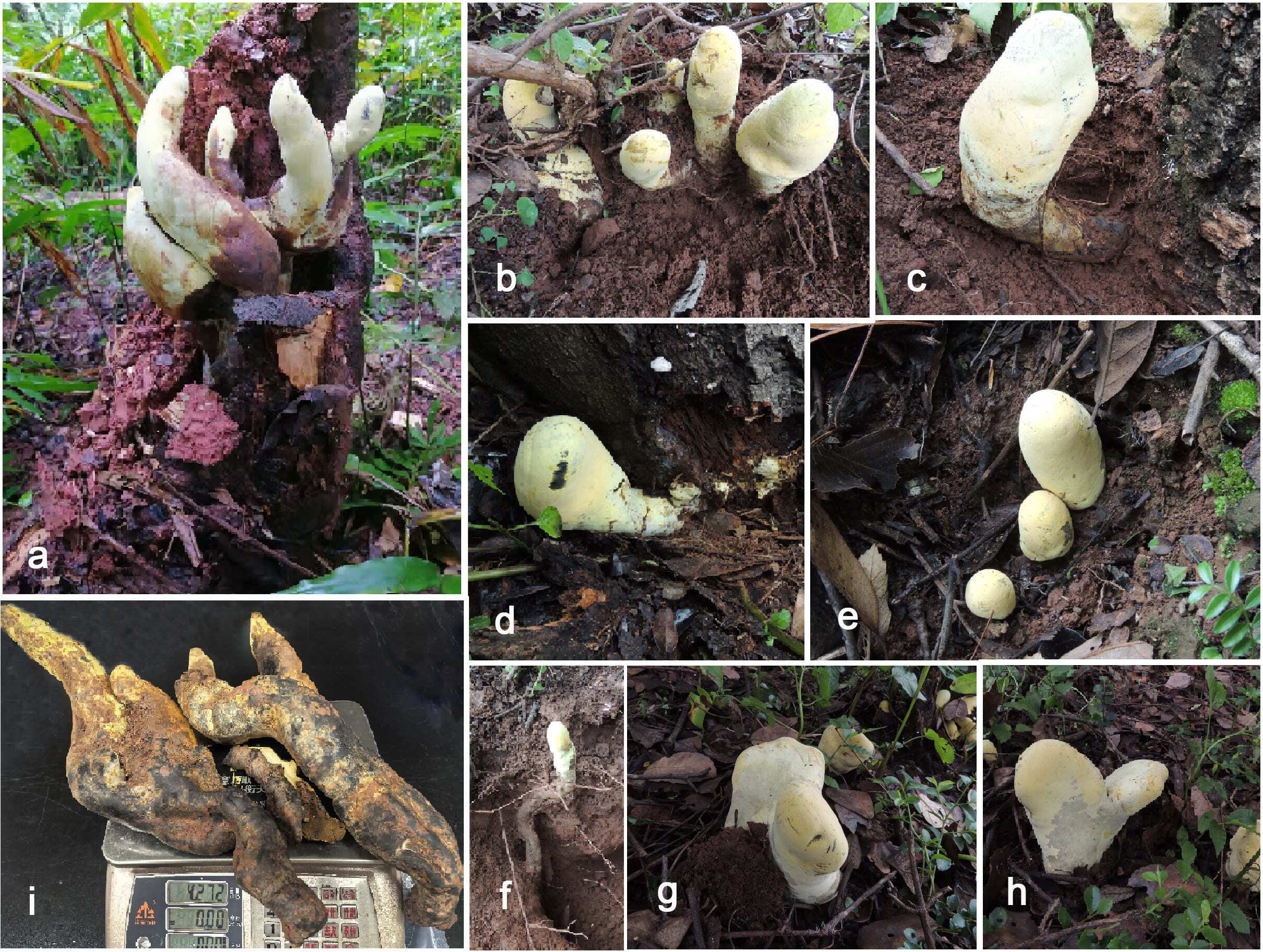
A team of Chinese mycologists discovered the species after noticing sizable, whitish fruiting bodies near the roots of Chinese cork oak trees located in both subtropical and temperate forests. They appeared to belong to the largest phylum of fungi, ascomycota, which release their spores from sacs rather than producing mushrooms.
Read more: “Mushrooms Stole a Trick From Bacteria. It Could Help Us Control the Weather”
After collecting samples of the fruiting bodies and hauling them back to the lab, the team cultured their spores, performed genetic analyses, and published their findings in Frontiers in Fungal Biology. It turns out the fungus wasn’t just a new species (which they called Dianjunus rex in a nod to its king-sized stature), it was unique enough to merit its own new family: dianjunaceae. They determined the family was part of the order xylariales, an ascomycete capable of producing enzymes that break down lignin, the organic polymer that gives wood its sturdy structure.
Comparing D. rex’s genome sequence to other fungal species, the team traced its origins to around 65 million years ago. As dinosaur fans will recall, this was a pretty auspicious time period, and it seems that as T. rex fell, D. rex rose. “This timing raises an intriguing possibility,” study author Indunil C. Senanayake of the Kunming Institute of Botany explained in a statement. “After the mass extinction, forests experienced dramatic changes, including the sudden availability of large amounts of dead plant material. For wood-associated decomposing fungi, such environmental disruption may have created new ecological opportunities.”
According to the team, massive fruiting bodies may have given D. rex an advantage amid the ensuing fungal smorgasbord. “A fruiting body which towers above surrounding vegetation and debris could have better dispersal of spores by wind in dense forests,” Senanayake said. “However, such a large structure requires substantial energy investment, suggesting that this strategy likely evolved only where the ecological benefits outweighed the costs.”
If scientists are only discovering a fungus with giant fruiting bodies now, imagine how many more species are left out there to find. 
Enjoying Nautilus? Subscribe to our free newsletter.
Lead Image: Song, Yan, Pérez-Moreno, Zhang, Yang, Xie, Su, Liu, Wang, Liu, Yang, Yang, Liu, Shi, Wan, Cheewangkoon, Dai, Senanayake and Yu