When most people hear the word “fungus” they picture a mushroom, which is understandable. After all, these reproductive organs are the most visible parts of fungi, but the vast majority of their “bodies” are underground in the form of microscopic mycelial threads. Thinner than a human hair, these spindly fibers can grow rapidly, sprawling out over miles in some cases. They even form a kind of communication network for fungi to “talk” to each other.
But what are they saying exactly?
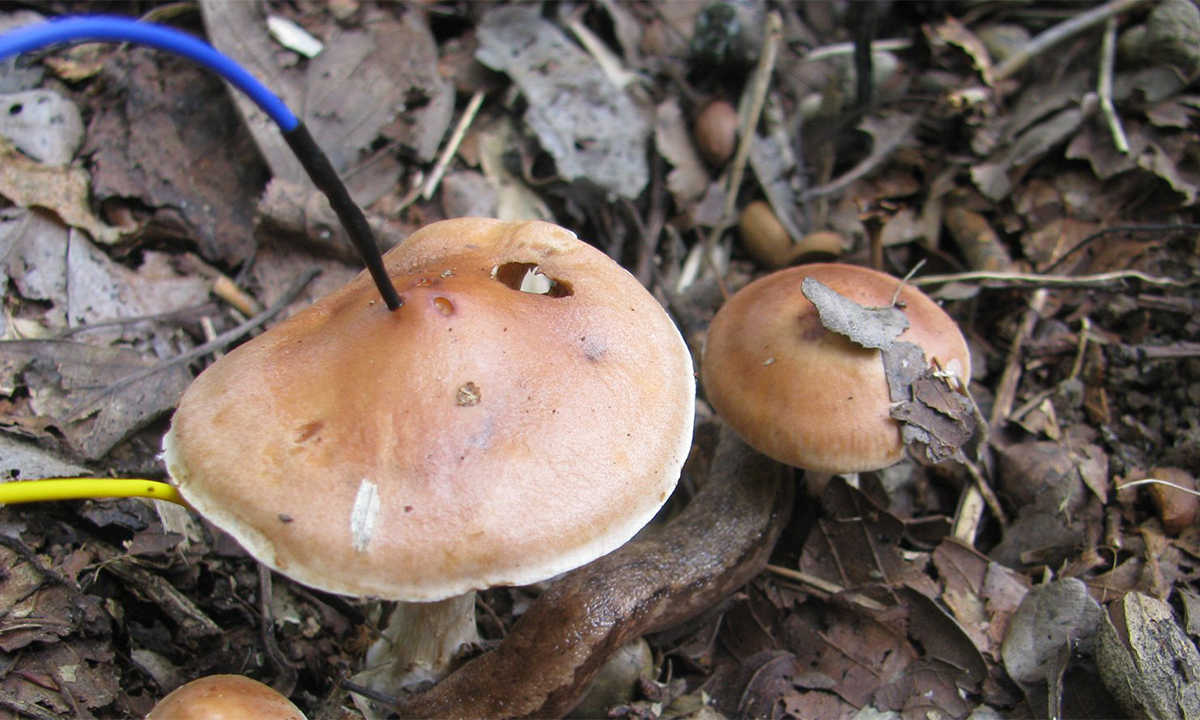
To find out, Yu Fukasawa of Tohoku University led a team into the woods near Kami town in Japan. There, they placed electrodes in 37 mushrooms belonging to different species of the genus Hebeloma, common fungi that form symbiotic relationships with tree roots.
To get the fungi conversing, the team sprinkled tap water around the base of their fruiting bodies. They then sprinkled urine (yes, urine). Why urine? It’s because these particular fungi are drawn to alkali soil and love to sprout fruiting bodies in the presence of ammonia, which the urea in urine breaks down into. (If you’re curious about the scientific process of obtaining urine, the paper has an answer: “The urine was collected from one of the authors.”)
Read more: “Never Underestimate the Intelligence of Trees”
After three days spent perturbing the mushrooms with the two liquids and measuring their electrical signals, the team got some interesting results. Applying water to the base of a single mushroom seemed to boost communication, while applying water in a widespread area didn’t lead to increased fungal chatter.
As for why this is the case, the researchers hypothesize that it’s more useful for fungi to communicate a localized hydration incident compared to a widespread hydration event, which would be kind of like saying “How about this weather?” during a rainstorm.
“It’s fascinating to think about why the mushrooms communicate the way they do," Fukasawa said in a statement. “For example, applying water to all the mushrooms may mean that there's no need to share information since the whole network already knows what’s going on, which could be why the flow of information decreased in this situation.”
But what about the urine?
Dousing mushrooms with pee didn’t lead to a lot of activity in the mycelial network. While researchers aren’t completely sure why, they have a guess. It takes urine about five days to break down into ammonia in temperatures under 68 degrees Fahrenheit, and the team only spent three days studying its effects in considerably chillier temperatures. To fully understand the effects of urine on the mycelial network, they may need a longer study period.
For now, you can rest easy knowing that if you have to relieve yourself on a hike, you’ll be able to beat a hasty retreat before the fungi start gossipping about it. 
Enjoying Nautilus? Subscribe to our free newsletter.
Lead image: ©Yu Fukasawa et al.