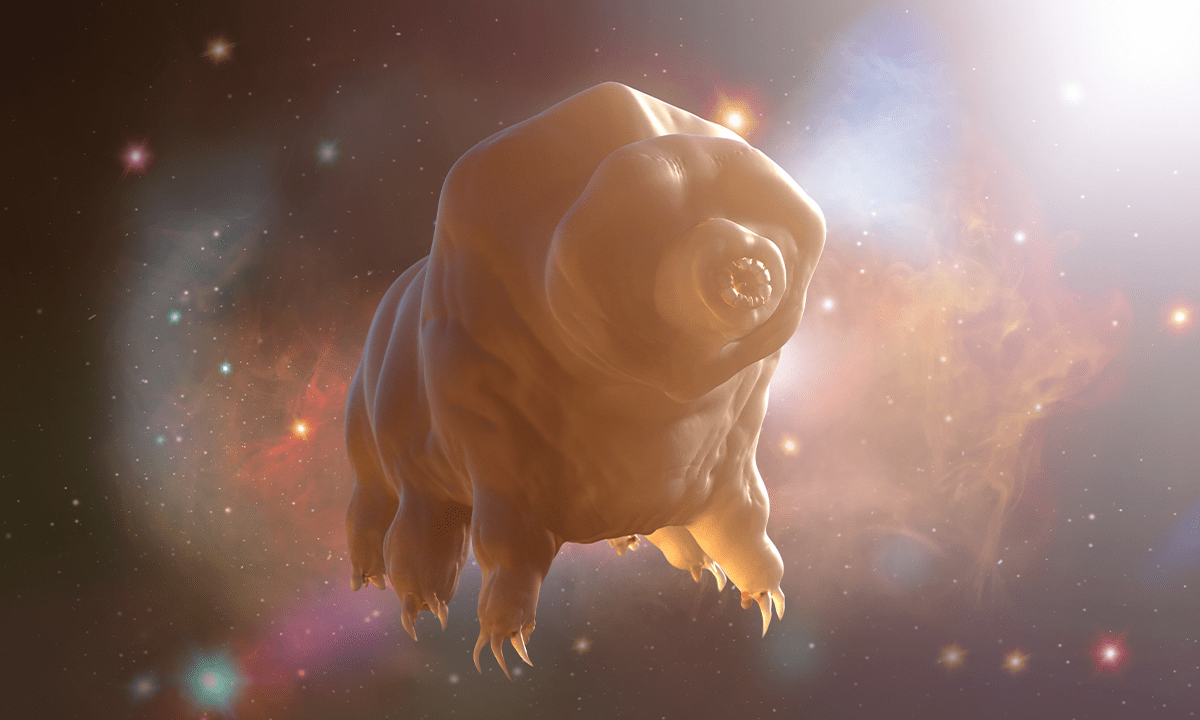
Tardigrades are sturdy little things. More commonly known as water bears, these eight-legged, multicellular, microscopic organisms have the ability to dehydrate, shrivel up, and reanimate when they encounter water again. They’ve been found deep in the ocean, in near-freezing conditions in the arctic, and can even survive in the vacuum of space. But what about Mars? New research published in the International Journal of Astrobiology shows the red planet might pose some challenges for the little critters.
To study how water bears might fare on Mars, microbiologist Corien Bakermans of Penn State University and her team mixed them with two kinds of simulated Martian soil or regolith. Both types were created to mimic samples taken from the Curiosity Rover, with one (MGS-1) serving as a general stand-in for regolith on the red planet and another (OUCM-1) more closely matching the sampling site. They didn’t really thrive in either environment, but there were still key differences.
Read more: “The Water Bear—from First Look to Facebook”
“For the MGS-1 simulant, we saw significant inhibition—reduced activity—within two days,” Bakermans said in a statement. “It was very damaging compared to OUCM-1, which was still inhibitory but much less so.”
Theorizing that there might be something in MGS-1 regolith that could be washed away with water, they rinsed the regolith sample and reintroduced the tardigrades. These water bears showed almost no reduced activity, trundling around under the microscope on their eight stubby legs.
“It seems that there’s something very damaging in MGS-1 that can dissolve in water—maybe salts or some other compound,” Bakermans explained. “That was unexpected, but it’s good in a sense, because it means that the regolith’s defense mechanism could stop contaminants. At the same time, it can be washed to help support plant growth or prevent damage to humans who come in contact with it.”
Preventing the unintended contamination of extraterrestrial bodies is a key concern for space explorers, and these findings suggest the regolith on Mars is resilient—at least to tardigrade infestation. One day, water bears may colonize Mars, along with humans, but not until we’re ready. 
Enjoying Nautilus? Subscribe to our free newsletter.
Lead image: Denis---S / Shutterstock