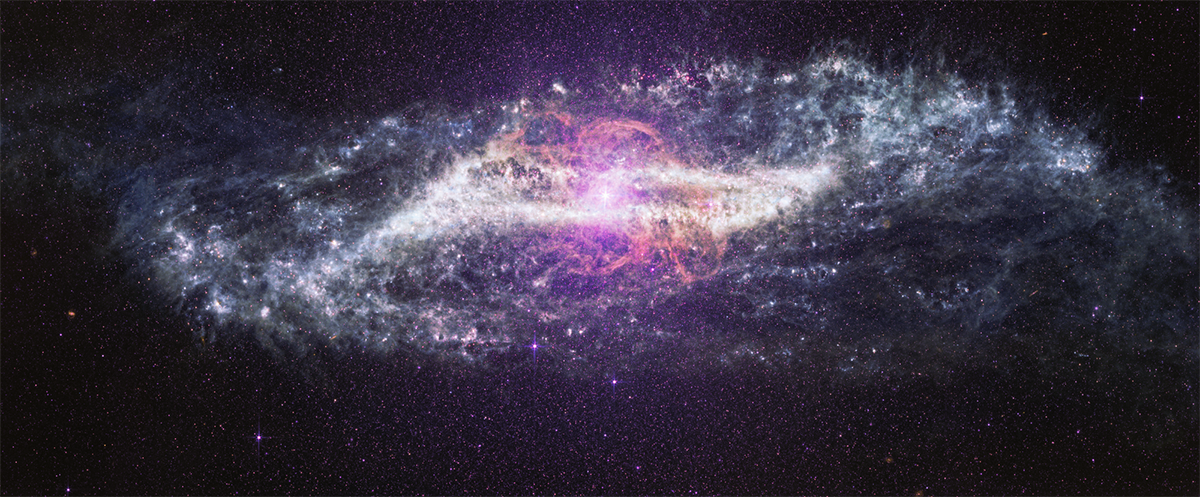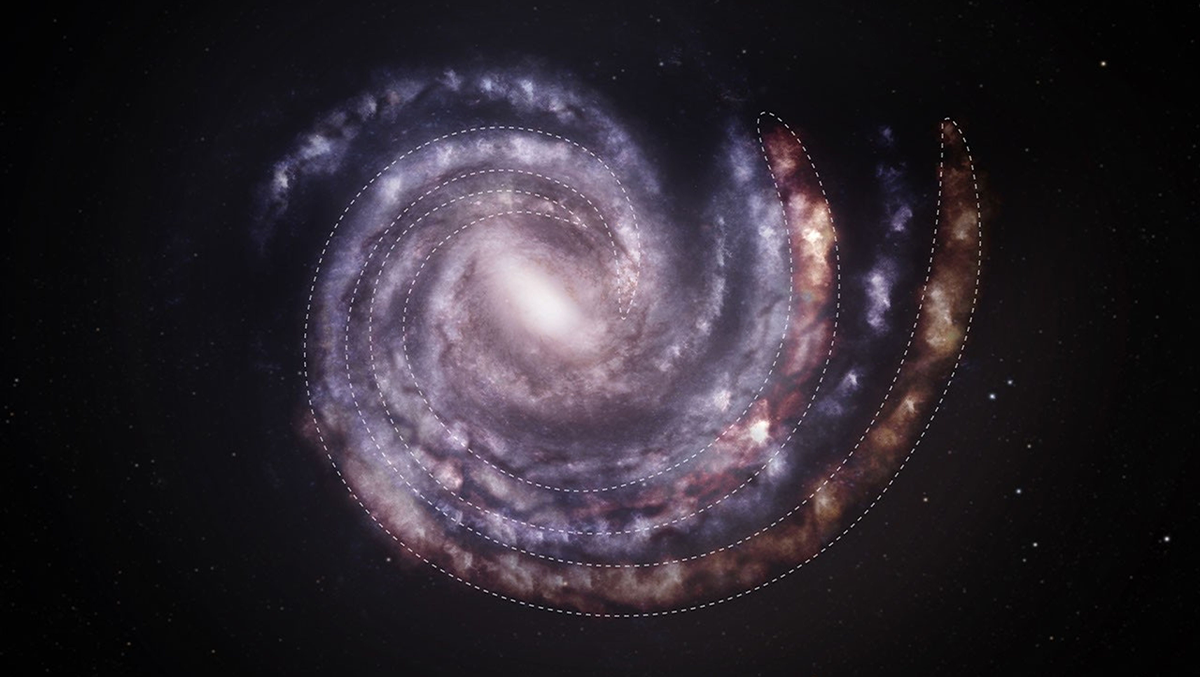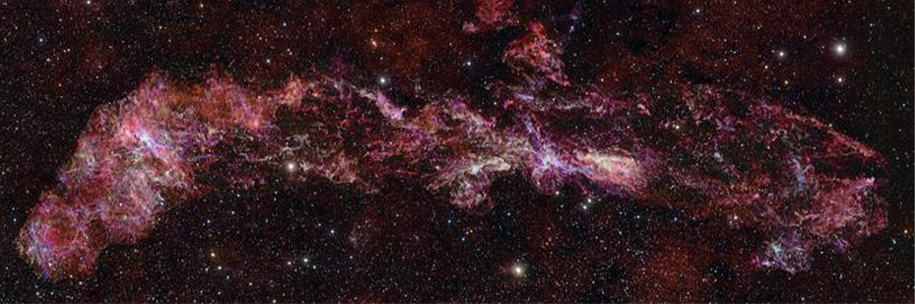
To paraphrase Archimedes, if we had a selfie stick long enough—and the means to operate it—we could take a picture of the entire Milky Way. Until then, we have to rely on telescopes like the Atacama Large Millimeter/submillimeter Array (ALMA) located in Chile’s Atacama Desert. Astronomers working with the European Southern Observatory (ESO), which operates the array, recently snapped a stunning photo of our galaxy, and it’s the largest one ever recorded.
Far from a simple snapshot, this new image spanning 650 light-years was created by stitching together smaller images of the night sky like a mosaic. It’s as large as three moons side-by-side and captures an area of intense interest to astronomers: the Central Molecular Zone (CMZ).
“It’s a place of extremes, invisible to our eyes, but now revealed in extraordinary detail,” ESO astronomer Ashley Barnes said in a statement.
This unique region, photographed in detail for the first time, features clouds of cosmic gas and dust with a density orders of magnitude larger than the outskirts of the Milky Way. While astronomers have long studied star formation there, the CMZ is much more turbulent, and this new survey offers a treasure trove of data.
Read more: “Why These Researchers Are Drawn to the World’s Edge”
“The CMZ hosts some of the most massive stars known in our galaxy, many of which live fast and die young, ending their lives in powerful supernova explosions, and even hypernovae,” Steve Longmore of Liverpool John Moores University said.
The image gives astronomers crucial insights into the chemistry of the CMZ, detecting both simple molecules like silicon monoxide, as well as complex organic ones like methanol, acetone or ethanol. “By studying how stars are born in the CMZ, we can also gain a clearer picture of how galaxies grew and evolved,” Longmore continued. “We believe the region shares many features with galaxies in the early universe, where stars were forming in chaotic, extreme environments.”
And they’re not done either. Built in the early 2000s, ALMA is scheduled for an equipment update that will update all of its receivers as well as its infrastructure, giving the astronomers an even better look at the Milky Way.
“The upcoming ALMA Wideband Sensitivity Upgrade, along with ESO’s Extremely Large Telescope, will soon allow us to push even deeper into this region—resolving finer structures, tracing more complex chemistry, and exploring the interplay between stars, gas, and black holes with unprecedented clarity,” Barnes said. “In many ways, this is just the beginning.”
It’s not a selfie stick of galactic proportions, but it’s still pretty incredible. 
Enjoying Nautilus? Subscribe to our free newsletter.
Lead image: ALMA(ESO/NAOJ/NRAO)/S. Longmore et al. Background: ESO/D. Minniti et al