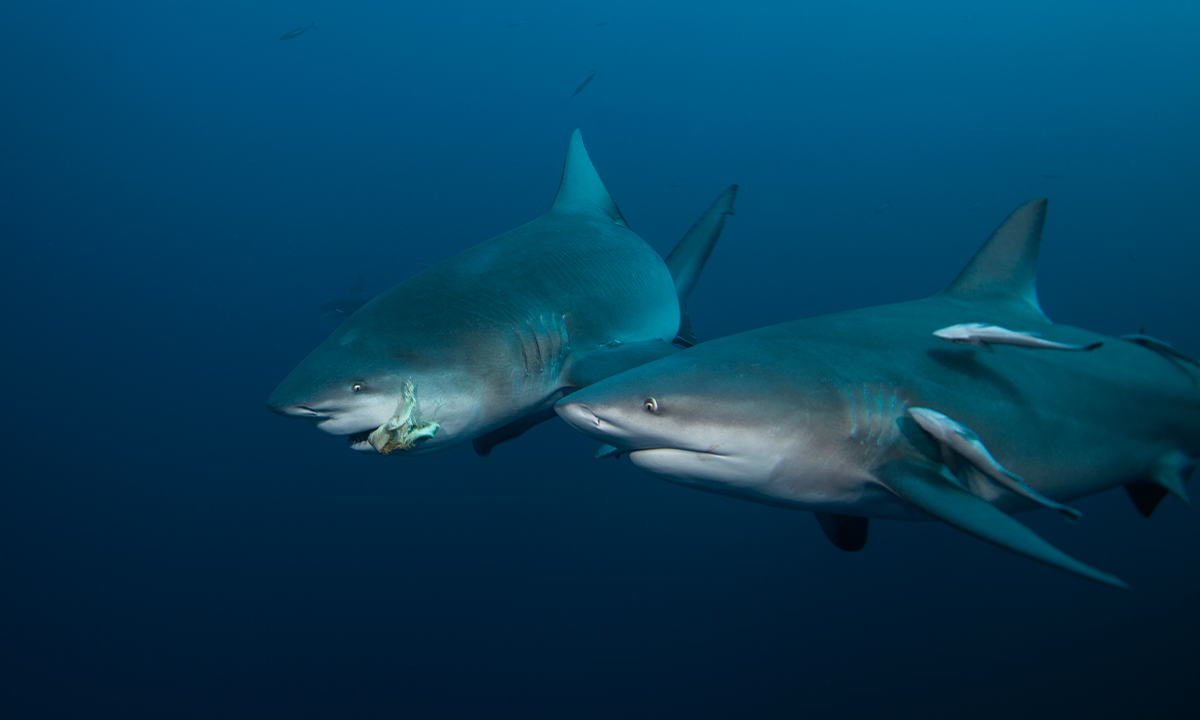
When we think about the dynamics of friendship, mean-girl cliques or frat bros typically come to mind. But a study published today in Animal Behaviour by researchers from the United Kingdom, Fiji, and Switzerland reported similar friendship dynamics in groups of bull sharks (Carcharhinus leucas).
“Contrary to commonly held perceptions of sharks, our study shows they have relatively rich and complex social lives,” said study author and University of Exeter behavioral ecologist Darren Croft in a press release.
Sharks were historically assumed to be solitary. It’s now known that they hang out in groups, but gathering together doesn’t necessarily mean socializing. They could just be capitalizing on the advantages of finding resources en masse. The researchers used six years of observational data of 184 individually recognizable bull sharks at the Shark Reef Marine Reserve in Fiji to determine whether they formed social bonds, defined as “joining and remaining in a group on the basis of social attraction to other individuals.”
Read more: “The Marine Biologist Who Dove Right In”
When sharks were seen swimming within one body length of each other, it was counted as an “association.” When they also interacted by parallel swimming; leading or following; or joining or turning back from another shark, it counted as “social interactions. Their sex was ascertained by the presence or absence of the male mating organs (claspers visible on the underside of the pelvic fins). Body size estimates were derived using a laser device, and age estimates were extrapolated from existing growth data.
Overall, “association patterns [were] not solely artefacts of spatiotemporal overlap but instead attributed to active social preferences and the selective interactions by individuals,” reported the study authors. The results showed associations that were correlated with sex and age. Both males and females preferred to socialize with females (think frat party). Adult sharks were responsible for most of the social behavior, and they preferentially associated with other adults (think not wanting to sit at the kids’ table). Subadults were much less social within their age class (shy teens) and preferred hanging around with adults (mentors).
“As humans, we cultivate a range of social relationships—from casual acquaintances to our best friends, but we also actively avoid certain people—and these bull sharks are doing similar things,” explained lead author Natasha D. Marosi, also a researcher at the University of Exeter and founder of Fiji Shark Lab.
As for the benefits of bull shark friendships, they could be sharing knowledge, gaining protection from bigger individuals, or scoping out future mates.
Sound familiar? 
Enjoying Nautilus? Subscribe to our free newsletter.
Lead image: Martin Prochazkacz / Shutterstock