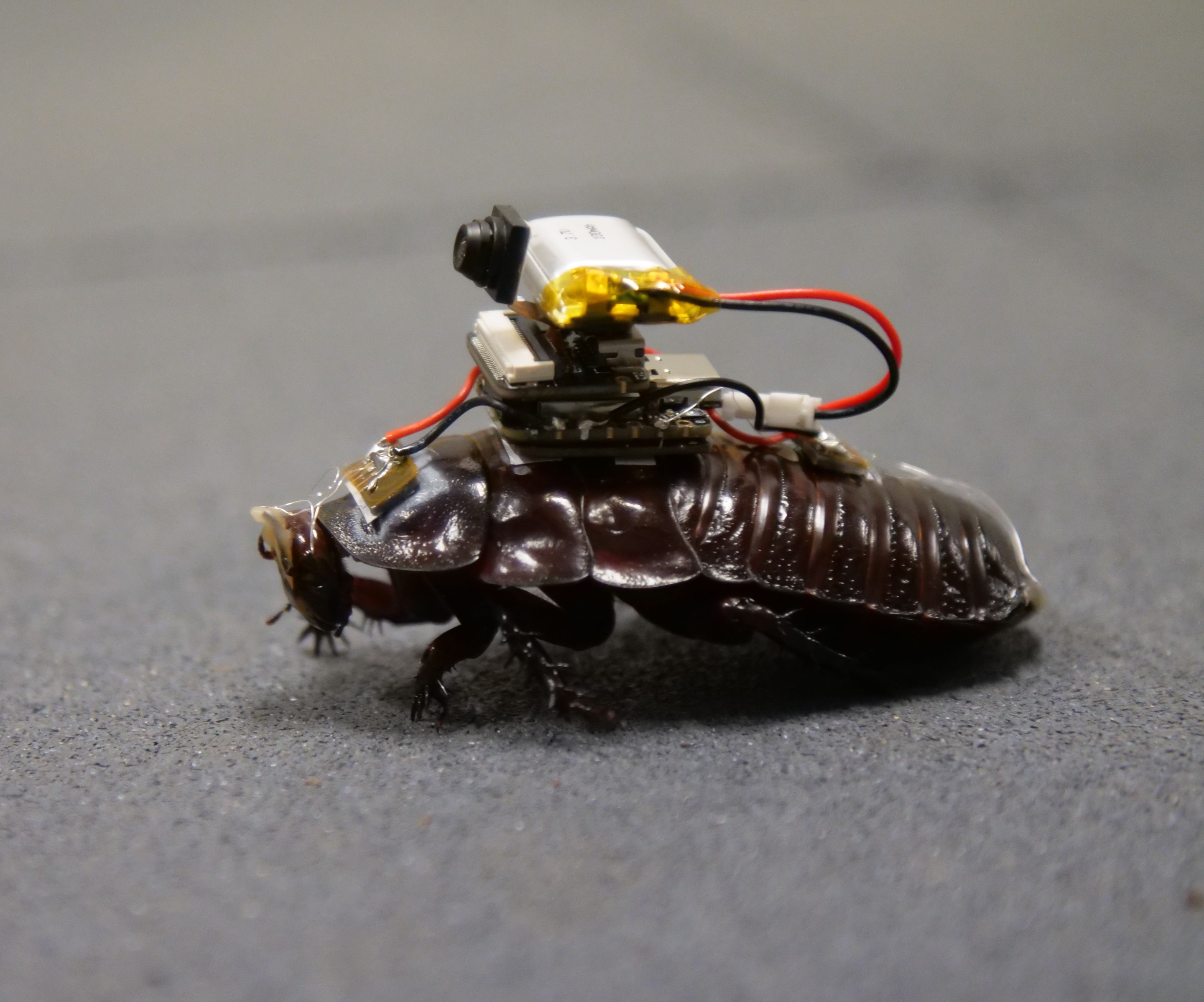
Australia has a reputation for harboring some particularly heinous wildlife. There are more than 100 species of venomous snakes, saltwater crocodiles, creeping tarantulas, and the giant burrowing cockroach. This massive insect (the world’s heaviest) can grow over three inches long. So, even though it’s not considered a pest, you might not want to encounter one if you’re, say, buried beneath some rubble.
Unless it was there to help.
Recently, Australian engineers developed a way to transform these beefy bugs into mini cyborg paramedics and published the results in Advanced Science.
Cyborg roaches aren’t new. Biomechanical engineers have been experimenting with fusing insects and electronics for quite some time. Their relatively rudimentary nervous systems, agile legs, and small bodies make them excellent recon drones capable of squeezing into tight spaces to locate disaster survivors. The problem is, that once they search, they can’t really rescue, and that’s what the team wanted to remedy.
Read more: “Watch This Cyborg Cockroach Test Its New Diving Suit”
“A lot of people might not like the sight of a giant cockroach scurrying towards them, but if you’re trapped in rubble or stuck in a cave and need help, it could make a real difference between life and death.”
The researchers outfitted North Queensland giant burrowing cockroaches with lightweight cameras, electronic controls, and a new device of their own design—an auto-inject mechanism. Built mostly from off-the-shelf parts, this device contains a tiny syringe dart that can be filled with any liquid drug of choice. Once launched, the needle strikes the skin while citric acid and potassium bicarbonate powder mix in the cartridge, producing carbon dioxide. As the gas expands, it injects the drug, and a hypothetical buried patient gets a new lease on life.
The next step was testing their new paraborgs (as they called them). They plopped the cyborg roaches in a basic obstacle course, navigated them to a silicone target, and fired off their payloads. The auto-inject mechanism worked great, deploying successfully in 95 percent of the tests. The trick was stabilizing the insects before firing, something they only achieved in 72 percent of the tests.
So what kind of drugs could these paraborgs carry?
The researchers mention oxytocin for postpartum hemorrhage and antivenom for snake bites (it is Australia after all), but epinephrine for allergic reactions and insulin for diabetics could work too.
And they wouldn’t be working alone—the team has also developed wall-climbing cyborg beetles. According to the researchers, beetles and paraborgs could be part of a platoon of insect helpers deployed at disaster sites to work with each other and human first responders.
“Some could carry cameras and environmental sensors, while others could carry specialized emergency or medical equipment,” study author Thang Vo-Doan said in a statement. “Hopefully, within the next 5 to 10 years, we could see cyborg insect rescue teams deployed to help people in real emergencies, provided we have the resources to accelerate the research and field testing.” 
Enjoying Nautilus? Subscribe to our free newsletter.
Lead Image: The University of Queensland