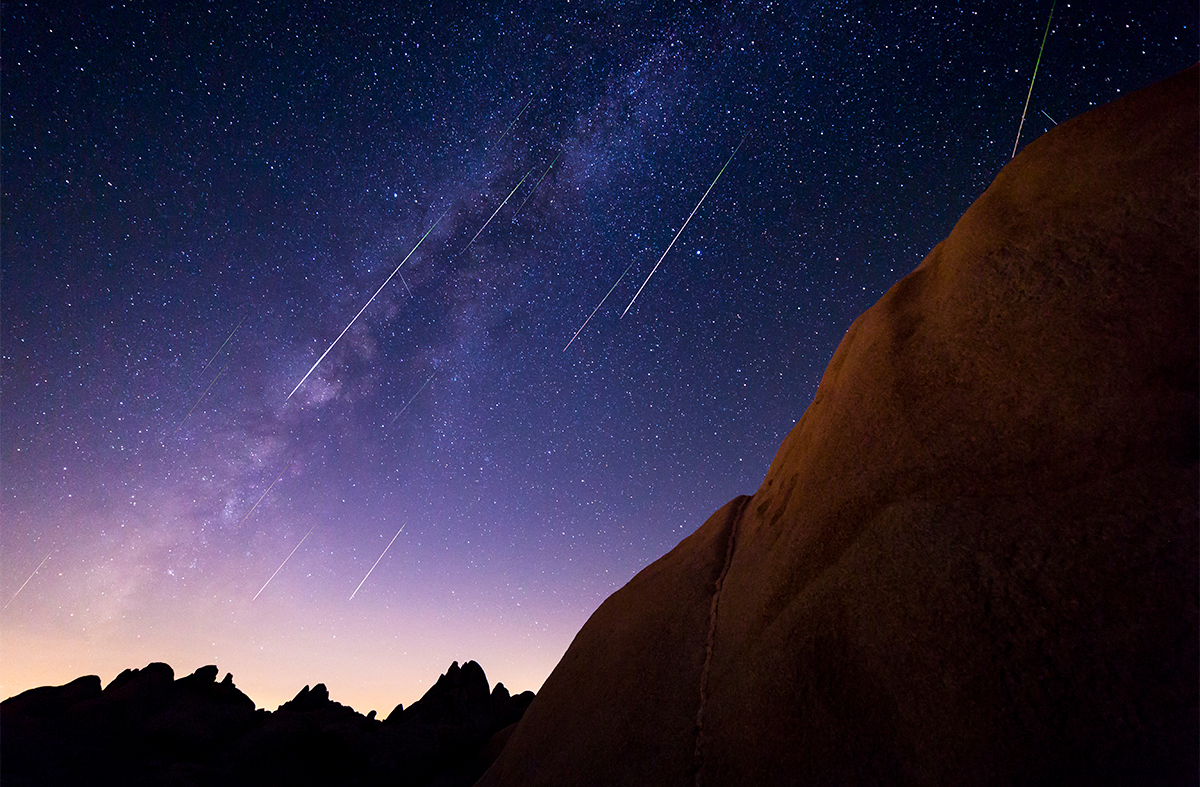
Late last year, people who live in North America were treated to a dazzling cosmic light show: the aurora borealis. Thanks to a period of especially intense solar activity, charged particles slamming into the atmosphere caused the phenomena to creep down to much lower latitudes, bathing the bulk of the United States in its otherworldly glow. Also late last year, passengers aboard a flight en route to Newark, New Jersey from Cancun, Mexico suddenly experienced a jolt as the nose of their aircraft unexpectedly pitched toward the ground, forcing an emergency landing in Florida.
It turns out those two events were linked. According to a new study, the same space weather responsible for the northern lights can wreak havoc on airplanes.
Earth is constantly being bombarded by cosmic radiation, both from the sun and from space. The atmosphere and Earth’s magnetic field provide some protection, but less and less of it the farther up you are. That means airplanes—and their crews—get a significantly higher dose than infrastructure on the ground. According to the new study, when radiation levels surge during solar storms, aircraft flying at routine altitudes (between 26,000 and 46,000 feet) are particularly vulnerable.
That’s because the high-energy particles can interfere with electronics, causing Single Event Upsets (SEUs), which are small errors that can accumulate, causing major failures. The Airbus A320 that suddenly pitched downward last year was controlled via a “fly-by-wire” system. Instead of the flight stick physically maneuvering the steering mechanisms, there was a layer of electronics and software between the two, interpreting the input and controlling the output. It was this system that proved to be vulnerable to a surge in radiation, prompting the grounding of 6,000 aircraft until their software could be patched.
Read more: “How to Protect Earth Against Violent Space Weather”
“The recent Airbus A320 grounding linked to cosmic radiation shows that space weather isn’t a theoretical risk; it’s already affecting aviation,” study author Fan Lei of the University of Surrey in the United Kingdom said in a statement. “As aircraft systems become more advanced and increasingly reliant on electronics, understanding and preparing for these events will be critical to maintaining flight safety.”
Per the team, different flight paths carry different risks of radiation. Flights that take routes over the poles, like to London’s Heathrow Airport or Canada’s Vancouver International, are typically more vulnerable than equatorial flights, where Earth’s magnetosphere is stronger. Still, surges in solar activity can send charged particles farther south, the researchers say.
Is this radiation dangerous?
According to researchers, there’s no acute risk (especially if you’re not flying routinely). The average person receives around 2.2 millisieverts (mSv) of radiation from natural sources each year, and the average CT scan gives you around 6 mSv. During the most intense solar storm they studied, they estimated a transatlantic flight would have resulted in a single dose of 5 to 10 mSv. Nonetheless, they caution that the only way for flight crews to avoid accumulating doses is to avoid risky flights during periods of high radiation.
As a measure of protection, the team has proposed adopting a new atmospheric radiation scale that takes into account solar activity, based on data from ground-level, high-latitude, and space-based measurements. The researchers believe the new scale could offer clearer thresholds for airlines to decide when to take ground or reroute a flight.
“At the moment, there is no consistent way for the aviation sector to assess and respond to extreme space weather risks,” study author Keith Ryden of the Surrey Space Centre explained. “We’ve introduced a clearer, aviation-specific radiation scale to help support more informed decision-making in aviation, helping operators act quickly to protect passengers, crew, and critical onboard systems.” 
Enjoying Nautilus? Subscribe to our free newsletter.
Lead image: muratart / Adobe Stock