
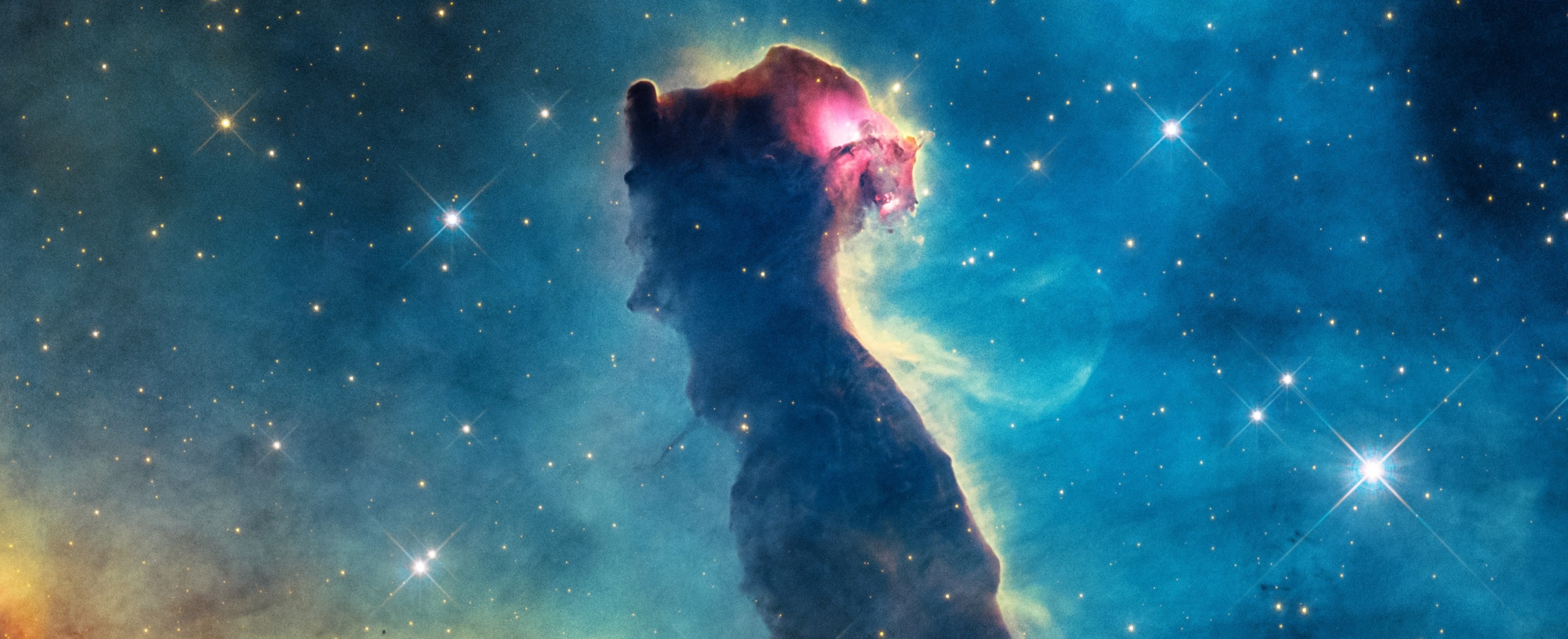
Looking at the images NASA just published from its Hubble and James Webb Space telescopes, you’d think part of the Carina Nebula was haunted. The vast cloud of gas and dust in these images resembles a cat sitting upright, with an eerily glowing eye.
It’s called the Cat’s Head Nebula, a piece of the Carina Nebula that, while not newly discovered, has been newly zoomorphized and nicknamed. It’s around 7,500 light-years away from Earth, carved out over eons by intense ultraviolet radiation and winds from the massive stars that call this region of the universe home.
That distinctive eye is thought to be a newly forged star, still largely cloaked in the dust that makes up the pillar shape that stretches below. Different densities of material are eroded at different rates, which gives us spectacular shots like these.
The Hubble Space Telescope image is the one capturing visible light, with the yellow ridges around the cat evidence of gas being ionized and lit up by ultraviolet radiation. Astronomers think photoevaporation might be happening here, which happens when gas is heated to such an extent it effectively boils off and disperses. You can also see oxygen lit up in blue, hydrogen glowing green, and sulfur burning red.
The two James Webb Space Telescope images chronicle the same scene in near-infrared and mid-infrared wavelengths, light that you wouldn’t see if you were peering out of a passing spaceship at the nebula. Near-infrared reveals some of the starlight partially hidden by dust, which is why the body of the cat looks more transparent. We get a better view of the background, though the thickest of the orange dust filaments are still visible.
The mid-infrared image is more about heat than light, and it’s the ghostliest of the lot—it really does look like a spectral feline keeping watch in space. The white outlines are created by the warmth of the dust and other carbon-based molecules that make up the Cat’s Head Nebula.
As always with these shots, the colors are chosen at the image-processing stage; the telescopes are grabbing the light readings in black, white, and gray.
Want to see more? Check out the video, below:
Enjoying Nautilus? Subscribe to our free newsletter.
Lead Image: NASA, ESA, CSA, STScI; Processing: Joseph DePasquale / STScI