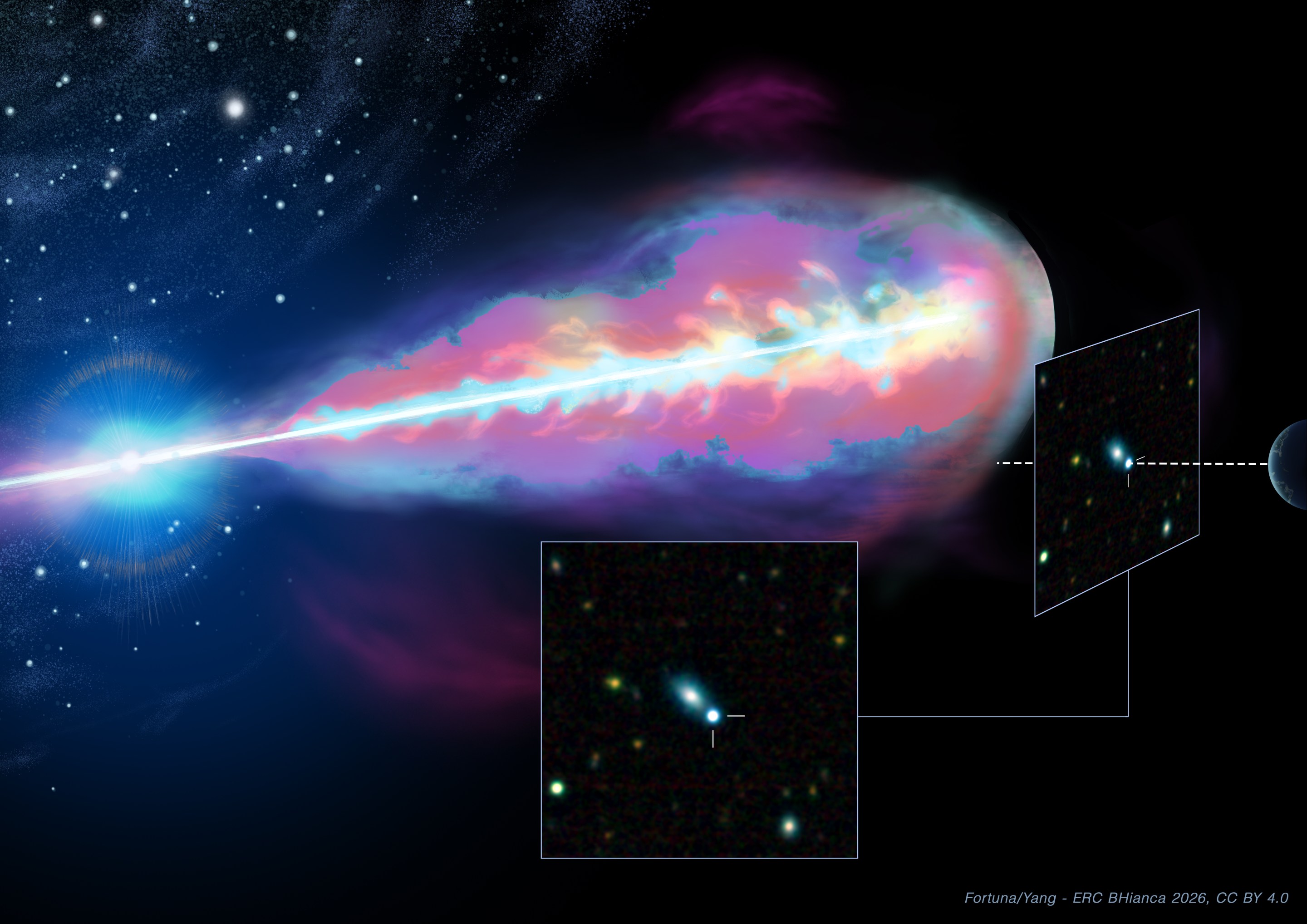
Much of what we understand about the universe comes from interpreting the light patterns that hit our telescopes—from the smallest twinkles of distant stars to giant clouds of dust and gas. That’s what makes the recent find from NASA’s Fermi Gamma Ray Space Telescope, which sits in low Earth orbit, so exciting: it’s one of the brightest bursts of light in decades.
The flash is an intense afterglow following a gamma-ray burst (GRB). While the gamma-ray light was modest, the afterglow was incredibly bright—among the brightest 1 percent of observed events compared in a newly published study.
Read more: “Dead Star Offers a Glimpse Into Our Solar System’s Future”
Why was the afterglow so much brighter than the event itself?
The team behind the study thinks it has to do with the angle of our view. “We see hundreds of GRBs every year, but the oddballs are the most informative ones,” study author Roberto Ricci said in a statement. “We could explain individual features of this burst, but fitting them all into the same picture proved much harder.”
What happened first was the death of a massive star around 2 billion light-years away. As stars collapse, they shoot out brief, intense jets of gamma rays from their poles, which was the first flash spotted by the Fermi telescope on March 10th.
As the jets of gamma rays continue to spread out through space, they collide with the surrounding gas and start accelerating particles, which glow with energy released as radiation (i.e., the afterglow). The GRB 260310A afterglow brightened gradually over several hours, until it was outshining its galaxy. It then faded, only to brighten again weeks afterward in the X-ray spectrum. That may have been the light from the narrow core of the gamma-ray burst finally escaping, the astronomers say.
Such an intense, long-lasting afterglow suggests that what would have been dismissed as a fairly standard gamma-ray burst may in fact have been much more intense, viewed from the right angle. “What appeared to us as an unremarkable GRB might have looked like a monster explosion to an observer looking straight down the jet’s core,” study author Yu-Han Yang said in a statement. “Our models suggest that the explosion packed roughly a billion years of the sun’s energy output into a pencil-thin beam.”
With increased telescope performance and broader sky-mapping capabilities, scientists hope to capture more gamma-ray bursts from a greater range of angles in the future—which will, in turn, improve our understanding of how giant stars die off.
After all, there’s a lot that you can glean from a beam of light.