
Unlike scaly reptiles, frogs aren’t well-armored. But a recent study published in the journal Animal Microbiome shows that some frogs do sport hidden armor for defense in their battle against pathogens.
One of frogs’ fiercest enemies is a deadly fungus that colonizes their skin and eventually causes heart failure. This chytrid fungus (Batrachochytrium dendrobatidis or Bd) has devastated amphibian populations worldwide, driving dozens of species to extinction.
Read more: “The Secret Lives of Japanese Temple Frogs”
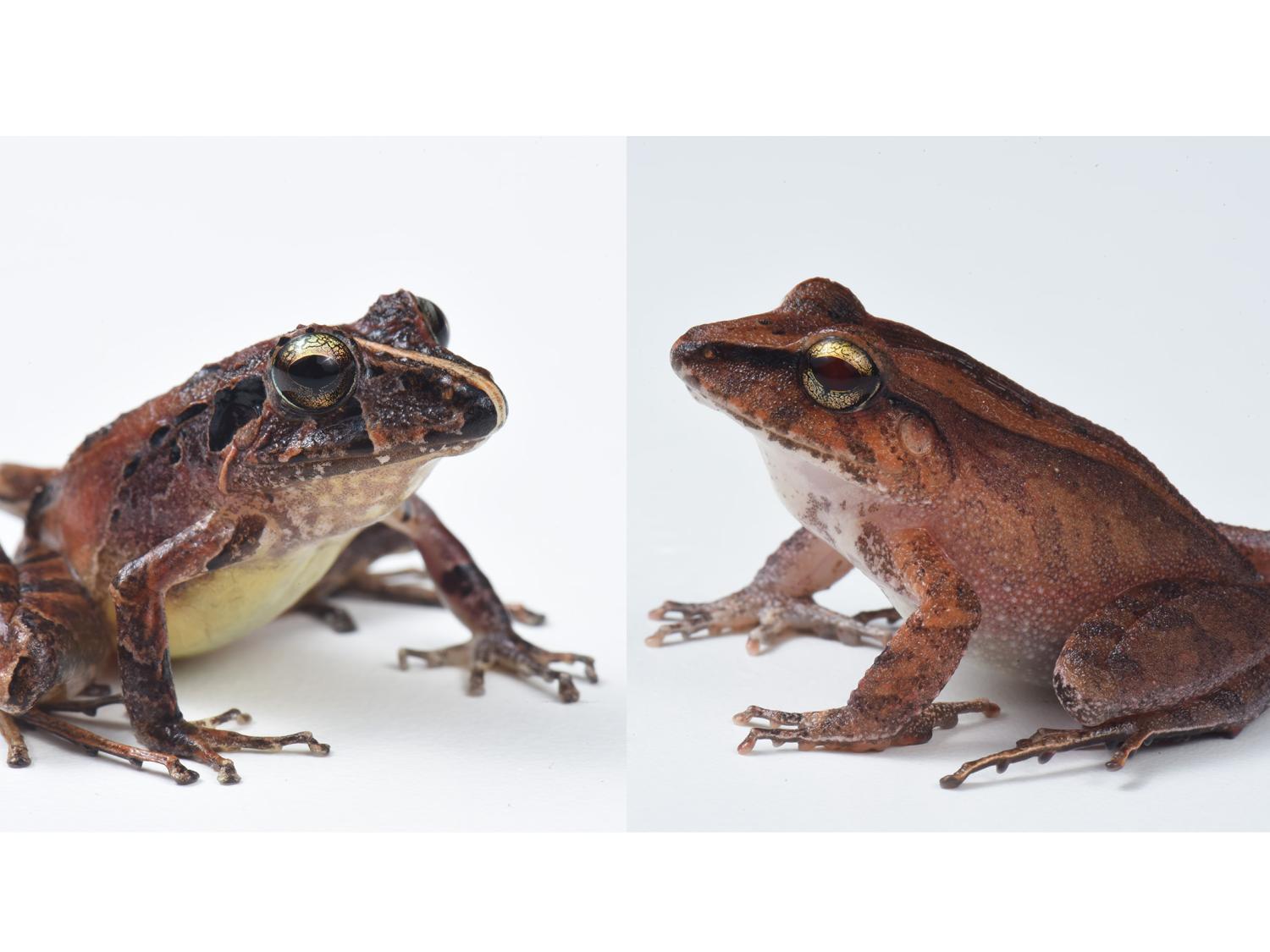
At the same time, many frog species somehow tolerate it. Case in point: In the rainforests of Brazil, Hensel’s big-headed frog (Ischnocnema henselii) is highly susceptible to the fungus, while the ecologically similar clay robber frog (Haddadus binotatus) is not.
“For years we knew that the tropical frog H. binotatus rarely became infected with the fungus in the wild, but we didn’t know why,” said lead author Laura Schuck, a doctoral student at Penn State.
Schuck and her colleagues in Brazil collected 40 individuals of each species from forest fragments near São Paulo. Back in the lab, half the frogs in each species were exposed to the Bd fungus while the other half were not. In addition, half the frogs in each group received antibiotic baths that killed their bacterial skin microbiomes, or “bacteriomes,” before fungal exposure, while the other half did not.
Clay robber frogs survived well when exposed to the Bd fungus but, if bathed with antibiotics first, their survival plummeted. Hensel’s big-headed frogs fared poorly, regardless of antibiotic treatment. So, the unique bacteriome of clay robber frogs, but not of Hensel’s big-headed frogs, acts as protection against the Bd fungus. “This study moved us from correlation to experimental evidence that the microbiome really is important against this disease,” remarked Schuck.
Schuck also extracted about 700 bacterial strains from the frogs’ skin, then grew each one in culture and exposed it to the Bd fungus. After scoring how each bacterial strain affected fungal growth, she sequenced the cultures for DNA and mapped them relative to their effects on the fungus to create a reference database.
The database will be like an armory—the ultimate guide to which frog species have the necessary defense to withstand the Bd fungus. 
Enjoying Nautilus? Subscribe to our free newsletter.
Lead Image: Renato Martins / Penn State