
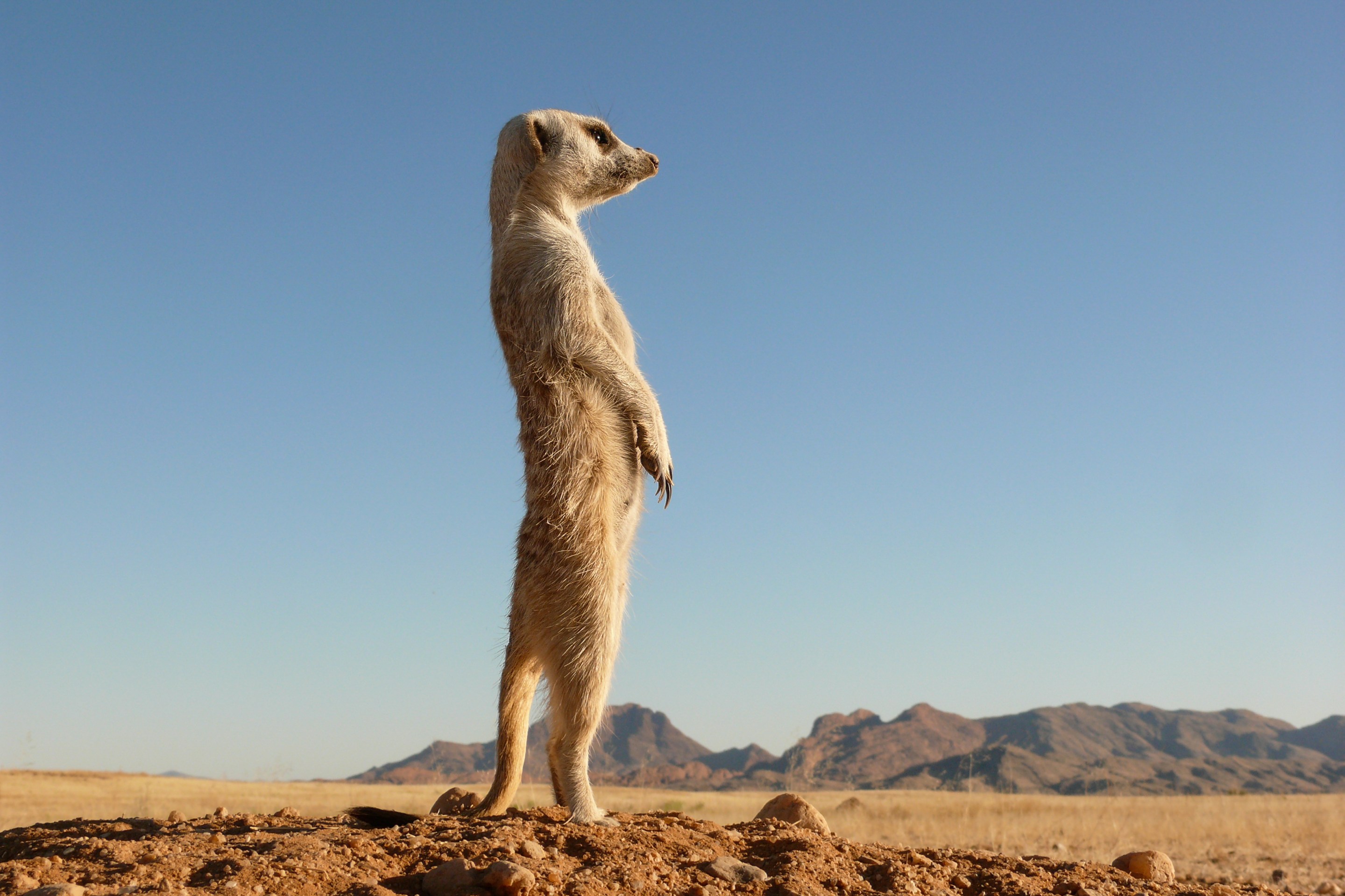
Meerkats are highly social animals, living in related gangs of up to 50 individuals to guard their colonies and care for their pups. They even forage together, setting off every morning as a group to search for insects and other small creatures. Because they’re always together, it’s difficult to tell which meerkats have the spatial knowledge to lead the group out and back home again. That said, you’d expect experience to play a role in their navigation abilities, such that some individual meerkats would get lost without their group.
To test this theory, for a recent study published in the Journal of Experimental Biology, researchers from Switzerland, alongside volunteers at the Kalahari Research Centre in South Africa, experimented with tracking individual meerkats (Suricata suricatta). They captured 20 teenagers or adults from five wild groups in the Kuruman River Reserve and fitted each with a GPS radio collar that in some cases also recorded sound.
Read more: “It Takes a Village to Raise a Meerkat”
Each radio-collared meerkat was returned to its colony, then scooped up the next morning and released 1.5 kilometers away, alone but still within its colony’s broader territory. Researchers trailed and filmed the behavior of each meerkat as it tried to find its way home. Most of them followed a fairly straight path, stopping every now and again to look or sniff for landmarks. All but two made it home—and those two males were, of course, eventually returned to their colonies. Even the younger, less experienced meerkats were adept navigators.
“This suggests that daily life in a meerkat social group provides ample opportunities for spatial learning, enabling all group members to navigate independently,” concluded the study authors.
It’s worth noting, however, that once meerkats found their way back to their original capture points or sleeping burrows, a handful of them failed to unite their groups within the three hours of the study period. It turns out, finding their neighborhoods was easy, but figuring out where their friends were was much more of a challenge. 
Enjoying Nautilus? Subscribe to our free newsletter.
Lead Image: meyblume / Adobe Stock