
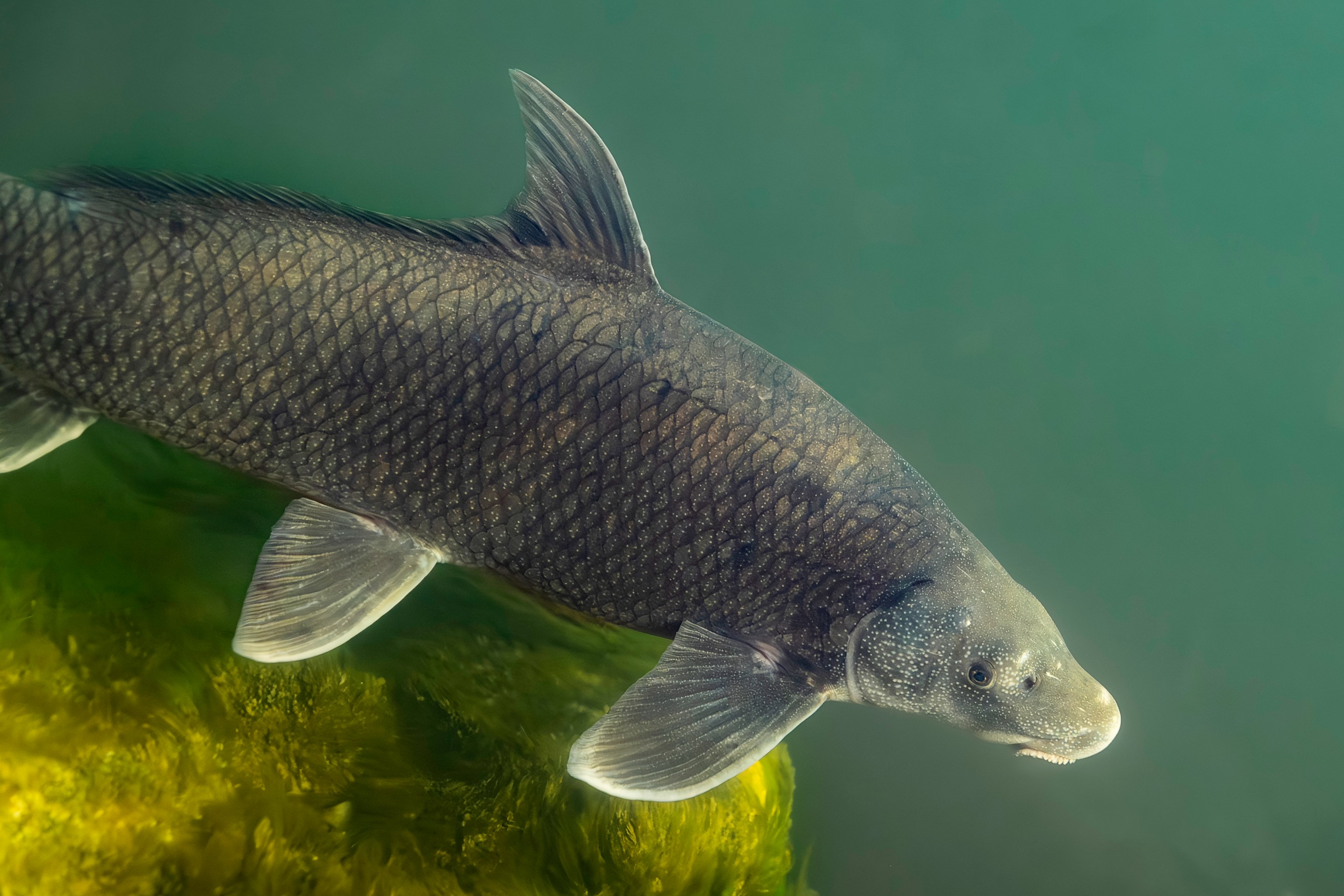
Earth is home to plenty of animals whose lifespans dwarf our own, and a lot of them seem to live in water. Now we can add one more to the list. According to a new study published in Communications Biology, the blue sucker—a bony, bottom-dwelling freshwater fish—can live up to 130 years.
A team of ichthyologists made the discovery after studying rock-like structures in the blue sucker’s inner ear called otoliths. These tiny calcium carbonate pebbles accumulate over the lifetime of the fish, like tree rings, which means if you carefully slice them open and count the layers, you can determine its age.
Read more: “When Fake Nuclear Disaster Fallout Reached Los Angeles”
After counting roughly 130 layers, the team was confident they’d identified the newest member of the centenarian fish club. But they had to be sure. After all, previous estimates of the blue sucker’s lifespan hovered around only 40 years. “When age estimates are that much older than previously thought, an additional line of evidence is needed to rigorously test their validity,” study author Alec Lackmann of the University of Minnesota Duluth explained in a statement.
So naturally they turned to atomic weaponry (or rather the effects of it). During the 1950s and 1960s, there were a lot of unregulated tests of nuclear bombs, which led to a global surge of atmospheric radioactive carbon-14 isotopes called the bomb pulse. Over the following decades, nation states gradually decided to stop testing, causing levels to steadily fall. Living things, being primarily made of carbon, showed the same pulse and decline in their carbon-14 levels over time. Testing blue sucker fish otoliths for carbon-14 revealed they lived through the same tumultuous period.
“To put a timeline on some of those older fish: the oldest one hatched around two years after Montana became a state, around the dawn of the automobile, like 20 years before the Titanic sank—it’s just wild,” study author Luke Holmquist with Montana Fish, Wildlife & Parks said. “We start putting it in the context of what the landscape looked like when these fish hatched, and all the changes that have happened since—and they just keep swimming along in the river.”
It’s a remarkable finding, especially considering the blue sucker doesn’t just float along the bottom of lakes, preferring a faster-paced river lifestyle. And this new addition isn’t the only long-lived member of the sucker family. The bigmouth buffalo, smallmouth buffalo, and black buffalo (suckers, all) can each live over 100 years. In fact, according to Lackmann’s previous research, these buffalofish actually improve with age. Compared to youngsters, buffalofish in their 80s and 90s showed improved immune function and better stress responses.
Unfortunately, the blue sucker may not be faring as well. Of the 23 states the fish is native to, it’s categorized as imperiled in 22 of them. In Montana, population studies have turned up virtually no smaller (i.e., young) specimens, possibly due to habitat fragmentation caused by dam construction.
It’s likely there are fish alive today who had to adapt, which makes their longevity all the more impressive. 
Enjoying Nautilus? Subscribe to our free newsletter.
Lead Image: Zach Shattuck