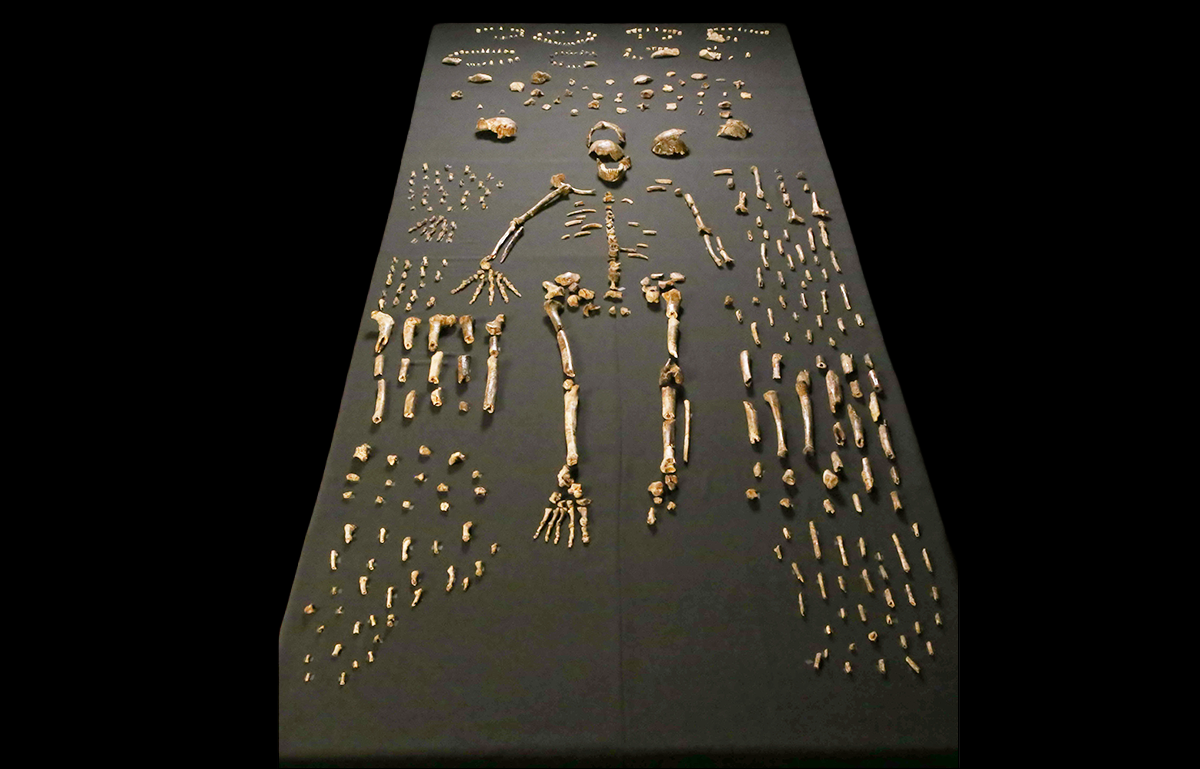
The branches of the human family tree have grown a lot more convoluted over the past 20 years. First, geneticists discovered that Neanderthals interbred with humans. Then, paleontologists unearthed the Denisovans in Asia, an archaic species or subspecies that also coexisted with modern humans. But perhaps the most peculiar addition to our genus in the past two decades is Homo floresiensis—the diminutive “hobbits” of Indonesia.
These mini hominins stood around 3 feet tall, wielded tiny stone tools, and hunted pygmy elephants on the island of Flores in Indonesia for over 100,000 years before going extinct. Like much of their lives, their disappearance around 50,000 years ago remains shrouded in mystery, but now new research is offering some clues.
After analyzing stalagmites in Liang Bua, the cave where the hobbits were first discovered, an international team of scientists determined the area suffered severe drought conditions beginning 61,000 years ago and lasting for thousands of years. Oxygen isotope levels in the enamel of pygmy elephant teeth confirmed their pint-sized prey were suffering from the same water shortages. In other words, a long slow drying of the climate likely starved out both the hobbits and their main food source. The scientists published their findings in Communications Earth & Environment.
Read more: “The Last Hominin Standing”
“The ecosystem around Liang Bua became dramatically drier around the time Homo floresiensis vanished,” lead study author Mike Gagan, a paleontologist at the University of Queensland, said in a statement. “Summer rainfall fell and riverbeds became seasonally dry, placing stress on both hobbits and their prey.”
Modern humans inhabited Indonesia around the same time as the hobbits’ disappearance, and they could have played a role in their demise as well.
“It’s possible that as the hobbits moved in search of water and prey, they encountered modern humans,” Gagan said. “In that sense, climate change may have set the stage for their final disappearance.”
Changing climate conditions causing shifts in migration patterns and conflict between groups—it’s a tale as old as time. 
Enjoying Nautilus? Subscribe to our free newsletter.
Lead image: Cicero Moraes / Wikimedia Commons