Skip to Content
Advertisement
Astronomy

How Juno Can Still Beam Back Breathtaking Images of Jupiter

Its camera was almost damaged beyond repair

Juno reached Jupiter almost 10 years ago, and it’s been studying the gas giant and its many moons ever since. In fact, just a few days ago, Juno zoomed close (around 3,000 miles) to Thebe, a small, irregularly shaped inner moon, and managed to snap a photo. 

Featured Video

Credit: NASA/JPL-Caltech

It’s obviously not the best photo, but that’s because it was taken with Juno’s Stellar Reference Unit camera. Primarily used to image star fields for navigation, this sensitive, low-light camera has been doing double duty collecting observations of Jupiter’s moons and other phenomena on its surface, like “shallow lightning” in the upper atmosphere. 

The best shots have been captured by the spacecraft’s JunoCam, its on-board, full-color telescopic camera that’s beamed back some of the most incredible images of Jupiter (and its moons) ever captured. For instance:

SOUTH POLE: An image of Jupiter’s south pole compiled using observations from three separate orbits showing swirling cyclones up to 600 miles in diameter. Credit: NASA/JPL-Caltech/SwRI/MSSS/Betsy Asher Hall/Gervasio Robles.
RED SPOT: A simulated view of Jupiter’s turbulent red spot captured by JunoCam and animated based on models from the Voyager spacecraft and telescopes on Earth. Credit: NASA/JPL-Caltech/SwRI/MSSS/Gerald Eichstadt/Justin Cowart.
SHADOW OF A MOON: Jupiter’s moon Io casts a shadow on its surface 2,200 miles wide. Credit: Enhanced image by Kevin M. Gill (CC-BY) based on images provided courtesy of NASA/JPL-Caltech/SwRI/MSSS.
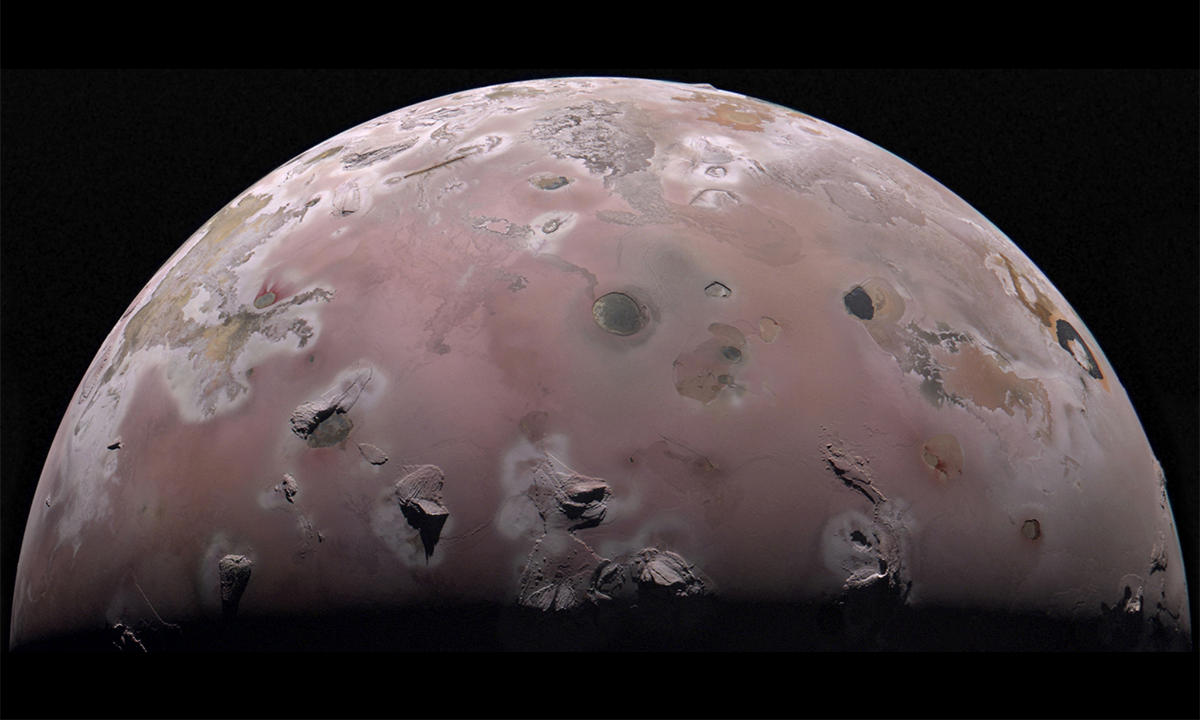
VOLCANO HAVEN: The violent surface of Io, the most volcanic body in our solar system. Credit: NASA/JPL-Caltech/SwRI/MSSS.
SURFACE OF A MOON: The pockmarked surface of Ganymede. The large dark crater, Kittu, is around 9 miles wide, and the inky material is believed to be leftover from a meteorite that impacted the surface. Credit: NASA/JPL-Caltech/SwRI/MSSS.

NASA originally planned to end Juno’s mission after 32 orbits, but they opted instead to prolong it (it’s past orbit 60). While radiation damage to JunoCam—which extends beyond the spacecraft’s titanium shield—threatened to curtail its operation, NASA was able to fix the camera using a process called “annealing.” Essentially, NASA engineers heated JunoCam up to 77 degrees Fahrenheit to remove its imperfections.

BEFORE AND AFTER: On the left, an image from JunoCam taken during orbit 56 showing grainy “noise” from radiation damage. On the right, an image from JunoCam taken during orbit 57 after the annealing process. Credit: Screenshot from Schaffner, J. et al. IEEE Transactions on Nuclear Science (2026).
NORTH POLE: Another view of Io showing its north pole, taken during Juno’s 57th orbit after the annealing process corrected radiation damage. Credit: NASA/JPL-Caltech/SwRI/MSSS; Image processing by Gerald Eichstädt.

That doesn’t mean, though, Juno, or its camera, will last forever. Thankfully, there’s another spacecraft on the way. The European Space Agency’s JUICE observer launched in 2023 and will reach Jupiter in 2031 to study its icy moons. With its higher-resolution camera, JUICE promises to send back even more breathtaking visuals.

Enjoying Nautilus? Subscribe to our free newsletter.

Lead image: NASA/JPL-Caltech/SwRI/MSSS; Image processing by Gerald Eichstädt.

Advertisement

Stay in touch

Sign up for our free newsletter

More from Astronomy

Explore Astronomy

The Many Ways to Build a Black Hole

Gravitational waves point to a multifaceted assembly line for the cosmic oddities

May 28, 2026

The Supernova That Sparked the Original Scientific Revolution

Centuries before we started debating the transformative effect of AI on science, a new light in the sky shone the way

May 27, 2026

See the Stunning Images Psyche Beamed Back From Mars

The spacecraft took a much-need detour en route to the asteroid of the same name

May 26, 2026

A Look Back at Hubble’s Most Breathtaking Images

It’s been 36 years since it beamed back the first glimpses of our universe from space

May 20, 2026

NASA Astronaut Films Spectacular Fireball Over Earth

The crewman captured the light show while waiting on a supply craft

May 19, 2026