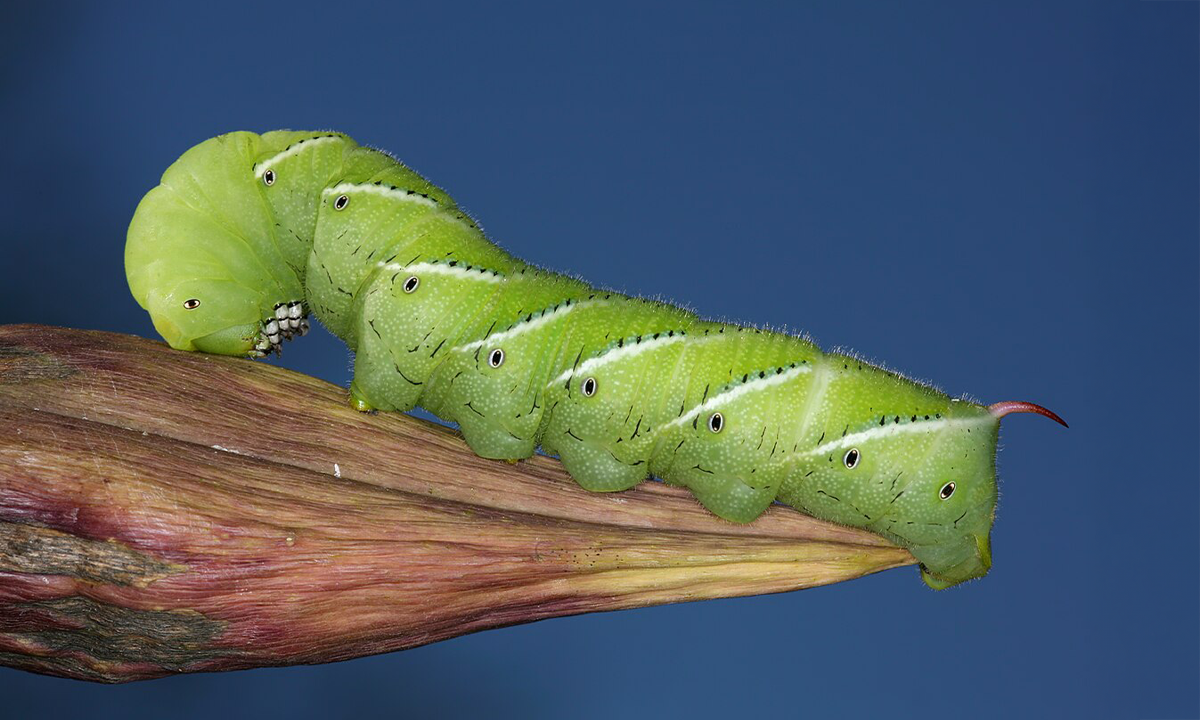
Farmers in North America are all too familiar with tobacco hornworms. These smooth, lime-green caterpillars, which look like they could be made from Play-Doh, are renowned agricultural pests. Tobacco hornworms, the larvae of the hawkmoth (Manduca sexta), feed on plants in the family Solanaceae which, you guessed it, includes tobacco but also tomatoes, peppers, and eggplants. New research unveiled at a meeting on animal bioacoustics identifies a superpower of tobacco hornworms that inform their crop menace behavior.
A biologist at Binghamton University had noticed that tobacco hornworms housed in the lab would jump when she talked. “Every time I went ‘boo’ at them, they would jump,” Carol Miles said in a statement. “And so I just sort of filed it away in the back of my head for many years.”
Until now.
Read more: “The Caterpillars That Can Kill You”
Miles, with Binghamton colleagues who were experienced in researching how animals respond to sound, set up acoustic experiments. The hornworm caterpillars were exposed to low frequency (150 Hz) and high-frequency (2000 Hz) sounds while inside a specialized “anechoic” chamber that suppresses all echoes. Inside anechoic chambers, the quietest rooms in the world, some humans freak out at hearing their blood flow and joints move.
But it was the perfect place to sort out whether hornworm caterpillars are jumping in response to airborne sound or to sound-induced vibrations of their feet. “They are always on the stem of the plant, so we thought maybe the vibration of the plant is the reason for them to detect sound,” explained study author and mechanical engineer Ronald Miles.
By controlling the inputs to sound with no vibration, versus vibration with no sound, the researchers discovered that the caterpillars were 10 to 100 times more responsive to the sounds than the vibrations. Since caterpillars are thought to lack ears, figuring out they detected sound inspired more experimentation. Denuded caterpillars, with fine body hair removed, showed a dampened sound response, indicating a sensory role for the hairs.
The research team hypothesizes that this tobacco hornworm caterpillar superpower evolved as an adaptation for evading predatory wasps, which tend to beat their wings at 100 to 200 Hz. If a caterpillar hears an approaching wasp, a quick jump or twitch may edge the soft, tasty larvae out of harm’s way.
Or the jumping could just be a sign of a startled caterpillar in the moments before it expects to get gobbled up. 
Enjoying Nautilus? Subscribe to our free newsletter.
Lead image: Daniel Schwen / Wikimedia Commons