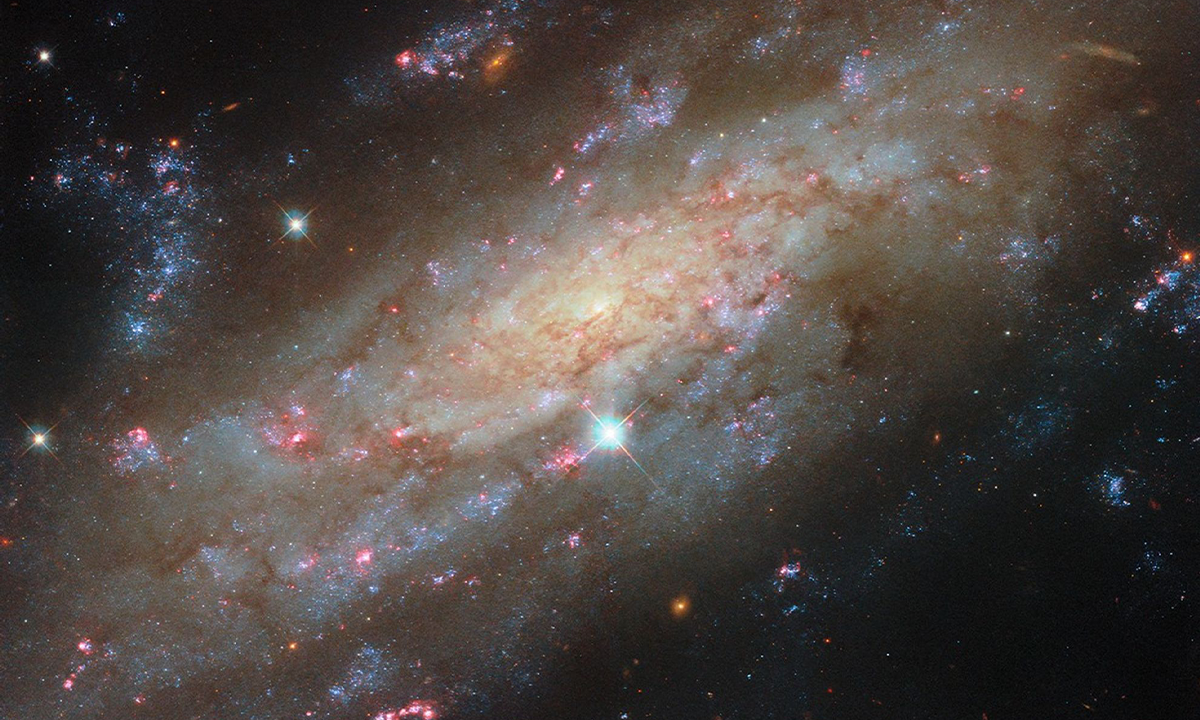
The Hubble Space Telescope recently captured an image of a roaming galaxy 50 million light-years away called NGC 3137, but it’s not traveling alone. NGC 3137 is part of a galactic gang of sorts, a cadre of galaxies moving through the cosmos together called the Local Group. This dumbbell shaped formation includes a system of dwarf galaxies clustered around our own Milky Way on one end with a similar system clustered around the much larger Andromeda Galaxy on the other.
Hubble’s recent snapshot of the NGC 3137—a composite of six observations using different color bands—shows the galaxy in astonishing detail. The bright blue spots are all juvenile stars, birthed from the clouds of luminous red gas that envelop them. It’s these nebulae and new stars that are of most interest to astronomers. Within NGC 3137, stars are produced at a rate of half a solar mass per year and observing them can offer astronomers crucial information about the stellar life cycle.
From our vantage point on Earth, NGC 3137 can be viewed through the constellation Antlia. This formation was first described in the early 1750s by the French astronomer Nicolas-Louis de Lacaille who named it in honor of the relatively recent invention of la machine pneumatique—the air pump.
It’s a bit like identifying a constellation today and naming it after the Hubble Space Telescope. 
Lead image: ESA / Hubble & NASA, D. Thilker and the PHANGS-HST Team