Last July, NASA’s Asteroid Terrestrial-impact Last Alert System (ATLAS), an automated system that monitors the skies for asteroids that might hit Earth, identified an object moving fairly speedily. It wasn’t an asteroid, it was a comet, and not just any comet—an interstellar one, meaning it originated outside of our solar system.
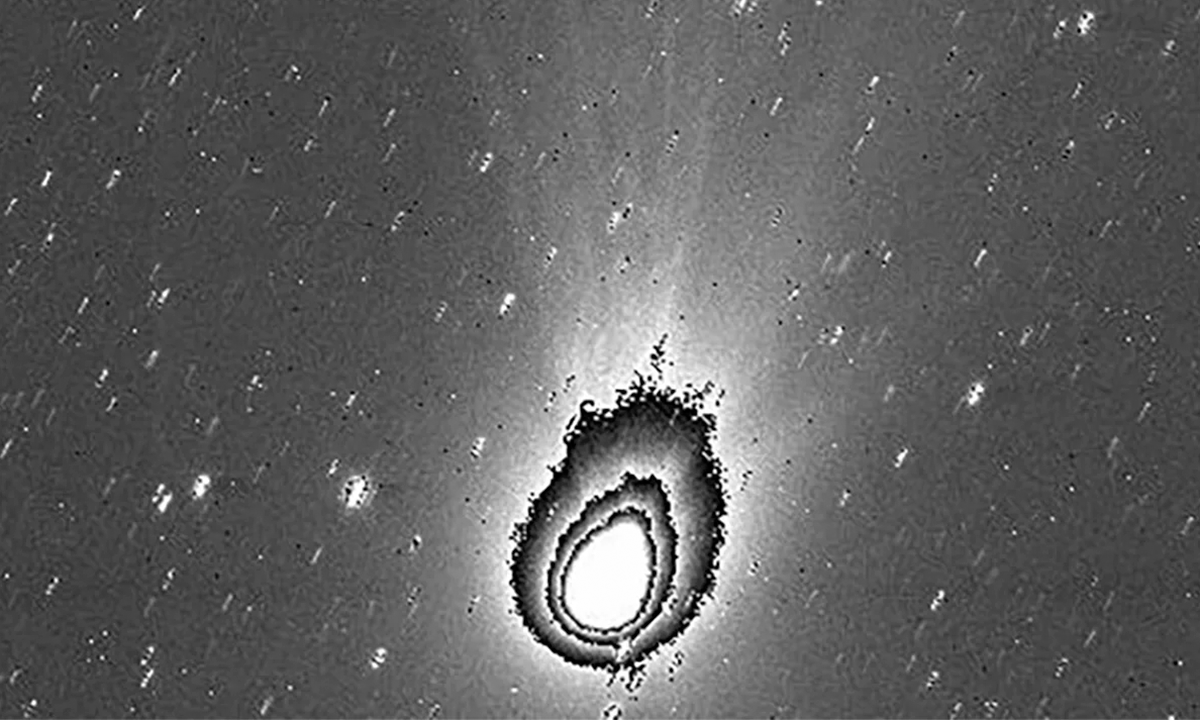
In the months that followed, spacecraft craned their proverbial necks to take a gander at the interstellar interloper (by now given the name 3I/ATLAS), including the European Space Agency’s Jupiter Icy Moons Explorer (Juice). Because Juice was on the opposite side of the sun to Earth and using its high-gain antenna as a heat shield, the images it captured in November only recently reached Earth.
While ESA scientists are still analyzing the data captured by five of Juice’s onboard instruments, other analyses have estimated the comet to be between 0.2 and 3.5 miles wide, with a faint tail, and unusually rich in carbon dioxide. 3I/ATLAS also contains smaller amounts of water vapor and carbon monoxide, as well as cyanide and atomic nickel.
Read more: “How ‘Oumuamua Got Shredded”
Its arrival marks only the third time an object originating from outside our solar system was caught on camera; the first was the enigmatic ʻOumuamua, and the second was another rogue comet, 2I/Borislov. But what’s just as remarkable is the sheer number of spacecraft we have to observe it. 3I/ATLAS has had its snapshot taken by at least 16 different scientific spacecraft, including the intrepid Perseverance rover on Mars.
Interstellar objects are like cosmic celebrities, and as such, we’re lucky to have the cosmic paparazzi ready with their cameras. 
Enjoying Nautilus? Subscribe to our free newsletter.
Lead image: ESA/Juice/JANUS