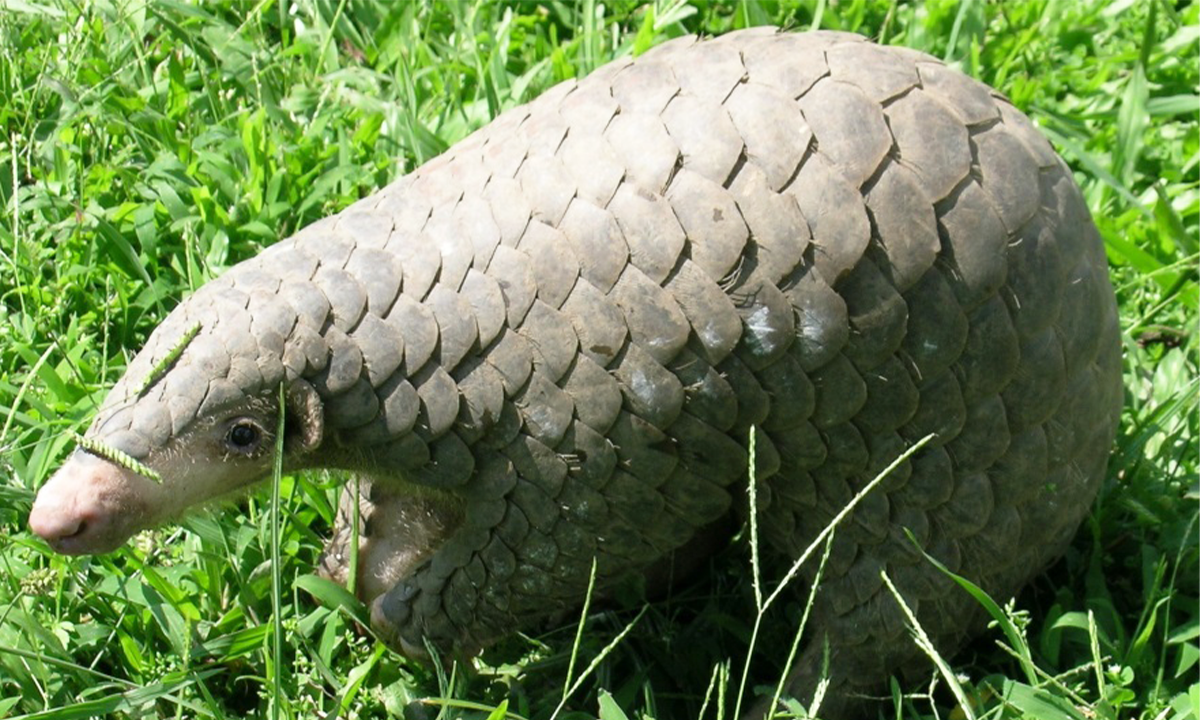
It’s hard to believe that pangolins are among the most common animals targeted for illegal wildlife trade. These heavily armored creatures—the only living mammals in the order Pholidota—are nocturnal and reclusive. But their meat is good eating, their skin serves for leather products, and their scales are used in traditional medicine across Asia and sub-Saharan Africa. Also, once you find one, they’re relatively easy to catch, since their first defense is to roll up into a ball that only weighs about five pounds.
A study published today in PLOS Biology used genetics to track pangolin harvest and trade. Led by biologists from the University of Toulouse in France, with more than a dozen university collaborators, the study analyzed pangolin DNA from the three most traded pangolin species: Sunda, Chinese, and white-bellied. Given pangolins’ elusive habits, such DNA is tough to come by, so the approach was optimized to work on low-quality samples from museum collections and seizures of illegal bushmeat.
Read more: “The Perilous Life of the Solitary Pangolin”
“Integrating archival museum material with newly collected field and seizure samples enabled us to bridge long-standing gaps in geographic coverage and strengthen the accuracy of pangolin trade tracing,” explained study author Philippe Gaubert, a conservation geneticist at the Institut de Recherche pour le Développement in France.
Of the more than 700 pangolin samples that were sequenced, 671 gene loci were captured, from which the study authors built a genomic reference map of the pangolins. Each individual was traced back to its probable geographic origin to identify hot spots of illegal collection—primarily in southwest Myanmar, Cameroon, and several additional locales in Africa.
By distinguishing between pangolin data from local sources like village vendors, versus domestic or international trade hubs, the study authors highlighted the trading patterns for these threatened species. “One of the most striking findings was that domestic pangolin trade is largely local, but it overlaps with the same sourcing regions that supply international trafficking—revealing a connected supply chain rather than separate markets,” concluded Gaubert.
With apparent connectivity between pangolin traffickers in different countries, this ancient animal faces an uphill battle for survival. Morphing into a spiky ball may work against natural predators like big cats and pythons, but it’s unfortunately a weak defense against humans who are hungry for food, handbags, and folk remedies. 
Enjoying Nautilus? Subscribe to our free newsletter.
Lead image: U.S. Fish and Wildlife Service Headquarters / Wikimedia Commons