The planet’s 3,000 or so known centipede species don’t initially seem like the nurturing type. Some are so big they prey on mice, bats, and songbirds, while others reportedly munch on human corpses. There are those that hiss like snakes, and those that are aquatic, swimming through tropical waters by undulating like eels. All are venomous and prefer the darkness, hiding in caves, basements, or dank leaf litter during the day and emerging at night to hunt. These multilegged arthropods, in other words, are the stuff of many people’s nightmares.
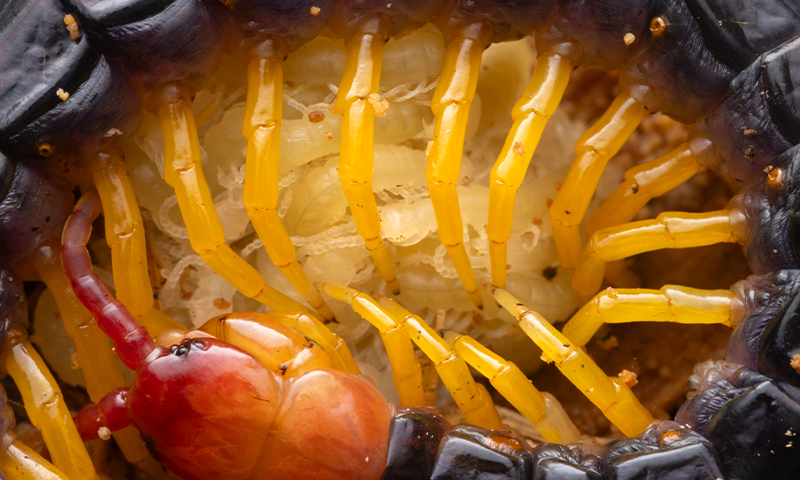
But for Alex Hyde, photographing this female guarding her newly hatched larvae in Ecuador was a dream. Hyde was leading a group of photographers in Yasuní National Park, a tenuously-protected area in the northwestern Amazon that shelters a dazzling array of biodiversity as well as two uncontacted tribes. He was walking on a trail through the jungle, listening to the hum of insects and screeching of macaws, when he lifted a fallen log and saw this centipede mother cradling her offspring. Altogether, the mass was about the size of an apple. “Many people fear [centipedes], but I found this to be a beautiful moment,” Hyde says.
While the parental duties of many arthropods cease after egg laying, the females of some centipede species—like this one from the Scolopendra genus—are more devoted mothers. They curl their bodies around their eggs to protect them and may continue guarding the babies for days after they hatch. Some centipede mothers even go a step further: They become their babies’ first meal. In an act known as matriphagy, the writhing mass of juvenile centipedes will eventually engulf their mother and eat her alive before skittering into the jungle to hunt down other prey.
Whether such behavior comes across as creepy or caring is a matter of perspective. Still, Hyde hopes that showing this mother centipede protecting her young will help people appreciate that invertebrates can be just as behaviorally complex as any mammal or bird. 
Alex Hyde is a freelance natural history photographer. Whether in a tropical rainforest or his own back garden, he specializes in the smaller organisms that are so often overlooked. He is based in the Peak District National Park, UK and runs tours and workshops on macro photography.
This article first appeared in bioGraphic, an independent magazine about nature and regeneration powered by the California Academy of Sciences.